
NEC Rules for Supporting Coaxial Cable (CATV) in Installations
NEC Rules for Supporting Coaxial Cable (CATV) in Installations
Properly supporting coaxial cable is not just about neatness; it’s a critical safety and performance requirement governed by the National Electrical Code (NEC). For any journeyman electrician or master electrician working with CATV or other low voltage systems, understanding these rules is essential for a compliant and reliable installation. According to NEC Article 820, coaxial cable installations must be performed in a professional and skillful manner, ensuring the cable is protected from physical damage and does not create a hazard. Key principles involve using independent supports, maintaining separation from power conductors when required by the code, and respecting the cable manufacturer’s bend-radius and installation instructions. Adhering to the NEC ensures that the coaxial cable system performs optimally without interference and, most importantly, protects people and property from potential electrical and fire hazards. This involves specific rules for securing cables, grounding, and dealing with legacy wiring.
The Foundation: NEC Article 820 and Workmanlike Installation
The primary reference for CATV and radio distribution systems in the United States is Article 820 of the National Electrical Code. This article provides the comprehensive rules for the safe installation of coaxial cable. However, before diving into the specifics of Article 820, it’s crucial to understand the foundational principle found in NEC 110.12: Mechanical Execution of Work. This section mandates that all electrical equipment, including low-voltage wiring, be installed in a “professional and skillful manner.” While this may seem subjective, it sets the expectation that installations must be orderly, secure, and free from defects that could compromise safety or performance. For both a master electrician overseeing a project and a journeyman electrician performing the hands-on work, a workmanlike installation is the starting point for every job.
Core Principles of Supporting Coaxial Cable
Article 820, in conjunction with other NEC sections it references, establishes clear guidelines for securing and supporting coaxial cable. These rules are designed to protect the cable’s integrity, ensure signal quality, and prevent hazardous interactions with other building systems. For more detail on the full scope of CATV installations, see our lesson on how CATV installations are handled in the 2023 NEC.
Independent Support and Proper Fastening
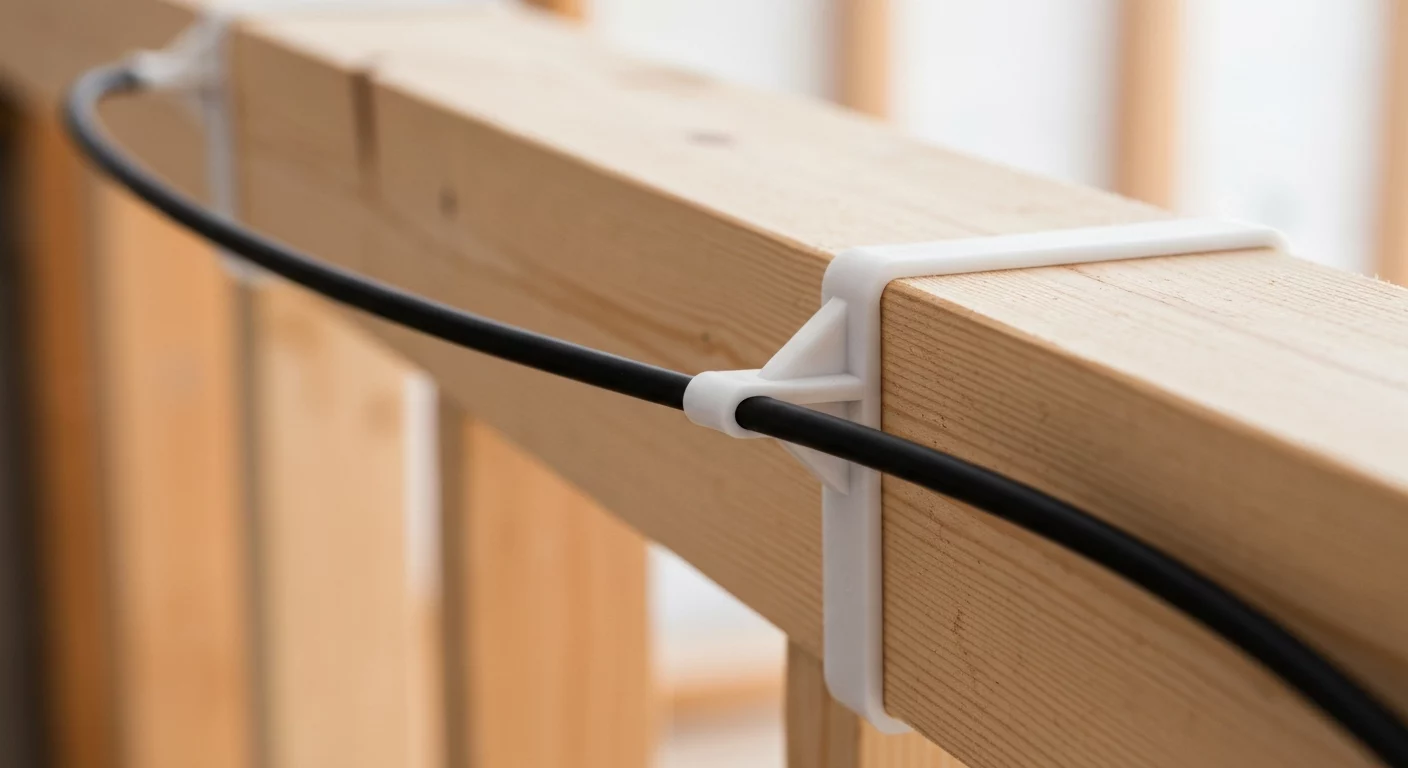
One of the most violated rules in low-voltage wiring involves how cables are supported. The NEC requires that coaxial cable not be supported by other trade raceways as the primary means of support; coaxial cable must be supported independently or be attached directly to structural members. Tying cables to electrical metallic tubing (EMT) or other raceways as the primary support is not an approved practice and the raceway cannot be relied on as the cable’s support. When securing these cables, you must use fittings designed for the purpose, such as dedicated coaxial cable support straps or listed tie wrap cable ties that do not damage the cable. Using staples that are too tight or zip ties that deform the cable’s shape can alter its electrical properties and degrade the signal. For further guidance on this topic, explore our article on how electrical cables should be tied.
Managing Coaxial Cable Bend Radius
The NEC requires that cable be installed so it is not damaged and that installations follow manufacturer instructions; this includes preventing excessive bending that could impair performance. Bending a coaxial cable too sharply can change its characteristic impedance, leading to signal reflections and poor performance. The NEC defers to the manufacturer’s instructions for allowable bend radius. As an industry guideline (not an NEC-mandated universal rule), many installers use a minimum bend radius of approximately 10 times the cable diameter, while some listed cable products allow tighter radii per the manufacturer’s specifications. When in doubt, always consult the specifications for the specific type of electrical cable you are installing.
Supporting Vertical Cable Runs
When installing cable between floors, supporting vertical cable runs is critical. The cable’s own weight can cause it to stretch over time, leading to conductor damage and signal degradation. For vertical installations and risers, the NEC and product listings require that cables be supported and that listed, riser-rated cable and supporting hardware appropriate to the shaft or riser be used; follow the cable manufacturer’s and the NEC’s support and listing requirements for spacing and method. This is also where cable ratings become important. A riser-rated coaxial cable (Type CMR) is designed with fire-resistant characteristics for use in vertical shafts that pass between floors.
Critical Safety: Separation, Grounding, and Protection
Beyond simple support, the NEC places significant emphasis on protecting coaxial cables from external electrical and physical threats.
Separation from Power Conductors
To prevent induced currents and potential interference or shock hazards, the NEC requires separation of communications cabling from electric light and power conductors unless an exception applies (for example, when conductors are in a raceway, or separated by a continuous and firmly fixed barrier, or when other specific exceptions are met). Understanding these requirements is important for safety and for minimizing signal interference. Where exceptions apply (raceways, listed barriers, or other NEC-allowed conditions) those solutions must be implemented per the Code and the manufacturer’s listing.
CATV Grounding Requirements
Proper grounding is arguably the most important safety aspect of a CATV installation. NEC 820.93 and 820.100 detail CATV grounding requirements: when the outer conductive shield of a coaxial cable is grounded, the NEC directs that it be done in accordance with the grounding rules and as close as practicable to the point of entrance into the building. This is typically done with a listed grounding block bonded to the building’s grounding electrode system or the appropriate bonding point. The grounding conductor must be sized in accordance with NEC Article 250 and the interconnection must be made in the manner described by Article 820. In short: keep the bonding conductor short and direct where possible, and size and connect it per Article 250 and the product/listing instructions so the system is safely tied into the building grounding system.
Protection from Physical Damage
Where coaxial cables are exposed and subject to physical damage, they must be protected. This requirement, consistent with NEC principles, applies to areas like unfinished basements, garages, or any location where the cable could be hit, crushed, or abraded. Protection can be provided by running the cable inside a raceway, such as EMT or PVC conduit, or by routing it through bored holes in framing members and following the clearance and protection rules found in Chapter 3 of the NEC.
Step-by-Step Guide for a Compliant CATV Installation
- Plan the Route: Before pulling any cable, map out a path that respects separation from power conductors, avoids sharp bends, and provides adequate access to structural members for support.
- Select the Right Cable: Choose the correct cable type for the application. Use plenum-rated coaxial cable (CMP) for spaces used for environmental air (plenums) and riser-rated coaxial cable (CMR) for vertical runs between floors.
- Install Support Structures: If not using building framing, install any necessary independent support wires or mounting hardware. Remember, raceways are not intended to serve as the primary support for separate communications cabling.
- Pull and Secure the Cable: Pull the cable along the planned route, avoiding excessive tension. Fasten it using listed coaxial cable support straps or other approved fittings, ensuring they are not over-tightened. For a deeper dive into this, see our electrical cable management guide.
- Ground and Bond the System: At the building’s point of entry, install a listed grounding block. Connect it to the building grounding electrode system or a permitted bonding point using a correctly sized conductor sized per Article 250 and installed in accordance with Article 820.
- Perform a Final Check: Inspect the entire run to ensure a workmanlike installation. Verify all separation, support, and bend radius requirements are met and that the cable is properly protected from physical damage.
Advanced Topics and Best Practices
A professional installation goes beyond the minimum code requirements. Mastering best practices demonstrates a higher level of expertise and ensures a more robust and future-proof system.
Bundling Coaxial Cables and Cable Management
When bundling coaxial cables, use hook-and-loop (Velcro) straps or loosely applied tie wrap cable ties to avoid deforming the cables. In commercial settings, a cable tray is often the preferred method for supporting large bundles of low-voltage wiring, providing continuous support and easy access for future work.
The Importance of Removing Abandoned Cable
The NEC requires that accessible portions of abandoned communications cable be addressed: accessible abandoned cable should be removed or clearly identified for future use according to the Code and local enforcement. Removing or properly identifying abandoned cables reduces fuel load in a fire scenario and prevents confusion when troubleshooting or installing new systems. The choice of plenum-rated cable ties can also impact fire safety; see our course lesson on how NEC rules affect plenum cable tie selection for more on that topic.
Mastering these low-voltage installations requires dedicated knowledge. Expand your skills into low voltage and data cabling. See our specialized courses.
Key Takeaways for Coaxial Cable Support
- Always reference NEC Article 820 from the current NEC code book for CATV installations.
- Coaxial cable should be supported independently and not relied upon to be primarily supported by raceways or plumbing; use proper cable support hardware or attach to structural members.
- Maintain the separation or protection from power conductors required by the NEC unless a specific exception applies; consult the Code and manufacturer instructions.
- Fulfilling CATV grounding requirements at the point of entrance is a critical life-safety step — size and connect grounding conductors per Article 250 and Article 820 guidance.
- Always complete the job with a neat and workmanlike installation, ensuring cables are protected and secure.
Primary Sources
- NFPA 70, National Electrical Code (2023 Edition), published by the National Fire Protection Association.
Frequently Asked Questions (FAQ)
- What is the proper support spacing for supporting coaxial cable?
- While NEC Article 820 and Chapter 3 require that cable runs be supported and protected from physical damage, the NEC does not prescribe a single prescriptive spacing interval for all coax types in every installation. A workmanlike installation and the cable manufacturer’s listing/installation instructions control. Industry best practice for horizontal runs is often to place supports every 4 to 5 feet, but that is an installer guideline rather than a universal NEC mandate.
- Can I use regular zip ties for tying cables like coax?
- You should use ties and straps that are listed and suitable for low-voltage data cables. Regular zip ties can be over-tightened, compressing the dielectric and changing the cable’s impedance. Using specialized coaxial cable support straps or hook-and-loop ties is a safer alternative.
- What does the NEC say about bundling coaxial cables with power cables?
- The NEC restricts placing communications cables in the same raceway, compartment, or enclosure with electric light and power conductors unless specific exceptions apply (listed barriers, raceways that meet the conditions, or other Code-allowed configurations). Always check Article 820 along with the Chapter 3 wiring rules to determine whether an exception is applicable for your installation.
- Is abandoned cable removal really mandatory for low voltage wiring?
- Yes — the NEC requires that accessible abandoned communications cable be removed or handled per the Code unless it is clearly marked and retained for future use. This reduces fire load and confusion during maintenance and upgrades; follow the applicable NEC provision and local enforcement policies.
Continuing Education by State
Select your state to view board-approved continuing education courses and requirements:

Disclaimer: The information provided in this educational content has been prepared with care to reflect current regulatory requirements for continuing education. However, licensing rules and regulations can vary by state and are subject to change. While we strive for accuracy, ExpertCE cannot guarantee that all details are complete or up to date at the time of reading. For the most current and authoritative information, always refer directly to your state’s official licensing board or regulatory agency.
NEC®, NFPA 70E®, NFPA 70®, and National Electrical Code® are registered trademarks of the National Fire Protection Association® (NFPA®)
You may also like
Colorado Electrical Licensing Requirements and Reciprocity Guide
Standby Generators in DE: Navigating Coastal Storm Regulations

 Login with Google