
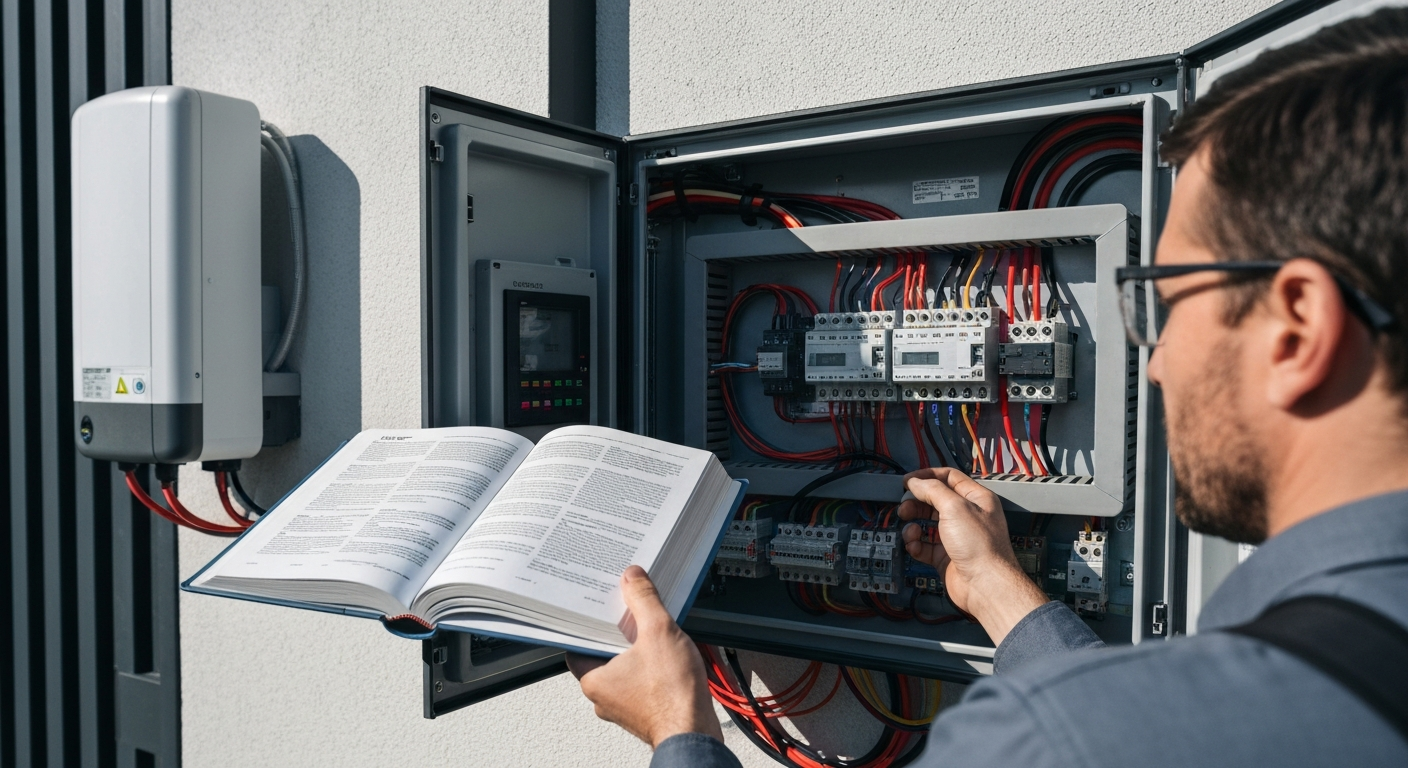
Sizing Conductors for Parallel Power Production Systems
Sizing Conductors for Parallel Power Production Systems: A Guide to NEC Article 705
Properly sizing conductors for parallel power production systems is a critical task for any master or journeyman electrician, governed by the stringent requirements of the National Electrical Code (NEC). According to NEC Article 705, the method for conductor sizing hinges on whether the system uses a supply-side or load-side connection. For supply-side connections, conductors are sized based on the power source’s output using the maximum circuit current calculation in Article 705 and the ampacity provisions in 705.28; where applicable, the code requires an ampacity equal to 125% of the calculated maximum source current. For load-side connections, calculations are more complex, often involving the busbar rating and the sum of overcurrent protection devices to prevent overload. Key considerations include ampacity, voltage drop, and the specific rules for interconnecting conductors. A failure to correctly apply these principles can lead to unsafe conditions and non-compliant installations, making a thorough understanding of NEC Article 705 essential for professionals working with solar, standby generators, and other interconnected systems.
Understanding Parallel Power Production Systems and NEC Article 705
Parallel power production systems involve one or more electric power sources, such as solar photovoltaic arrays or a standby generator, operating in parallel with a primary power source like the electric utility. As these systems become more common, every licensed electrician must be proficient in the rules governing their safe and effective interconnection. The authoritative guide for this work is the nec code book, specifically NEC Article 705, titled “Interconnected Electric Power Production Sources.”
This article provides the foundational requirements for all such installations, ensuring that the introduction of a new power source doesn’t overload existing electrical service conductors or create hazards. While the concept of a parallel vs series circuit is fundamental, Article 705 applies this principle on a larger scale, dictating how multiple power sources can safely feed into a single electrical system. It addresses everything from the point of connection to the necessary overcurrent protection and disconnecting means.
Critical Distinction: Supply-Side vs. Load-Side Connections
The most important decision a master electrician or journeyman electrician must make when designing one of these systems is where to interconnect the new power source. NEC Article 705 outlines two primary methods: supply-side connections and load-side connections. The choice between them dictates the rules for conductor sizing, overcurrent protection, and overall system design.
Supply-Side Connections (NEC 705.11)
A supply-side connection, as the name implies, taps into the feeder conductors on the supply side of the main service disconnect. In simpler terms, it connects between the utility meter and the main breaker. This method is often preferred for larger systems where the output from the power production source might exceed the limits allowed for a load-side connection.
NEC Article 705 and Article 230 provide the requirements for supply-side service connections. For conductor sizing in particular, follow the maximum circuit current calculations in 705.28(A) and then apply the conductor ampacity rules in 705.28(B). Where 705.28(B)(1) applies, the power-source output conductors are given an ampacity equal to the calculated maximum current multiplied by 125%. Any splices or taps made to service conductors must use listed devices and comply with the service-tap rules in Article 230 and the interconnection provisions in Article 705. For guidance on recent code changes and impacts to microgrid operation consult this 2023 NEC update overview.
Load-Side Connections (NEC 705.12)
Load-side connections are far more common in residential and small commercial installations. Here, the power production source connects to the load side of the service disconnect—typically, via a dedicated breaker in the main electrical panel. The rules for these connections are designed to prevent overloading the panelboard’s busbar.
The National Electrical Code provides several methods under 705.12 to ensure the busbar is not overloaded. One of the commonly applied options is the “120%” limitation that appears among the busbar options in 705.12(B) and is used where specified conditions are met (for example, when two sources are at opposite ends of a busbar). The 2023 NEC edition reorganized and clarified 705.12’s options; this helps practitioners select the correct compliance method for connections to feeders and busbars. For additional perspective on overcurrent protection in interconnected systems see this guidance on overcurrent protection.
Step-by-Step Conductor Sizing Calculation
Accurate conductor sizing is non-negotiable. Using undersized conductors creates a fire hazard, while oversized conductors are an unnecessary expense. Follow these steps for a compliant installation.
- Determine the Connection Type: First, decide if you will use a supply-side (NEC 705.11) or load-side (NEC 705.12) connection, as this dictates which set of rules to follow.
- Calculate Maximum Source Current: Identify the maximum current output of the power production source (e.g., the inverter’s rated output current) and use 705.28(A) methods when applicable.
- Apply the Ampacity Rule in 705.28: For power-source output conductors, apply the sizing methods in 705.28. Where 705.28(B)(1) applies, the conductor ampacity is the calculated maximum current multiplied by 125% (the code provides exceptions where listed equipment is rated for continuous operation at 100% of rating).
- Select a Conductor from an Ampacity Chart: Using a wire ampacity chart, such as NEC Table 310.16, select a conductor size that meets or exceeds the calculated ampacity based on the insulation temperature rating and conductor material (copper or aluminum).
- Apply Correction Factors: Adjust the conductor’s ampacity for conditions of use. This includes ambient temperature adjustments and adjustments for more than three current-carrying conductors in a raceway per Article 310.
- Verify Voltage Drop: Finally, calculate the expected voltage drop over the length of the run to ensure it falls within commonly recommended limits (the NEC provides informational guidance).
The Importance of Voltage Drop and Parallel Conductor Rules
Beyond basic ampacity, two other factors are critical for high-performance parallel power systems: voltage drop and the rules for installing conductors in parallel.
Calculating and Managing Voltage Drop
Voltage drop is the reduction in voltage as electricity flows along a conductor. Excessive voltage drop can cause equipment to underperform or fail, reduce energy harvest from a solar array, and generate waste heat. While the NEC’s ampacity tables and rules are mandatory, voltage drop limits are provided as informational guidance (for example, informational notes in 210.19 and 215.2) recommending that designers aim to limit voltage drop to about 3% to the farthest outlet and 5% total for feeder plus branch circuits as a best practice.
The basic voltage drop formula for a single-phase AC circuit is: VD = 2 × K × I × L / CM, where K is the conductor resistivity constant, I is the current, L is the one-way length in feet, and CM is the circular-mill area of the conductor. For complex runs, a voltage-drop calculator or engineering review is recommended.
Rules for Installing Interconnecting Conductors in Parallel (NEC 310.10(G))
When the required ampacity is too large for a single conductor, electricians can install multiple conductors in parallel. NEC 310.10(G) sets strict rules for this practice to ensure current divides evenly between the conductors. When installing conductors in parallel, you must adhere to the following:
- Minimum Size: Conductors must be 1/0 AWG or larger.
- Identical Characteristics: All parallel conductors in a set must be the same length, material (e.g., all copper), cross-sectional area, and insulation type.
- Same Termination: They must be terminated in the same manner (e.g., all compression lugs or all mechanical set screws).
- Same Raceway Configuration: If run in separate raceways, the raceways must have comparable electrical characteristics; individual sets must be installed so each paralleled set has the same electrical properties.
Properly wiring solar components, such as when you wire MC4 connectors for parallel strings, is a precursor to these larger interconnection requirements.
Integrating Overcurrent and Ground-Fault Protection
A parallel power system has multiple sources of current, so robust protection is essential. A dedicated overcurrent device (breaker or fuse) must be installed for the power production source to protect the interconnecting conductors. Furthermore, the addition of a new power source must not compromise the existing ground-fault protection for the service. The system must be designed so that all fault currents are properly detected and interrupted; where ground-fault protection of equipment is required by other Code sections, the interconnection need to be coordinated so protection functions as intended.
For systems involving a standby generator, this often includes a transfer switch to ensure the generator and utility are never connected simultaneously unless the system is specifically designed as a parallel interactive system. A manual transfer switch is a common device used to provide this isolation safely. For more advanced applications, a listed power control system (PCS) can actively manage power flow and ensure all components operate within safe limits.
Staying current with these complex NEC requirements is part of a professional’s commitment to safety and quality. Become an expert in renewable energy systems with our specialized training.
Frequently Asked Questions (FAQ)
- What is the main difference between supply-side and load-side connections under NEC Article 705?
- A supply-side connection taps into the service conductors between the utility meter and the main service disconnect. A load-side connection connects to a circuit breaker or fusible disconnect on the load side of the main service disconnect, typically inside the main panelboard.
- How do I size feeder conductors for a standby generator connected in parallel?
- You must follow the rules in NEC Article 705 and the related provisions for generator installations. Use the maximum source current calculation and the conductor ampacity provisions in 705.28; where the 125% ampacity rule applies to source output conductors, design accordingly and coordinate overcurrent protection so that conductors and equipment are protected.
- Is there a maximum allowed voltage drop for parallel power production systems?
- The NEC provides recommendations, not a strict mandate, for voltage drop. Informational notes (for example, in 210.19 and 215.2) recommend designing for a voltage drop not exceeding 3% to the farthest outlet, and a total maximum of 5% combined for both feeders and branch circuits as a best practice to maintain performance.
- Why can’t I use conductors smaller than 1/0 AWG in parallel for power applications?
- NEC 310.10(G) requires conductors installed in parallel to be 1/0 AWG or larger to help ensure that current divides evenly among the conductors. Parallel installations must also meet the identical-characteristics, termination, and installation requirements so that one conductor does not carry a disproportionate share of the load.
Continuing Education by State
Select your state to view board-approved continuing education courses and requirements:

Disclaimer: The information provided in this educational content has been prepared with care to reflect current regulatory requirements for continuing education. However, licensing rules and regulations can vary by state and are subject to change. While we strive for accuracy, ExpertCE cannot guarantee that all details are complete or up to date at the time of reading. For the most current and authoritative information, always refer directly to your state’s official licensing board or regulatory agency.
NEC®, NFPA 70E®, NFPA 70®, and National Electrical Code® are registered trademarks of the National Fire Protection Association® (NFPA®)
You may also like

Colorado Electrical Licensing Requirements and Reciprocity Guide
Standby Generators in DE: Navigating Coastal Storm Regulations

 Login with Google