
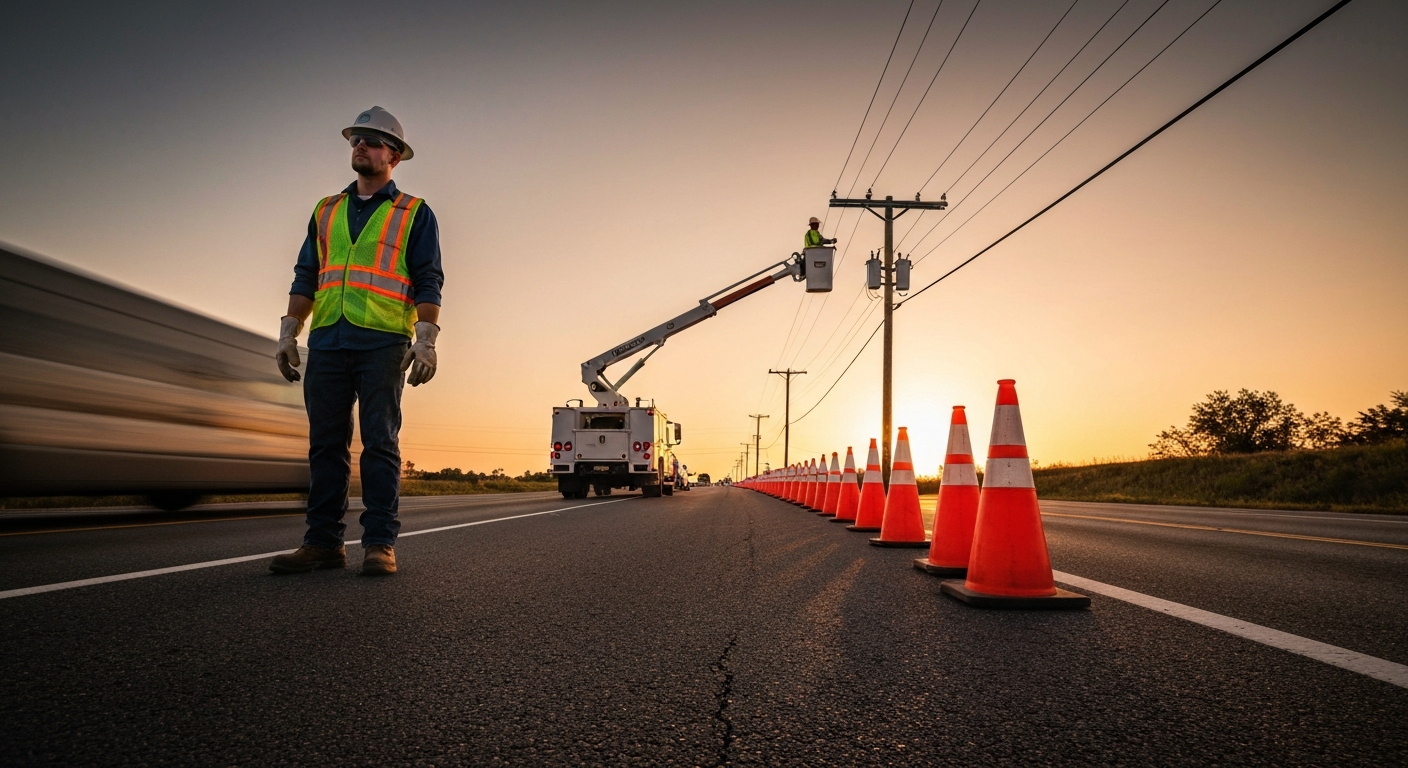
Setting Up a Safe Work Zone for Roadside Line Work
Setting Up a Safe Work Zone for Roadside Line Work: A Comprehensive Guide
Setting up a safe work zone for line work is a critical, multi-faceted process that balances the dual threats of public traffic and high-voltage electrical hazards. A successful setup hinges on a meticulously crafted Temporary Traffic Control Plan (TTCP) that adheres to the standards outlined in MUTCD Part 6, which governs how road users are guided through a work area. For any journeyman electrician or master electrician, this involves a pre-work Job Hazard Analysis for line work to identify all potential risks, from traffic flow to electrical dangers like step and touch potential. The physical zone requires a clear sequence of signs, channelizing devices, and potentially flagger safety procedures to protect workers and the public. Equally important is mitigating electrical risks by enforcing the minimum approach distance from energized components, implementing robust lockout/tagout procedures, and establishing an equipotential zone grounding system. This comprehensive approach, mandated by standards like OSHA 1910.269, ensures a controlled and safe environment for performing complex electrical tasks near active roadways.
The High Stakes of Roadside Electrical Work
For any master electrician or journeyman electrician involved in utility and line work, the roadside is one of the most hazardous environments imaginable. The dangers are twofold: the constant, unpredictable threat of moving traffic and the ever-present risk of contact with high voltage electricity. Statistics paint a grim picture of these risks. Transportation incidents are a leading cause of fatalities for lineworkers, and the overall fatality rate for the profession is drastically higher than the national average for all occupations. These sobering facts underscore the non-negotiable importance of establishing and maintaining a safe work zone for line work. Every project, no matter how brief, demands a systematic approach to safety that addresses both traffic control and electrical hazard mitigation.
The Foundation of Safety: Planning and Hazard Analysis
Effective work zone safety doesn’t start with setting out cones; it begins with comprehensive planning. Before any boots hit the ground, a thorough assessment of the worksite and its associated risks is essential. This planning phase is built on two core components: the Job Hazard Analysis and the Temporary Traffic Control Plan.
Conducting a Job Hazard Analysis (JHA) for Line Work
A Job Hazard Analysis for line work is a systematic process of identifying potential hazards for each step of a task and defining measures to eliminate or control them. As required by OSHA 1910.269, a job briefing must be conducted before starting work to cover these hazards. For roadside electrical work, the JHA must consider:
- Traffic: Vehicle speed, traffic volume, and road type (e.g., highway vs. residential street).
- Site Conditions: Line of sight for drivers, weather, and time of day.
- Electrical Hazards: Voltage levels, overhead line clearance, and the location of energized components.
- Underground Utilities: The potential for buried cables or pipes, requiring thorough underground utility locating before any excavation.
This analysis forms the basis of all safety procedures implemented on the site.
Developing a Temporary Traffic Control Plan (TTCP)
Based on the JHA, a Temporary traffic control plan (TTCP) must be developed. This plan is the blueprint for how traffic will be managed around the work area. The Federal Highway Administration’s Manual on Uniform Traffic Control Devices (MUTCD) Part 6 provides the standards for TTC zones, which consist of four main areas:
- Advance Warning Area: Notifies drivers of the upcoming work zone.
- Transition Area: Moves traffic out of its normal path using cones or barrels.
- Activity Area: The space where work is performed, including a buffer space for worker safety.
- Termination Area: Allows traffic to return to its normal path.
The TTCP must be specific to the site and account for all road users, including pedestrians and cyclists.
Establishing Traffic Control: A Step-by-Step Process
Deploying traffic control devices is a methodical process. Rushing or improperly setting up the zone can create confusion and danger for both the public and the crew. Adherence to the TTCP and MUTCD standards is paramount.
- Conduct a Pre-Job Briefing: Review the JHA and TTCP with the entire crew so everyone understands their roles, the identified hazards, and the control measures in place.
- Deploy Advance Warning Signs: Starting from the furthest point and working toward the work area (against traffic), place warning signs to give drivers ample time to react.
- Establish the Taper: Use cones, drums, or other channelizing devices to gradually guide traffic away from the work space. The length of this taper depends on the speed and type of roadway.
- Create the Activity Area: Clearly define the work space using temporary traffic barriers or additional cones. A longitudinal buffer space should separate the active work area from the traveled lane.
- Position Flaggers (If Necessary): If the work requires closing a lane on a two-lane road, implement proper flagger safety procedures. Flaggers must be trained and equipped with standard STOP/SLOW paddles.
- Ensure Proper Nighttime Illumination: For work conducted at night, the zone must be well-lit to maintain visibility for both workers and drivers, while controlling glare.
Mitigating Electrical Hazards in the Work Zone
While managing traffic is critical, the primary purpose of the work is electrical. A safe zone must rigorously control all electrical hazards. This goes beyond standard practices and requires specific protocols for high-voltage environments.
Understanding and Enforcing Minimum Approach Distance
The minimum approach distance (MAD) is the closest a qualified electrical worker can get to an energized or grounded object. This distance, defined in OSHA 1910.269, is not arbitrary; it’s calculated based on the system voltage, transient overvoltage possibilities, and other factors to prevent an arc flash. All personnel must be trained on the specific MAD for the job and maintain that distance at all times unless the line is de-energized and properly grounded. Maintaining these distances is a key element in working safely with high voltage lines.
Controlling Step and Touch Potential with Equipotential Zone Grounding
During a fault, the ground itself can become energized. Step and touch potential refers to the dangerous voltage difference that can occur between a worker’s feet or between a hand touching an object and their feet. To mitigate this, an equipotential zone grounding (EPZ) system is created. This involves bonding all conductive objects in the work area (like the utility truck, ladders, and the ground itself via a mat) to the same ground source. This ensures there is no difference in potential, preventing deadly current from flowing through a worker’s body.
Critical Electrical Safety Procedures
- Lockout/Tagout (LOTO) Procedures: The most fundamental safety step is de-energizing the circuit. Robust lockout/tagout procedures ensure that a line cannot be accidentally re-energized while work is in progress.
- Arc Flash Protection Boundary: Before work begins, an arc flash protection boundary must be calculated. This determines the distance at which a worker would sustain a second-degree burn if an arc flash occurred. Appropriate arc-rated PPE is mandatory inside this boundary.
- Insulated and Isolating Equipment: All workers must use properly rated and inspected insulated and isolating equipment, including rubber gloves, sleeves, blankets, and hot sticks.
- GFCI Protection: For any portable electric tools or lighting used in the work zone, GFCI protection in wet conditions is essential to prevent shock hazards from auxiliary equipment.
The Role of Training and Continuous Learning
The standards and technologies for ensuring a safe work zone for line work are constantly evolving. Continuous electrician training is not just a recommendation; it’s a career-long necessity. Certifications from organizations like NCCER provide structured, standardized training that covers critical safety fundamentals. Furthermore, a deep understanding of the NEC code book provides the foundational knowledge for many safety practices, including those related to clearances and equipment. For instance, understanding NEC working clearance requirements is fundamental to setting up a safe workspace around electrical gear. Keeping up with the latest changes to NEC 2023 requirements for electrical equipment ensures compliance and safety. Convenient online electrical courses offer a flexible way for a busy master electrician or journeyman electrician to stay current with these vital updates.
Protect yourself and the public. Master work zone traffic control.
Frequently Asked Questions (FAQ)
- What are the most important regulations for a safe work zone for line work?
- The two most critical standards are OSHA 1910.269, which covers the construction and maintenance of electric power generation, transmission, and distribution systems, and the Federal Highway Administration’s MUTCD Part 6, which dictates the requirements for the temporary traffic control plan.
- How do you protect workers from step and touch potential?
- Protection from step and touch potential is achieved by creating an equipotential zone grounding (EPZ) system. This is done by bonding the work vehicle, any conductive equipment, and the worker (often via a conductive mat) to the de-energized and grounded conductor, ensuring everything in the immediate work area is at the same electrical potential.
- What is a Job Hazard Analysis for line work and why is it critical?
- A Job Hazard Analysis for line work is a formal process where you break down a job into its core tasks, identify the associated hazards (both electrical and non-electrical, like traffic), and establish procedures to eliminate or control those risks. It’s critical because it forces a proactive approach to safety, ensuring that all potential dangers are considered and addressed before work ever begins, which is a requirement under OSHA regulations.
Continuing Education by State
Select your state to view board-approved continuing education courses and requirements:

Disclaimer: The information provided in this educational content has been prepared with care to reflect current regulatory requirements for continuing education. However, licensing rules and regulations can vary by state and are subject to change. While we strive for accuracy, ExpertCE cannot guarantee that all details are complete or up to date at the time of reading. For the most current and authoritative information, always refer directly to your state’s official licensing board or regulatory agency.
NEC®, NFPA 70E®, NFPA 70®, and National Electrical Code® are registered trademarks of the National Fire Protection Association® (NFPA®)
You may also like

Colorado Electrical Licensing Requirements and Reciprocity Guide
Standby Generators in DE: Navigating Coastal Storm Regulations

 Login with Google