
A Guide to Different Wire Stripper Types and Their Uses
A Comprehensive Guide to Wire Stripper Types and Their Uses
For any professional electrician, selecting the right tool is the first step toward a safe, compliant, and efficient job. When it comes to electrical connections, a clean strip is non-negotiable. This guide provides a comprehensive overview of the different wire stripper types available to the modern tradesperson. From basic manual models to advanced, specialized tools, understanding each type’s function is crucial for working with various cables and conductors. Key categories include the versatile manual wire stripper, the efficient automatic wire stripper, and application-specific tools like the Romex wire stripper. Choosing the correct tool for the specific wire gauge (AWG) and insulation material not only speeds up workflow but also prevents conductor damage that can compromise a connection’s integrity. For a journeyman electrician, mastering these tools is as fundamental as understanding the National Electrical Code (NEC).
The Critical Role of Proper Wire Stripping
The primary function of any wire stripper is to remove a section of electrical insulation from a conductor without nicking or cutting the copper or aluminum core. A compromised conductor can lead to overheating, arcing, and eventual failure at the termination point. The distinction between stripping solid core wire and stranded wire is particularly important. Solid core wire is less forgiving and nicks can create weak points, while stranded wire can lose individual strands if stripped improperly, reducing its effective cross-sectional area and compromising its current-carrying capability and connection integrity; NEC Article 310 addresses conductor ampacity and sizing considerations. A precise, clean strip ensures a full-contact connection with terminals, wire nuts, or other connectors, forming the foundation of a reliable electrical system.
Manual Wire Stripper Types: The Workhorses of the Trade
Manual strippers are the most common and versatile tools found in an electrician’s bag. They rely on the user’s skill to select the right gauge and apply the correct pressure.
The Standard Manual Wire Stripper
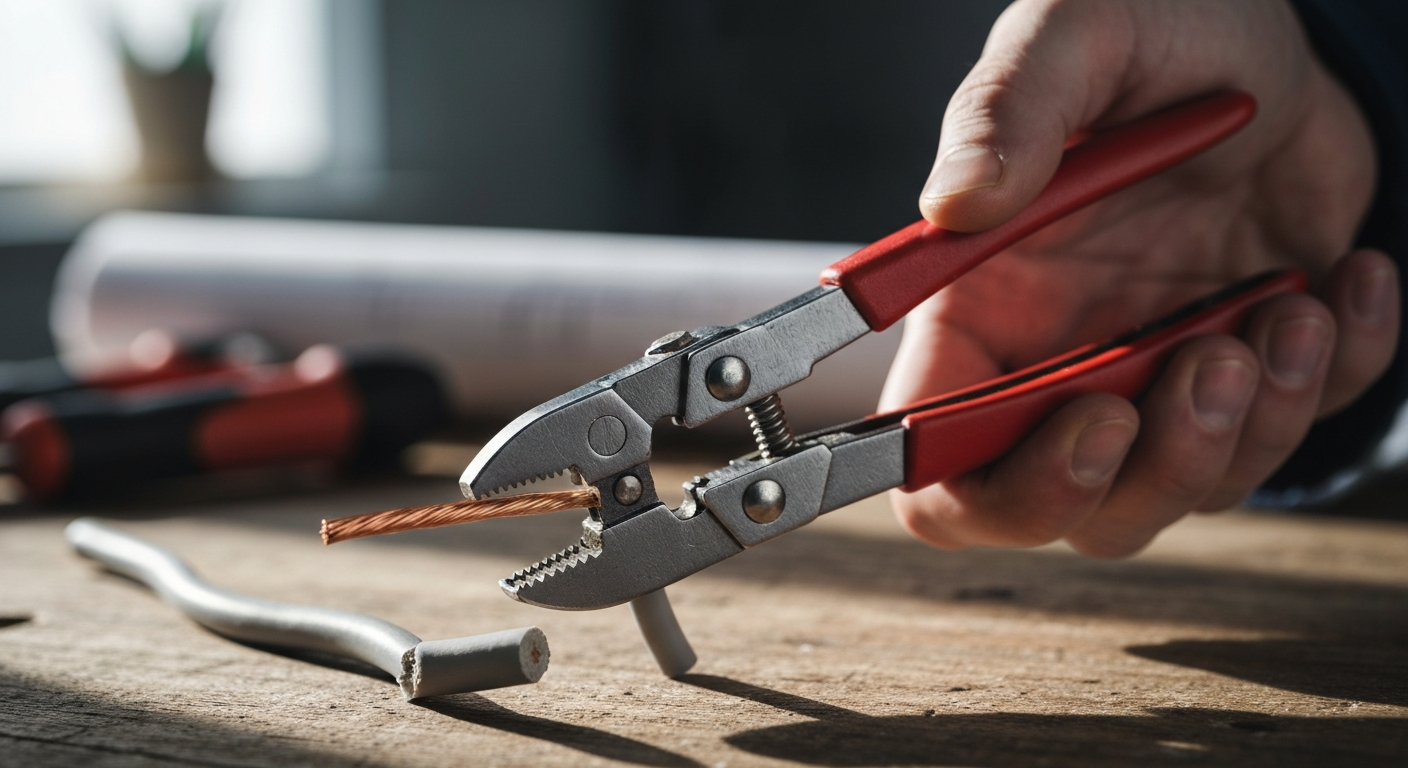
This is the classic design, featuring a series of precision-milled holes or notches, each labeled for a specific wire gauge (AWG). The user places the wire in the corresponding hole, closes the handles, and manually pulls to remove the insulation. Most models also integrate a wire cutting section in the jaw, allowing for quick cuts without switching tools. This simple and reliable manual wire stripper is indispensable for everyday tasks involving common conductor sizes.
Combination and Multi-Tool Wire Strippers
Evolving from the basic stripper, the combination wire stripper or multi-tool wire stripper packs several functions into one device. In addition to stripping and cutting, these often include:
- A crimping function for insulated and non-insulated terminals.
- A needle-nose stripper tip for pulling and looping wire.
- Bolt cutters for trimming common 6-32 and 8-32 screws.
- Grooved jaws for gripping and pulling.
For a busy journeyman electrician moving between different tasks, a multi-tool stripper reduces tool-belt weight and increases efficiency on the job site, making these ergonomic, multi-functional tools a popular choice for minimizing hand fatigue and boosting productivity.
The V-Notch Wire Stripper
A simpler variation, the V-notch wire stripper (or V-stripper) uses a single V-shaped blade instead of gauged holes. The user applies gentle pressure to cut through the insulation and then pulls the wire out. While it requires more finesse to avoid damaging the conductor, it is highly versatile and can be used on a wide range of wire sizes without needing a specific slot. It is a lightweight and fast option for experienced professionals.
Automatic and Self-Adjusting Wire Strippers: Speed and Precision
For repetitive tasks, automatic strippers offer a significant upgrade in speed and consistency. The growing demand for these tools reflects an industry-wide push for greater efficiency.
The Automatic Wire Stripper
An automatic wire stripper uses a compound action to grip, cut, and remove insulation in a single squeeze of the handles. The user simply places the wire between the jaws and the tool does the rest. This mechanism helps provide consistent, clean strips and generally speeds up preparation of multiple conductors for termination in junction boxes or panels.
The Self-Adjusting Wire Stripper
The self-adjusting wire stripper is one of the most significant innovations in this tool category. It automatically senses the wire gauge (AWG) and strips the insulation without requiring any manual adjustment from the user. This is ideal when working with mixed cables or when the gauge is not immediately obvious. It greatly reduces the risk of nicking the conductor, making it an excellent choice for delicate electronics work as well as standard residential and commercial wiring.
Specialized Strippers for Specific Cable Types
Standard strippers are not always suitable for compound or armored cables. For these applications, specialized tools are essential for both safety and code compliance.
Romex Wire Stripper
Specifically designed for non-metallic (NM) sheathed cable, the Romex wire stripper is a must-have for residential electricians. It cleanly slices the outer jacket of cables like 12/2 wire without damaging the insulation on the inner conductors. Some models are designed to strip both the outer jacket and the inner wires simultaneously. Using a utility knife for this task is slow and carries a high risk of cutting into the conductor’s insulation, a common defect found during inspections. For more on NM cables, explore our guide to NM cable types.
Strippers for MC Cable and THHN Wire
Armored (MC cable) and metal-clad cables require a dedicated rotary cutter or appropriate armor-sheath cutter to safely slice the metal sheathing without harming the conductors inside. Once the armor is removed, a standard stripper can be used on the individual THHN wire conductors. Having the right tool is critical for working with the wide variety of conductors detailed in our comprehensive electrical cable types guide.
Coaxial Cable Stripper
A coaxial cable stripper is designed for data, video, and communication cables. These tools perform a stepped, multi-level strip in a single action, exposing the center conductor, cutting back the dielectric insulator, and trimming the braided shielding and outer jacket to precise lengths required for connector installation.
From Hand Tools to Heavy Duty: The Wire Stripping Machine
In industrial settings, salvage yards, or high-volume production shops, a manual tool is impractical. The wire stripping machine is a bench-mounted or freestanding piece of equipment that can process thousands of feet of wire per hour. These machines are essential for recycling operations and for preparing large quantities of wire for manufacturing. The market for automated wire processing is growing; industry market research projects continued growth in demand for automated stripping equipment.
How to Properly Strip a Wire: A Step-by-Step Guide
A perfect termination starts with a perfect strip. Follow these steps for a clean, professional result:
- Select the Right Tool and Gauge: Identify the wire type (e.g., THHN, NM-B) and size (e.g., 12 AWG, 14 AWG). Choose the appropriate stripping tool and, for a manual stripper, select the corresponding gauge hole.
- Measure the Strip Length: Check the strip gauge on the back of the device (outlet, switch) or on the packaging for wire nuts. This typically ranges from 1/2″ to 3/4″.
- Position the Wire: Insert the wire into the correct hole or jaw position on your stripper at the measured length. Ensure the tool is perpendicular to the wire.
- Cut and Remove the Insulation: Squeeze the handles firmly to cut through the insulation. For a manual stripper, pull the tool straight off the end of the wire. An automatic stripper will complete this motion for you.
- Inspect the Conductor: Examine the stripped end. There should be no nicks, cuts, or scrapes on the copper or aluminum. For stranded wire, ensure all strands are intact and twisted together neatly.
- Terminate the Wire: Proceed with making the connection, whether it involves looping the wire around a terminal screw, inserting it into a push-in connector, or twisting it under a wire nut. If needed, use high-quality electrical tape to further secure the connection.
Mastering this fundamental skill is essential for every electrician. Perfect your terminations with our guide to stripping and connecting wires.
Key Considerations When Choosing Your Next Wire Stripper
- Ergonomics: Look for cushioned, non-slip grips and a spring-loaded action to reduce hand fatigue during repetitive use. This is a key trend in modern tool design.
- Application: Will you be working primarily with residential Romex, commercial MC cable, or delicate control wires? Choose a tool designed for your most common tasks.
- Functionality: Decide if you need a simple, dedicated stripper or a multi-tool wire stripper with a crimping function and other features to consolidate your tool bag.
- Wire Type and Gauge Range: Ensure the tool accommodates the range of gauges you work with most often, and that it is suitable for both solid core wire and stranded wire.
Frequently Asked Questions (FAQ)
What are the main wire stripper types for a journeyman electrician?
A journeyman electrician should carry a few core types. A high-quality combination wire stripper is essential for its versatility (stripping, cutting, crimping, looping). A dedicated Romex wire stripper is crucial for residential work to safely remove NM sheathing. Finally, a self-adjusting wire stripper can be a major time-saver for panel work and light fixtures where multiple wire sizes are present.
When should I use an Automatic wire stripper versus a Manual wire stripper?
Use a manual wire stripper for general-purpose work and when you need the multi-functional capabilities of a combination tool. Switch to an automatic wire stripper or self-adjusting wire stripper for repetitive tasks, such as making up multiple junction boxes or wiring a panel, where its speed and consistent results will significantly improve your workflow.
What is the best tool for stripping Romex wire?
The best tool is a dedicated Romex wire stripper. These tools are specifically designed to slit or remove the outer PVC jacket from flat or round NM cable (like 12/2 wire) without damaging the insulation of the conductors inside. Using a utility knife is strongly discouraged as it frequently leads to nicks and damaged wires.
Can a multi-tool wire stripper handle both solid core wire and stranded wire?
Yes, most quality multi-tool wire stripper models are designed to effectively strip both solid core wire and stranded wire. The key is to use the correct gauge-marked hole for a clean cut without removing any of the copper strands or scoring the surface of a solid conductor.
Continuing Education by State
Select your state to view board-approved continuing education courses and requirements:

Disclaimer: The information provided in this educational content has been prepared with care to reflect current regulatory requirements for continuing education. However, licensing rules and regulations can vary by state and are subject to change. While we strive for accuracy, ExpertCE cannot guarantee that all details are complete or up to date at the time of reading. For the most current and authoritative information, always refer directly to your state’s official licensing board or regulatory agency.
NEC®, NFPA 70E®, NFPA 70®, and National Electrical Code® are registered trademarks of the National Fire Protection Association® (NFPA®)
You may also like
Colorado Electrical Licensing Requirements and Reciprocity Guide
Standby Generators in DE: Navigating Coastal Storm Regulations

 Login with Google