
Understanding Ratios for Transformer Voltage Calculations
Understanding Ratios for Transformer Voltage Calculations
For any journeyman electrician or master electrician, a core competency is the ability to work confidently with an electrical transformer. Central to this is understanding the transformer turn ratio, a fundamental principle that dictates how a transformer alters voltage and current. The turn ratio is the ratio of the number of turns in the primary winding to the number of turns in the secondary winding. This ratio directly determines the voltage ratio, making it the key to calculating if a transformer is a step-up transformer (increasing voltage) or a step-down transformer (decreasing voltage). A solid grasp of this concept is essential for accurate voltage calculations, ensuring equipment is powered correctly, and adhering to the safety standards outlined in the NEC code book. This knowledge is not just theoretical; it’s a practical requirement for everything from installing low voltage systems to managing high voltage power distribution.
What is a Transformer Turn Ratio?
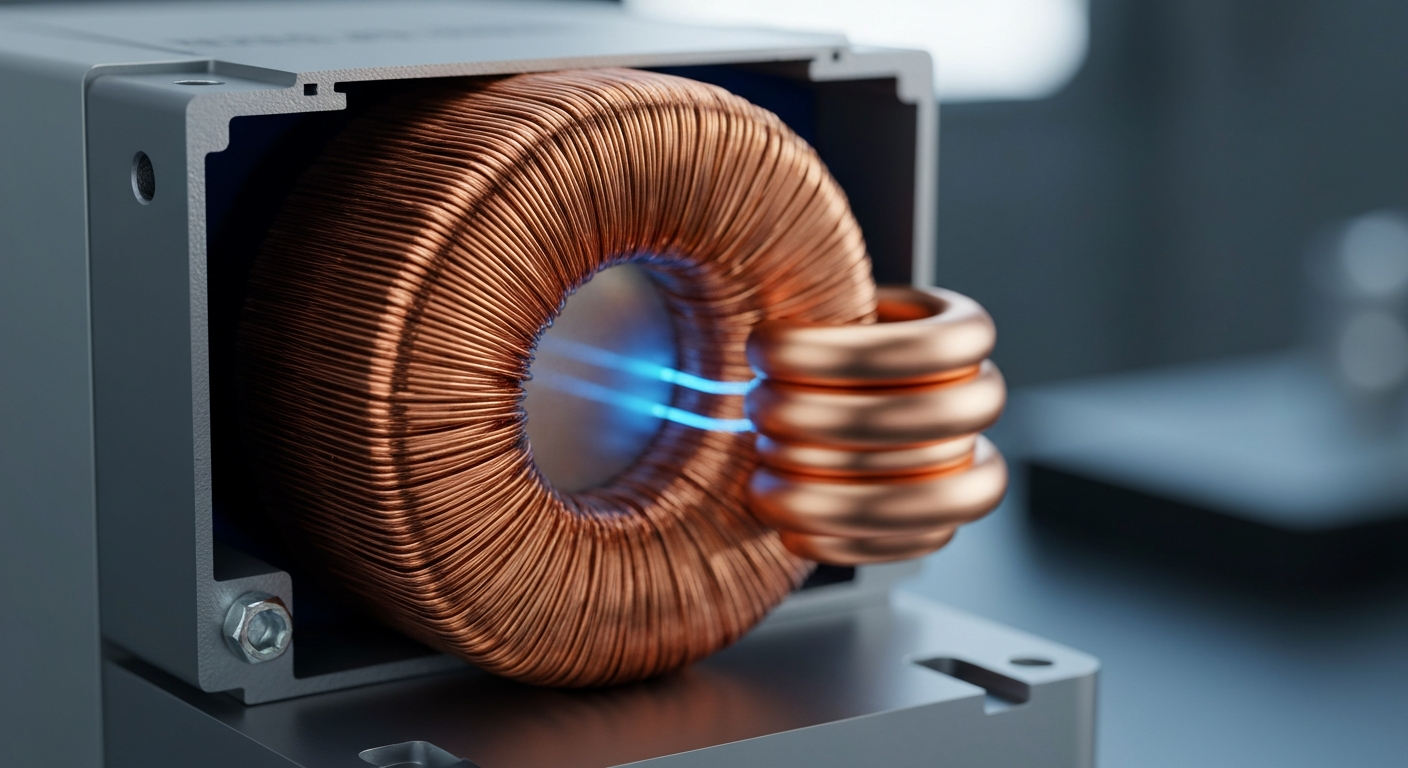
At its heart, an electrical transformer works by magnetic induction between two coils: the primary winding, which receives the input voltage, and the secondary winding, which delivers the output voltage. The transformer turn ratio (often denoted as ‘a’ or T.R.) is simply the ratio of the number of turns in the primary winding (Np) to the number of turns in the secondary winding (Ns).
The formula is: T.R. = Np / Ns
For an ideal transformer, this turn ratio is directly proportional to the voltage ratio. This relationship is the foundation for all transformer voltage calculations.
Voltage Ratio Formula: Vp / Vs = Np / Ns
Where:
- Vp is the voltage on the primary winding.
- Vs is the voltage on the secondary winding.
- Np is the number of turns on the primary winding.
- Ns is the number of turns on the secondary winding.
Step-Up vs. Step-Down Transformer Ratios
The turn ratio immediately tells a working electrician whether a transformer will increase or decrease voltage.
- A step-up transformer has more turns on its secondary winding than its primary (Ns > Np). This results in a turn ratio of less than 1, and the voltage increases from primary to secondary, creating a high voltage output. These are typically used in power transmission to send electricity over long distances efficiently.
- A step-down transformer has fewer turns on its secondary winding than its primary (Np > Ns). This results in a turn ratio greater than 1, and the voltage decreases, creating a low voltage output. This is the most common type seen in residential and commercial distribution, reducing grid voltage to usable levels like 120V or 240V.
- An isolation transformer has a 1:1 turn ratio (Np = Ns). It doesn’t change the voltage but provides galvanic isolation, separating the secondary circuit from the primary for safety.
A Step-by-Step Guide to Calculating Secondary Voltage
For a journeyman electrician or master electrician in the field, the most common task is to verify or calculate the secondary voltage. Here’s how to do it methodically:
- Consult the Nameplate Data: The first step is always to examine the transformer’s nameplate. This plate contains critical information, including the primary voltage, secondary voltage, and kVA rating. The nameplate often gives the voltages directly, but you may need to calculate them if using different taps.
- Determine the Transformer Turn Ratio: If the number of turns isn’t known, you can calculate the turn ratio using the rated primary and secondary voltages from the nameplate data. For example, a transformer with a 480V primary and a 120V secondary has a turn ratio of 480 / 120 = 4, often expressed as 4:1.
- Apply the Voltage Ratio Formula: Rearrange the formula to solve for the secondary voltage (Vs): Vs = Vp / T.R.
- Calculate the Result: Insert the known values to find the output voltage. For example, if a single-phase transformer with a 4:1 turn ratio is supplied with 480V on the primary side, the secondary voltage will be 480V / 4 = 120V.
Beyond Voltage: Understanding Current and Impedance Ratios
While voltage is critical, a professional electrician must also understand how a transformer affects current and impedance for safe and compliant installations per the NEC code book.
Current Ratio
The current ratio is the inverse of the turn ratio. As voltage steps down, current must step up to conserve power, and vice-versa. This is crucial for sizing wires and overcurrent protection.
Current Ratio Formula: Ip / Is = Ns / Np = 1 / T.R.
Using our 4:1 step-down transformer example, if the secondary delivers 40A, the primary will only draw 10A (Is / T.R. = 40 / 4 = 10). Misunderstanding this relationship can lead to dangerously undersized primary conductors.
Impedance Ratio
The impedance ratio is important for more advanced applications, particularly in electronics and for ensuring maximum power transfer. It is equal to the square of the turn ratio.
Impedance Ratio Formula: Zp / Zs = (Np / Ns)² = T.R.²
For a transformer with a 4:1 turn ratio, the impedance ratio is 16:1. This means a 10-ohm load on the secondary will appear as a 160-ohm load (10 x 4²) to the primary circuit. This principle is fundamental in designing systems where matching source and load impedance is critical.
Single-Phase vs. Three-Phase Transformer Considerations
The principles of turn ratios apply to both single-phase transformer and three-phase transformer systems, but the calculations for a 3-phase transformer require an extra step. The voltage and current relationships depend on the transformer winding configurations (e.g., Delta-Wye or Wye-Delta). These configurations affect the line and phase voltages differently, which must be accounted for in your calculations. For a deeper dive into these complex setups, it’s beneficial to review 3-phase transformer configurations in detail.
Practical Application and NEC Compliance
In the real world, several factors influence transformer performance. The calculated secondary voltage is the theoretical no-load voltage. Under load, the actual voltage will be slightly lower due to transformer losses and its internal impedance, a characteristic known as voltage regulation. This is why referencing the nameplate is so important. The nameplate provides the rated output at a specific kVA rating, which accounts for these real-world factors.
From an installation perspective, these calculations are directly tied to safety and code. For example, understanding how 2023 NEC grounding rules affect transformer installations is critical for safety compliance. Even for seemingly simple low voltage systems, like learning how to install a doorbell transformer, a failure to respect the step-down ratio can lead to fried components and callbacks.
For any journeyman electrician seeking to advance or a master electrician wanting to stay sharp, a complete command of these principles is non-negotiable. It forms the basis of effective troubleshooting, safe installation, and code-compliant work. Mastery of these concepts is a hallmark of true professional expertise and is a core component of advanced electrician training.
Key Takeaways for Electricians
- The transformer turn ratio (Np/Ns) is the primary determinant of the voltage and current transformation.
- A turn ratio greater than 1 indicates a step-down transformer (lower voltage, higher current). A ratio less than 1 indicates a step-up transformer (higher voltage, lower current).
- The current ratio is the inverse of the voltage ratio. This is critical for sizing conductors and overcurrent protection devices according to the NEC code book.
- Always start with the nameplate data, which provides the kVA rating, rated voltages, and impedance.
- For a 3-phase transformer, winding configurations (Delta/Wye) must be considered to correctly calculate line and phase voltages.
- Real-world voltage output is affected by load and voltage regulation; the calculated value is the no-load voltage.
Frequently Asked Questions
What is the formula for the transformer turn ratio?
The transformer turn ratio is the number of turns in the primary winding (Np) divided by the number of turns in the secondary winding (Ns). The formula is T.R. = Np / Ns. This ratio is equal to the voltage ratio (Vp / Vs) in an ideal transformer.
How does the turn ratio determine if a transformer is step-up or step-down?
If the turn ratio (Np/Ns) is greater than 1, it is a step-down transformer, meaning the secondary voltage is lower than the primary. If the turn ratio is less than 1, it is a step-up transformer, and the secondary voltage is higher than the primary.
Why is understanding current ratio as important as voltage ratio for an electrician?
Understanding the current ratio is critical for safety and NEC compliance. A step-down transformer increases current on the secondary side, requiring larger conductors to handle the load. Conversely, a step-up transformer decreases current. Correctly calculating current is essential for sizing fuses, circuit breakers, and wiring to prevent overheating and fire hazards.
Where can I find the primary and secondary voltage on an electrical transformer?
The most reliable source for an electrical transformer’s voltage ratings is its nameplate. The nameplate lists the rated primary (input) and secondary (output) voltages, the kVA rating, frequency, and other essential data for safe installation and operation.
Continuing Education by State
Select your state to view board-approved continuing education courses and requirements:

Disclaimer: The information provided in this educational content has been prepared with care to reflect current regulatory requirements for continuing education. However, licensing rules and regulations can vary by state and are subject to change. While we strive for accuracy, ExpertCE cannot guarantee that all details are complete or up to date at the time of reading. For the most current and authoritative information, always refer directly to your state’s official licensing board or regulatory agency.
NEC®, NFPA 70E®, NFPA 70®, and National Electrical Code® are registered trademarks of the National Fire Protection Association® (NFPA®)
You may also like

Colorado Electrical Licensing Requirements and Reciprocity Guide

Standby Generators in DE: Navigating Coastal Storm Regulations

 Login with Google