
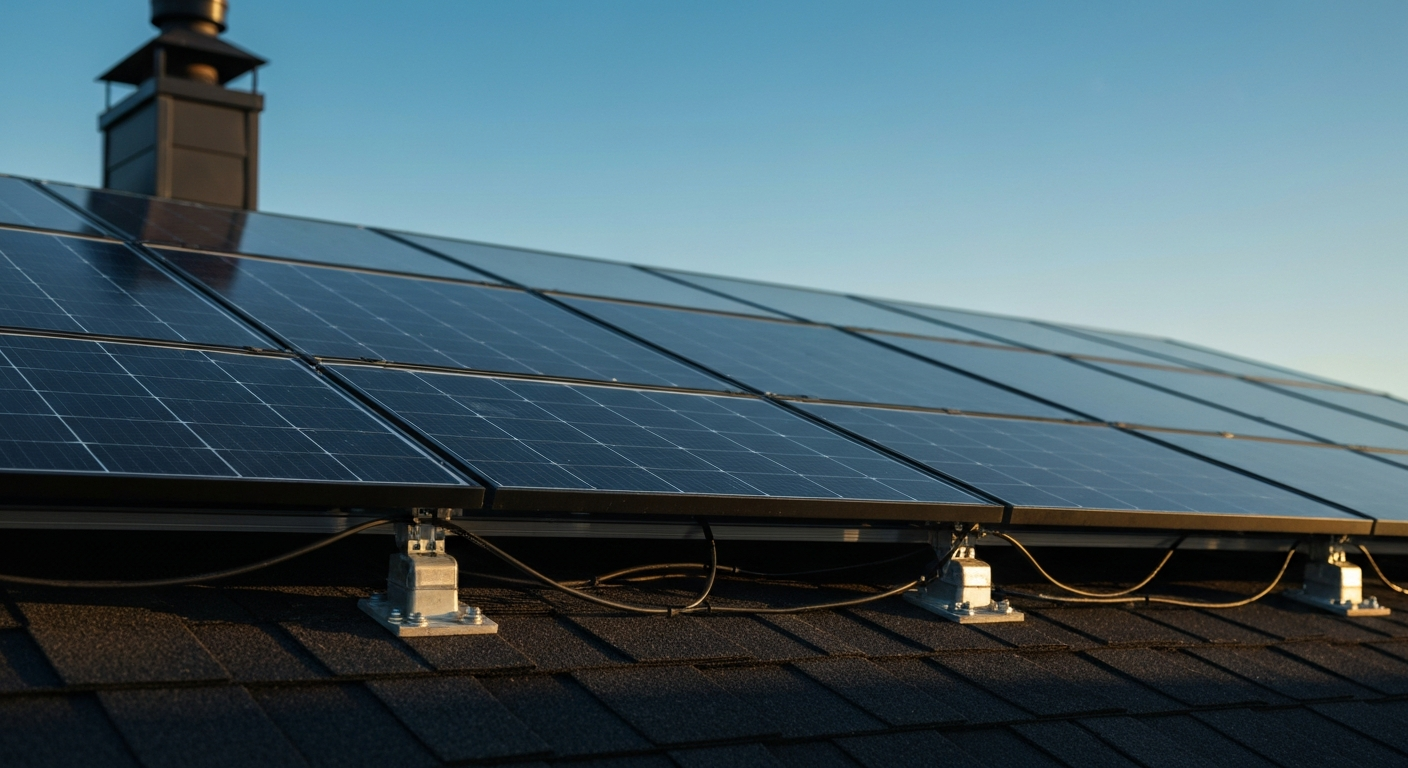
String Inverters vs. Microinverters vs. Power Optimizers
String Inverters vs. Microinverters vs. Power Optimizers: A Guide for Electricians
Choosing the right inverter technology is a critical decision in solar PV system design, directly impacting performance, safety, cost, and long-term reliability. For licensed electricians, understanding the trade-offs between string inverters vs microinverters and power optimizers is essential. The primary difference lies in where the DC-to-AC power conversion happens. String inverters convert power from a whole “string” of panels at a centralized unit. In contrast, Module-Level Power Electronics (MLPE), which include microinverters and power optimizers, operate at each individual solar panel. This granular approach offers benefits like improved performance in shaded conditions, enhanced panel-level monitoring, and can simplify meeting NEC 690.12 rapid shutdown requirements when the MLPE devices and system are listed for that function and installed per the manufacturer’s instructions and the Code. While string inverters are often more cost-effective upfront, MLPE solutions frequently provide greater system design flexibility and — depending on site conditions, shading, and long-term production gains — can improve lifetime energy yield and thus reduce Levelized Cost of Energy (LCOE) in some projects.
What Are Solar Inverters and Why Are They Critical?
At its core, a solar inverter is the brain of a photovoltaic (PV) system. Solar panels produce direct current (DC) electricity, but homes and the electrical grid use alternating current (AC). The inverter’s primary job is to perform this crucial DC-to-AC conversion. However, modern inverters do much more, including maximizing power production, monitoring system performance, and ensuring grid safety. The choice of inverter topology fundamentally defines the system’s architecture, influencing everything from wiring methods to troubleshooting procedures. For a master electrician or journeyman electrician, a deep understanding of these components is as crucial as knowing the nec code book itself.
String Inverters: The Traditional Workhorse
A string inverter is a centralized device that connects to a “string” of solar panels wired in series. It converts the aggregated DC power from the entire string into usable AC power. For larger projects, multiple strings can be connected to a single, high-capacity inverter, which can include three-phase inverters for commercial applications.
How They Work: The Series vs. Parallel Circuit Impact
In a string inverter setup, panels are connected in a series vs parallel circuit arrangement—specifically, a series string. This means the current flows through each panel sequentially. The major drawback is the “Christmas light effect”: if one panel’s output drops due to shading, soiling, or a defect, the performance of the entire string is reduced to the level of that lowest-performing panel. This can significantly impact energy harvest in locations with intermittent shading.
Pros and Cons of String Inverters
- Pros: Lower upfront cost, proven technology with a long history, and simpler to service since there is only one main component to troubleshoot.
- Cons: Susceptible to production loss from shading, limited system design flexibility on complex roofs, no individual panel-level monitoring unless MLPE are added, and more complex to make compliant with NEC 690.12 rapid shutdown rules without additional listed hardware or a listed system design that addresses the rapid-shutdown function.
Step-by-Step: Basic String Sizing Calculation
Proper string sizing is critical to ensure the inverter operates efficiently and safely without being damaged. A master electrician must perform these calculations carefully during the design phase.
- Find Panel Specifications: From the panel’s datasheet, find the Open-Circuit Voltage (Voc), Maximum Power Voltage (Vmp), and the temperature coefficient of Voc.
- Calculate Maximum String Voltage: Determine the coldest expected ambient temperature for the site. Use the temperature coefficient to calculate the maximum possible Voc of a single panel at that temperature. This is crucial to ensure the total string voltage never exceeds the inverter’s maximum DC input voltage.
- Calculate Minimum String Voltage: Determine the highest expected operating cell temperature. Use the temperature coefficient to find the minimum Vmp of a single panel. This ensures the string voltage remains within the inverter’s MPPT (Maximum Power Point Tracking) window during hot conditions.
- Determine Panels Per String: Divide the inverter’s maximum input voltage by the calculated maximum panel Voc to find the maximum number of panels per string. Divide the inverter’s minimum MPPT voltage by the calculated minimum panel Vmp to find the minimum number of panels. A valid string size must be between these two numbers.
Designers also consider the DC-to-AC ratio, often oversizing the DC array relative to the inverter’s AC rating. This can lead to inverter clipping (power capping) during peak sun hours but increases overall energy yield during lower light conditions.
Module-Level Power Electronics (MLPE): A Modern Approach
Module-Level Power Electronics (MLPE) is a category that includes both microinverters and DC power optimizers. These devices are installed at every single solar panel, optimizing power and providing monitoring at the module level. The rise of MLPE is driven by declining costs and stringent safety codes, particularly rapid shutdown requirements. When using MLPE, verify manufacturer listings and the overall system design to confirm the rapid-shutdown method meets NEC 690.12.
Microinverters: Maximum Granularity and Performance
Microinverters are small inverters installed on the back of each solar panel, converting DC to AC right at the source. The AC power from all microinverters is then combined and sent to the main service panel. This architecture transforms the system into a parallel circuit, mitigating the “Christmas light effect”.
Pros and Cons of Microinverters
- Pros: Maximizes energy harvest per panel, ideal for complex roofs and shaded sites, offers detailed panel-level monitoring for easier troubleshooting and diagnostics, and many microinverter products include module-level shutdown behavior that can simplify meeting rapid-shutdown rules when used as part of a listed solution. Excellent system design flexibility allows for easy future expansion.
- Cons: Higher upfront cost per watt, more components mounted on the roof which increases the number of rooftop terminations to inspect and maintain, and proper setup of the remote monitoring and control gateway is critical. Always verify listings and manufacturer’s instructions for installation and safety compliance.
Power Optimizers: A Hybrid Solution
Power optimizers offer a middle ground. Like microinverters, a small optimizer is attached to each panel. However, they don’t convert DC to AC at the module. Instead, they perform per-module MPPT (maximum power point tracking) and condition the DC output. The optimized DC power is then sent to a conventional string inverter for central conversion. This mitigates the impact of shading like a microinverter but retains a centralized inverter architecture.
Pros and Cons of Power Optimizers
- Pros: More cost-effective than microinverters in many cases, provides panel-level optimization and monitoring, offers great system design flexibility, and many optimizer + inverter combinations are designed to meet rapid-shutdown requirements when installed per listing and manufacturer instructions.
- Cons: Still has a central point of conversion (the string inverter), and the system is more complex than a standard string-only system. Troubleshooting and diagnostics can involve checking components both on the roof and at the inverter.
Key Considerations for the Licensed Electrician
As the solar industry grows, offering new challenges and lucrative career opportunities, electricians must master these technologies. The core function of inverting power is similar in principle to other power electronics, like a VFD (Variable Frequency Drive), but with unique challenges.
Choosing the right inverter is more than a technical preference; it’s a core part of project success. For any job, from a residential solar panel generator setup to a large-scale commercial project requiring detailed commercial solar inverter sizing, the choice impacts labor, safety, and client satisfaction. Knowing how to correctly install and connect these systems, including how to properly wire MC4 connectors, is a fundamental skill.
For electricians looking to expand their expertise in this growing field, ExpertCE offers a range of online electrical courses to keep you ahead of the curve. Choose the right inverter for any job. Explore our solar component courses.
Important Factors for Your Decision
- NEC 690.12 Rapid Shutdown: This is a non-negotiable safety requirement. The nec code book mandates a method to reduce PV array conductor voltages to safe levels quickly. MLPE devices can help meet the requirement, but the specific devices and system design must be listed or otherwise demonstrated to meet the Code.
- Grounding and Bonding: Each system type has specific requirements for grounding and bonding to ensure safety. Follow the grounding rules in Article 250 and the PV-specific grounding guidance in Article 690, and verify manufacturer instructions for equipment-mounted hardware and racking bonding.
- Levelized Cost of Energy (LCOE): Don’t just look at upfront cost. Consider the total energy production over 25+ years. A system with MLPE might produce more energy under shading or complex arrays, potentially lowering LCOE — but results are site-specific.
- Utility Interconnection Standards: All inverters must comply with standards such as IEEE 1547 and relevant interconnection requirements. Ensure the chosen inverter is listed and approved for interconnection with the local utility. Some systems may be paired with battery storage and a transfer switch for generator-like functionality; these hybrid systems require coordinated equipment and listed components.
Primary Sources
- National Fire Protection Association (NFPA) for access to the National Electrical Code (NEC), particularly Article 690 covering Solar Photovoltaic (PV) Systems.
Frequently Asked Questions
What is the main installation difference in a string inverters vs microinverters debate?
The main difference is component location and wiring. For string inverters, electricians run high-voltage DC wiring from the rooftop array down to a single, wall-mounted inverter. For microinverters, the work is concentrated on the roof, installing a unit at every panel and running standard AC wiring from the roof to the load center. This removes the high-voltage DC string between the array and a central inverter (and thus the typical DC string wiring and disconnects at that point), but the installer still must provide the required PV system disconnecting means and comply with all grounding and bonding requirements.
How does Module-Level Power Electronics (MLPE) help meet NEC 690.12 rapid shutdown?
NEC 690.12 rapid shutdown requires different actions depending on the location of the conductors. Conductors outside the array boundary must be limited to 30 volts or less within 30 seconds of initiation. For conductors inside the array boundary, the limit is 80 volts or less within 30 seconds. Many microinverters and some power optimizer products incorporate module-level shutdown behavior that limits module voltage; however, compliance is achieved only when the specific products and the combined system are listed or are used in a listed arrangement that meets the Code. Installers should verify device listings and follow manufacturer instructions to ensure the assembled system meets 690.12.
Is inverter clipping a major concern for modern solar system design?
Inverter clipping is a deliberate design choice, not necessarily a problem. By using a higher DC-to-AC ratio (e.g., 1.25:1), designers can capture more energy during non-peak hours (mornings, evenings, cloudy days), increasing total annual production. The small amount of power “clipped” during the few peak hours of the year is often less than the energy gained during all other times. Modern design software accurately models this trade-off.
What’s more important for commercial solar inverter sizing: DC-to-AC ratio or string sizing?
Both are critically important and interdependent. Proper string sizing is a fundamental safety and operational requirement; incorrect string voltage can damage the inverter or prevent it from turning on. The DC-to-AC ratio is an optimization parameter that affects the system’s economic performance and Levelized Cost of Energy (LCOE). A master electrician or engineer must get the string sizing right first, then optimize the DC-to-AC ratio for the project’s financial and production goals.
Continuing Education by State
Select your state to view board-approved continuing education courses and requirements:

Disclaimer: The information provided in this educational content has been prepared with care to reflect current regulatory requirements for continuing education. However, licensing rules and regulations can vary by state and are subject to change. While we strive for accuracy, ExpertCE cannot guarantee that all details are complete or up to date at the time of reading. For the most current and authoritative information, always refer directly to your state’s official licensing board or regulatory agency.
NEC®, NFPA 70E®, NFPA 70®, and National Electrical Code® are registered trademarks of the National Fire Protection Association® (NFPA®)
You may also like
Colorado Electrical Licensing Requirements and Reciprocity Guide
Standby Generators in DE: Navigating Coastal Storm Regulations

 Login with Google