
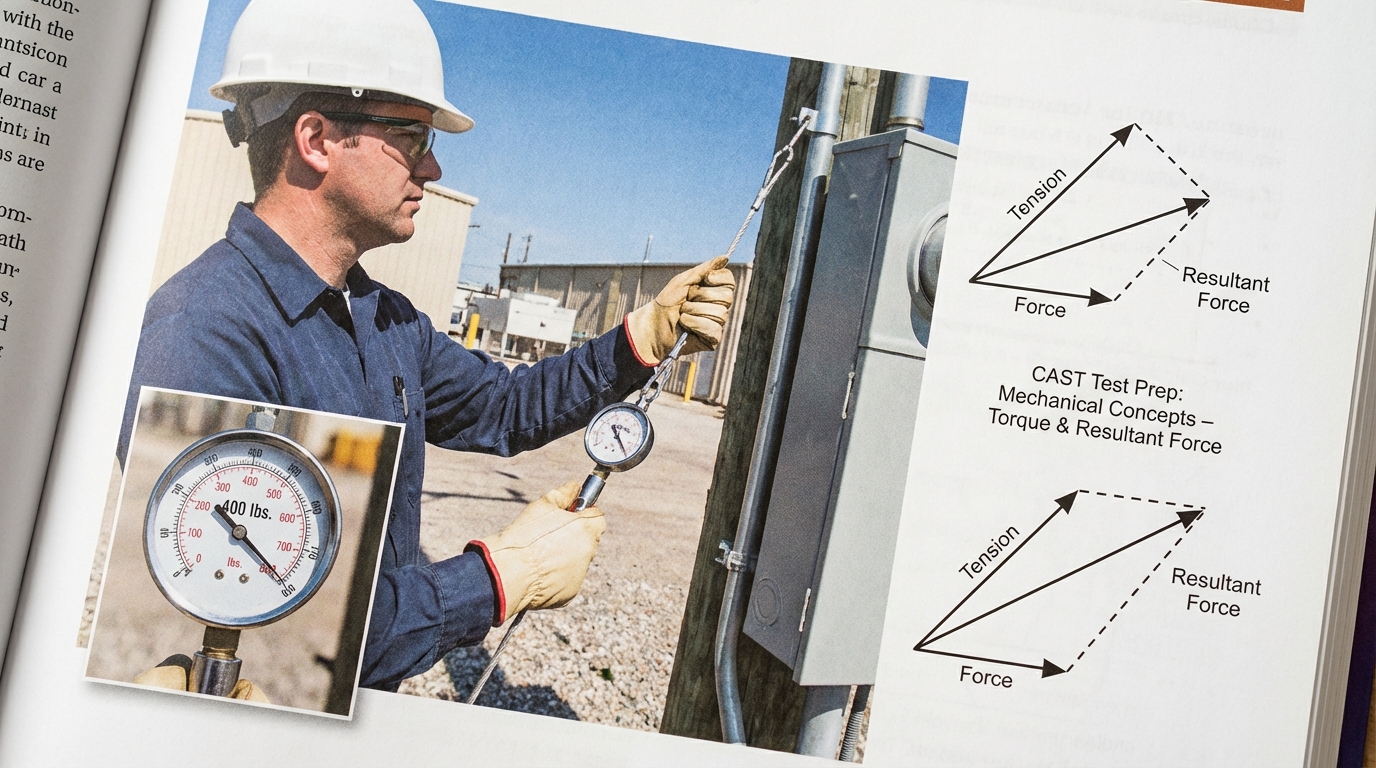
Solving Force and Vector Problems: CAST Mechanical Concepts Prep
Solving Force and Vector Problems: A Guide for the CAST Test
Successfully solving force and vector problems is a critical skill for passing the CAST test and excelling as a professional electrician. These problems test your CAST test mechanical aptitude by evaluating your ability to understand and calculate how physical forces interact. This is a concept essential for applying engineering principles to meet National Electrical Code (NEC) performance requirements for tasks like ensuring electrical service mast stability and performing accurate conductor tension calculation. For any journeyman electrician or apprentice, mastering vector addition and understanding concepts like torque and mechanical advantage is not just for exam day; it’s fundamental to safe and effective on-the-job performance. This guide breaks down the core principles of forces and vectors, providing practical examples and preparation strategies to help you succeed in your electrician training and career.
Why Mechanical Concepts Are Crucial for Modern Electricians
While electrical theory is the core of the trade, a deep understanding of mechanical principles separates proficient electricians from the rest. The entire electrical infrastructure, from power generation to the last outlet, is a physical system subject to forces like tension, compression, and torque. According to the U.S. Bureau of Labor Statistics, the electrical field is experiencing technological growth, with advancements in renewable energy like solar and wind requiring electricians to install and link these alternative systems to homes and power grids. This evolution means that both apprentice and master electrician professionals must be adept at electromechanical systems analysis.
Furthermore, the industry faces a significant labor shortage, with a high demand for skilled technicians. The U.S. Bureau of Labor Statistics projects that there will be an average of approximately 73,500 openings for electricians each year, on average, from 2022 to 2032. Screening tools like the Construction and Skilled Trades (CAST) test are used by organizations like the IBEW and other employers to identify candidates with strong foundational knowledge. The mechanical concepts portion is specifically designed to assess whether a candidate can handle the physical demands and complex problem-solving required in the field. Understanding force vectors in electrical design is directly linked to safety and code compliance, particularly concerning NEC support requirements for conduits, raceways, and equipment, such as those detailed in Article 358 for EMT.
The Basics: Understanding Scalars, Vectors, and Forces
Before tackling complex problems, it’s essential to grasp the fundamental concepts. Many aspiring electricians begin their journey at an electrician school or through online electrical courses where these physics principles are first introduced.
What Is a Vector?
In physics, quantities are described as either scalars or vectors. A scalar is a quantity that has only magnitude (a numerical value), such as temperature, voltage, or mass. A vector, however, has both magnitude and direction. Force is a perfect example of a vector. It’s not enough to know a pole is being pushed with 500 pounds of force; you must also know the direction of that push to predict the outcome. This distinction is the foundation of solving force and vector problems.
Common Forces in Electrical Work
Electricians encounter various forces daily. Understanding them is key to troubleshooting with vector analysis and ensuring system integrity.
- Tension: A pulling force transmitted along a cable, wire, or strut. Guy wire tension analysis and calculating the pull on service conductors are common applications.
- Compression: A pushing force that squeezes an object. Conduit supports and structural mounts must withstand compressive loads.
- Torque: A rotational force. Properly applying torque on service equipment, like tightening lugs and bolts to manufacturer or NEC specifications (e.g., NEC 110.14(D)), is vital for secure electrical connections.
- Shear: A force acting parallel to a surface. Bolts holding a heavy transformer to a wall are under shear stress.
How to Solve Force and Vector Problems: Key Techniques
The CAST test features 44 mechanical concept questions in just 20 minutes, making efficiency crucial. The key is to visualize the problem and apply the correct method for finding the net effect of multiple forces.
Step-by-Step Guide: Vector Addition for Electricians
One of the most common tasks is to find the combined effect of two or more forces, known as the resultant force. This is done through vector addition for electricians. Imagine two conduits pulling on a single support bracket at different angles. To determine the total force on that bracket, you would add the vectors. Here’s how to do it graphically using the “head-to-tail” method:
- Draw the First Vector: Represent the first force as an arrow. The length of the arrow should be proportional to its magnitude, and it should point in the correct direction.
- Draw the Second Vector: Draw the arrow for the second force, starting with its “tail” at the “head” of the first vector. Again, ensure its length and direction are accurate.
- Find the Resultant: Draw a new arrow from the tail of the first vector to the head of the second vector. This new arrow is the resultant vector—it represents the total combined force.
- Measure the Resultant: Measure the length and angle of the resultant vector to find its magnitude and direction. This shows the total resultant force on conduit supports or other equipment.
This skill is not just for exams; it’s critical for planning and verifying structural loads on electrical systems in the field.
Using Trigonometry for Precise Calculations
While graphical methods are great for visualization, real-world applications and exam questions often require precise calculations. By breaking vectors into their horizontal (X) and vertical (Y) components using basic trigonometry (sine, cosine, tangent), you can perform more accurate electrical load distribution analysis. This mathematical approach is essential for complex scenarios involving pole line hardware forces and is a core component of advanced electrician training.
Practical Scenarios for the CAST Test and Field Work
Theory comes to life when applied to real-world challenges. Whether you’re a candidate for an apprenticeship or a journeyman electrician honing your skills, these examples are critical.
Conductor Tension Calculation and Sag
Overhead electrical lines are subject to their own weight and external forces like wind and ice. The tension on the line is a vector force that pulls on utility poles and service masts. Proper conductor tension calculation ensures the sag is within acceptable limits to maintain clearance as specified by standards like the National Electrical Safety Code (NESC) or local utility guidelines. This is a classic example of balancing horizontal and vertical force vectors.
Electrical Service Mast Stability
A service mast on a building is subjected to tension from the overhead service drop. This force can be broken down into vertical (downward) and horizontal (pulling away from the building) vector components. The mast and its attachments must be strong enough to counteract this resultant force, a principle directly tied to NEC support requirements found in sections like NEC Article 230.28, and a frequent subject of force and vector problems.
Mechanical Advantage in Electrical Work
The CAST test often includes questions on simple machines like pulleys, levers, and gears. This is because understanding mechanical advantage in electrical work is crucial for efficiency and safety. Using a pulley system to hoist a heavy transformer or a long lever to bend large-gauge conduit allows an electrician to multiply their force. Recognizing how these systems work is a key indicator of strong mechanical aptitude.
Preparing for Success on the CAST Test
Success on the CAST test is a significant step toward a rewarding career. Preparation should be systematic and focused. For a comprehensive approach to exams, review strategies from a master electrician exam prep study plan, as many of the principles of disciplined study apply here. Likewise, a strong grasp of core electrical principles is assumed, so refreshing your knowledge on topics like three-phase power can be beneficial. For a deeper dive, review our guide to three-phase electrical calculations.
Focus your practice on timed mechanical aptitude questions to get used to the pace. Master the physics principles you need to pass the CAST test by working through as many sample problems as possible.
Key Takeaways for Mastering Force and Vector Problems
- Vectors Have Magnitude and Direction: This is the most fundamental concept and the key difference from scalar quantities like voltage.
- Visualize the Forces: Always start by drawing a simple diagram to represent the forces acting on an object. This is essential for force vectors in electrical design.
- Master Vector Addition: The “head-to-tail” method is a quick and effective way to visualize the resultant force, a common task on the CAST test.
- Connect to the Real World: Relate abstract problems to practical tasks like guy wire tension analysis or calculating loads on conduits. This reinforces learning and demonstrates your practical knowledge.
- Know Your Code: Practical application of force calculations often intersects with the NEC, especially when determining support spacing and hardware requirements as detailed in articles like NEC 358.30 for conduit support.
Frequently Asked Questions (FAQ)
What kind of force and vector problems appear on the CAST test?
The CAST test includes questions on pulleys, levers, gears, gravity, and balancing forces. You can expect scenarios that require you to calculate a resultant force, determine the tension in a rope or cable, or identify how a force is distributed in a simple structure. These questions directly assess your CAST test mechanical aptitude.
How is vector addition for electricians used in daily work?
Electricians use vector principles when planning conduit runs with multiple bends, ensuring service masts are properly supported against wire tension, and installing large equipment. For example, when securing a heavy panel to a wall, the mounting hardware must resist both the downward force of gravity (a vertical vector) and any pulling forces (horizontal vectors), making an understanding of the resultant force essential for a safe installation.
Why is understanding mechanical advantage in electrical work important for a journeyman electrician?
A journeyman electrician often works with heavy materials and equipment. Understanding mechanical advantage allows them to use tools like cable pullers, hoists, and conduit benders safely and efficiently. It reduces physical strain, prevents injury, and ensures that tasks requiring significant force are performed correctly, which is a hallmark of professional skill and experience gained through programs like those from NCCER or an apprenticeship.
What is the best way to prepare for force and vector problems?
The best preparation involves a combination of understanding the theory and practicing with sample problems. Start by reviewing the basic physics of forces. Then, work through dozens of practice questions from CAST test prep materials. Focus on visualizing each problem as a diagram, which makes it easier to apply concepts like vector addition and torque.
Continuing Education by State
Select your state to view board-approved continuing education courses and requirements:

Disclaimer: The information provided in this educational content has been prepared with care to reflect current regulatory requirements for continuing education. However, licensing rules and regulations can vary by state and are subject to change. While we strive for accuracy, ExpertCE cannot guarantee that all details are complete or up to date at the time of reading. For the most current and authoritative information, always refer directly to your state’s official licensing board or regulatory agency.
NEC®, NFPA 70E®, NFPA 70®, and National Electrical Code® are registered trademarks of the National Fire Protection Association® (NFPA®)
You may also like

Colorado Electrical Licensing Requirements and Reciprocity Guide

Standby Generators in DE: Navigating Coastal Storm Regulations

 Login with Google