
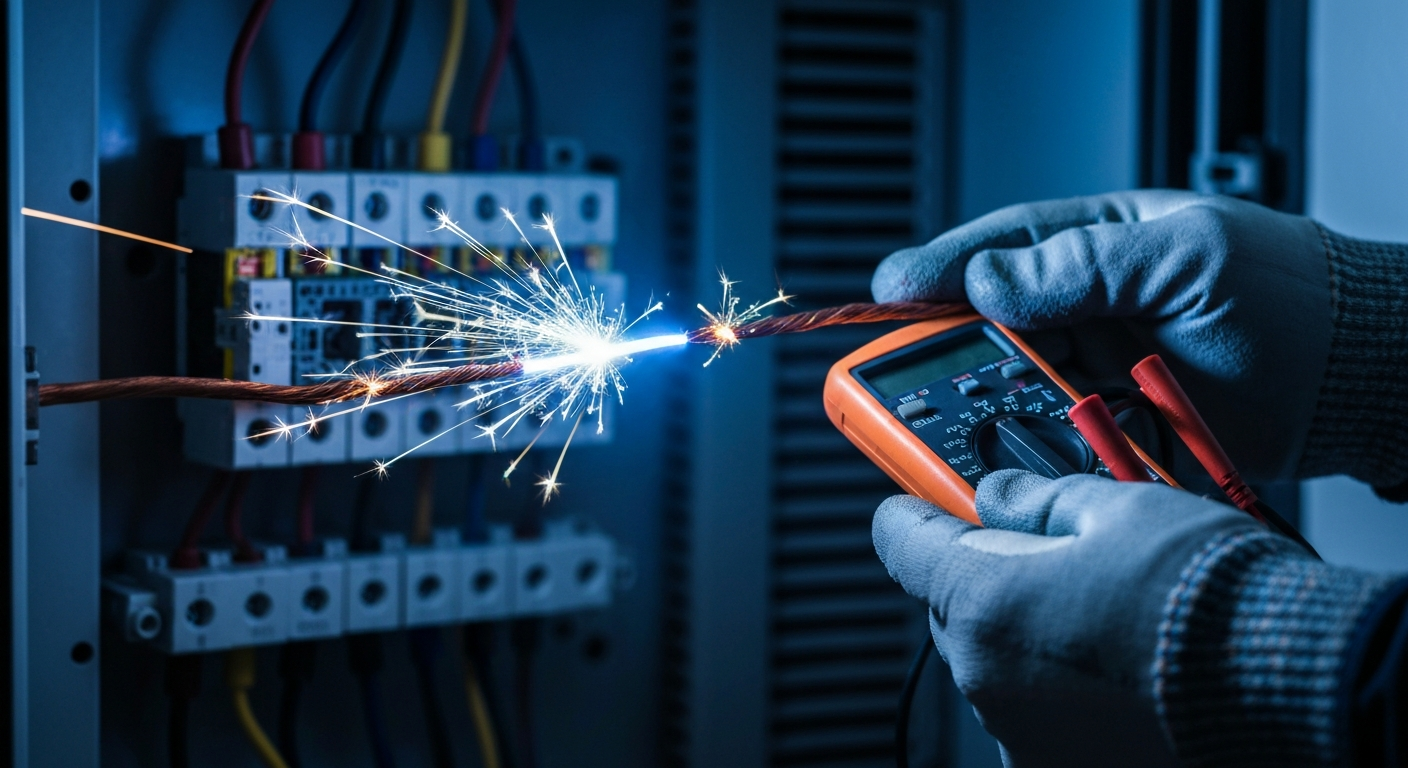
Understanding the Difference: Open Circuit vs. Short Circuit
Open Circuit vs. Short Circuit: A Diagnostic Guide for Electricians
In the field of circuit fault diagnostics, understanding the fundamental difference in an open circuit vs. short circuit is essential for any licensed electrician. An open circuit represents an interruption or break in the conductive path, which stops the electrical current from flowing entirely due to extremely high or infinite resistance. This results in a non-functional device or circuit segment. Conversely, a short circuit is an unintended, low-resistance pathway that allows an excessive amount of current, known as fault current, to flow, bypassing the intended load. This condition is what often causes a breaker keeps tripping, as overcurrent protection devices engage to prevent catastrophic failure, fire, or an arc fault. While an open circuit typically leads to a loss of function, a short circuit presents a significant safety hazard requiring immediate attention. Effective troubleshooting involves different strategies for each, from simple continuity testing for opens to advanced diagnostics for shorts.
What is an Open Circuit?
An open circuit is a path that has been interrupted, preventing the flow of electrical current. Think of it as a raised drawbridge; traffic (current) cannot cross because the path is incomplete. This condition can be intentional, like flipping a light switch to the “off” position, which creates a deliberate break in the circuit. However, when it’s unintentional, it’s a fault.
The key characteristic of an open circuit is its resistance, which is theoretically infinite. Because of this extremely high resistance, current cannot flow. This also means the full source voltage is present across the two points of the break.
Common Causes and Effects of Open Circuits
Unintentional open circuits are often the result of physical damage or degradation over time. Common causes include:
- A broken or severed wire.
- A loose connection at a terminal, wire nut, or splice point.
- A failed component, such as a burnt-out resistor or a blown fuse.
- A corroded or fatigued switch or contact.
The primary effect of an open circuit is straightforward: the circuit stops working. A lamp won’t light, a motor won’t run, and a receptacle will show no power. While not as immediately dangerous as a short circuit, an intermittent open or a poor connection can create hazardous arcing (a condition known as series arcing) as the connection makes and breaks. The requirement for secure connections is emphasized in NEC Article 110.12, which mandates that electrical equipment be installed in a neat and workmanlike manner.
What is a Short Circuit?
A short circuit is the opposite of an open circuit. It’s an abnormal, low-resistance connection between two points of different potential, such as between a hot and neutral conductor or a hot conductor and a ground path (a fault known as a short-to-ground). This unintended path allows the electrical current to bypass the circuit’s load, following the path of least resistance. This results in a massive surge of current, far exceeding the circuit’s design limits.
The primary danger of a short circuit is the immense heat it generates due to this high fault current. This can melt wire insulation, ignite surrounding materials, and cause fires or even explosions. The intense energy can also create a dangerous arc fault, where electricity violently jumps across an air gap, reaching extreme temperatures. This is precisely why overcurrent protection is a cornerstone of the NEC code book.
Common Causes and Dangers of Short Circuits
Short circuits are almost always caused by a failure of insulation or a wiring error. Common causes include:
- Damaged or deteriorated wire insulation from age, heat, or pests.
- Loose connections that allow conductors to touch.
- Punctured wire insulation from nails or screws.
- Conductive materials (like dust or water) creating a bridge between conductors.
- Faulty appliances or equipment with internal wiring failures.
The immediate result of a short circuit is often a loud pop, a bright flash, and a tripped circuit breaker or blown fuse. That’s a sign your protective devices are working as intended. For more about breaker behavior, explore our article on the inverse time circuit breaker and its trip curve. The hazard of loose connections is a critical point of workmanship addressed in NEC 110.12, as poor connections can overheat and lead to insulation failure, causing a short circuit.
Key Differences Summarized: Open Circuit vs. Short Circuit
| Characteristic | Open Circuit | Short Circuit |
|---|---|---|
| Resistance | Infinite or extremely high | Near-zero or very low |
| Current Flow | Zero or no flow | Extremely high (fault current) |
| Primary Indication | Device or circuit is dead/not working | A breaker keeps tripping; sparks, smoke, or melting |
| Primary Danger | Loss of function; potential for arcing in intermittent cases | Fire, explosion, equipment damage, electric shock |
| Voltage Reading | Full source voltage across the break | Near-zero voltage across the short |
Diagnosing Circuit Faults: Tools and Techniques for the Journeyman Electrician
Effective circuit fault diagnostics require a systematic approach and the right tools. Whether you’re dealing with an open or a short, the first step is always safety.
Basic Troubleshooting with a Multimeter
A digital multimeter is the most fundamental tool for diagnosing both open and short circuits. One of the most common procedures is continuity testing, which verifies if a complete electrical path exists.
- Practice Safe Circuit Isolation: Before testing, turn off the circuit breaker supplying power to the area. Use a lockout/tagout (LOTO) procedure to ensure it cannot be re-energized accidentally. Verify the circuit is dead with a voltage tester.
- Set Your Multimeter: Switch your multimeter to the continuity or resistance (Ω) setting. Most meters have an audible beep for continuity.
- Test the Meter: Touch the two meter probes together. The meter should beep and display a resistance value close to zero, confirming it’s working correctly.
- Test the Conductor: Place one probe at each end of the wire or circuit path you are testing.
-
Interpret the Results:
- A beep and a low resistance reading (near 0 Ω) indicate good continuity. The path is complete.
- No beep and a reading of “OL” (Over Limit) or infinity indicates an open circuit—there is a break in the path.
- If testing between a hot and neutral/ground conductor on an isolated and de-energized circuit with no loads connected, a continuity beep indicates a short circuit.
Ready to master this essential skill? Learn to find these faults by testing for continuity with a multimeter. ExpertCE offers a variety of online electrical courses to sharpen your troubleshooting abilities.
Advanced Diagnostic Tools for Complex Faults
For faults that are not immediately obvious, a journeyman electrician relies on more advanced tools:
- Circuit Tracer: Also known as a “toner,” a circuit tracer is invaluable for finding the physical location of a wire and pinpointing the exact spot of an open or short within walls, ceilings, or underground. It consists of a transmitter that sends a signal down the wire and a receiver that audibly detects it.
- Megohmmeter: Often called a Megger, a megohmmeter is used to perform insulation resistance testing. By applying a high DC voltage, it can detect weaknesses in wire insulation that could lead to a future short-to-ground or phase-to-phase fault, long before they become catastrophic.
- Thermal Imaging: A thermal camera can instantly spot hotspots caused by a high-resistance connection (like a poor connection) or an overloaded circuit. This allows for proactive repairs before a failure occurs.
The Role of the NEC and Protective Devices
The entire framework of electrical safety, as outlined in the NEC code book (NFPA 70), is built around mitigating the dangers of overcurrent. Article 240 of the NEC is dedicated to overcurrent protection, mandating the use of fuses and circuit breakers to protect conductors and equipment from excessive heat and fire hazards caused by overloads and short circuits. Understanding these protective devices is key. For example, some faults occur in series vs parallel circuit configurations, which can affect how they are diagnosed.
Understanding Breakers and Fuses
Standard circuit breakers operate based on a specific circuit breaker trip curve, which dictates how quickly they will open based on the magnitude of the overcurrent (a characteristic defined by standards like UL 489). However, some dangerous conditions don’t draw enough current to trip a standard breaker. This is where specialized devices come in:
- Arc Fault Circuit Breaker (AFCI): An AFCI is specifically designed to detect the unique electrical signatures of a dangerous arc fault—a condition that might not trip a standard breaker. AFCIs are critical for preventing fires started by arcing in damaged wires or loose connections.
- Ground Fault Circuit Interrupter (GFCI): A GFCI provides protection against electric shock from a ground fault, where current finds an unintended path to ground. It does this by sensing an imbalance between the hot and neutral conductors. You can learn more by reading our guide on troubleshooting tripping GFCI/AFCI breakers.
Key Takeaways for Electrical Troubleshooting
- Always prioritize safety with proper circuit isolation and LOTO procedures before any hands-on testing.
- An open circuit stops current flow (infinite resistance); a short circuit causes extreme current flow (near-zero resistance).
- A tripped breaker is a symptom, not the root problem. The cause is typically a short circuit or an overload.
- Insulation resistance testing with a megohmmeter is a critical preventative maintenance step to identify deteriorating wiring.
- Proficiency in electrical schematic analysis is fundamental to efficient circuit fault diagnostics, especially in complex systems.
Frequently Asked Questions (FAQ)
- What’s the main difference in an open circuit vs short circuit?
- The primary difference is resistance and current flow. An open circuit has an infinite resistance and no current flow, causing the circuit to fail. A short circuit has near-zero resistance and causes an extremely high current flow, leading to overheating and tripping protective devices.
- Can a short circuit fix itself?
- No. A short circuit is caused by a physical problem like damaged insulation or a loose wire. While the symptom (a tripped breaker) can be temporarily reset, the underlying fault must be located and repaired to prevent it from recurring and to eliminate the fire hazard.
- Is an open circuit dangerous?
- Generally, a complete open circuit is not immediately dangerous as it de-energizes the circuit. However, an intermittent open or a poor connection can be hazardous, creating heat and arcing each time the connection is momentarily made, which is a significant fire risk.
- Why does my breaker keep tripping instantly?
- An instantly tripping breaker is a classic sign of a direct short circuit. This creates a massive fault current that the breaker interrupts immediately to prevent catastrophic damage. This is different from a slow trip, which usually indicates a sustained overload.
- What is the difference between an arc fault and a short circuit?
- An arc fault is a specific type of fault where electricity jumps across an air gap between two conductors, often due to loose or corroded wiring. A short circuit is a broader term for any low-resistance path. While a powerful arc can become a short circuit, many dangerous arcing conditions don’t draw enough current to trip a standard breaker, requiring an arc fault circuit breaker (AFCI) for detection.
Primary Sources
- NFPA 70, National Electrical Code (NEC), 2023 Edition
- UL 489, Standard for Molded-Case Circuit Breakers, Molded-Case Switches, and Circuit-Breaker Enclosures
Continuing Education by State
Select your state to view board-approved continuing education courses and requirements:

Disclaimer: The information provided in this educational content has been prepared with care to reflect current regulatory requirements for continuing education. However, licensing rules and regulations can vary by state and are subject to change. While we strive for accuracy, ExpertCE cannot guarantee that all details are complete or up to date at the time of reading. For the most current and authoritative information, always refer directly to your state’s official licensing board or regulatory agency.
NEC®, NFPA 70E®, NFPA 70®, and National Electrical Code® are registered trademarks of the National Fire Protection Association® (NFPA®)
You may also like

Colorado Electrical Licensing Requirements and Reciprocity Guide

Standby Generators in DE: Navigating Coastal Storm Regulations

 Login with Google