
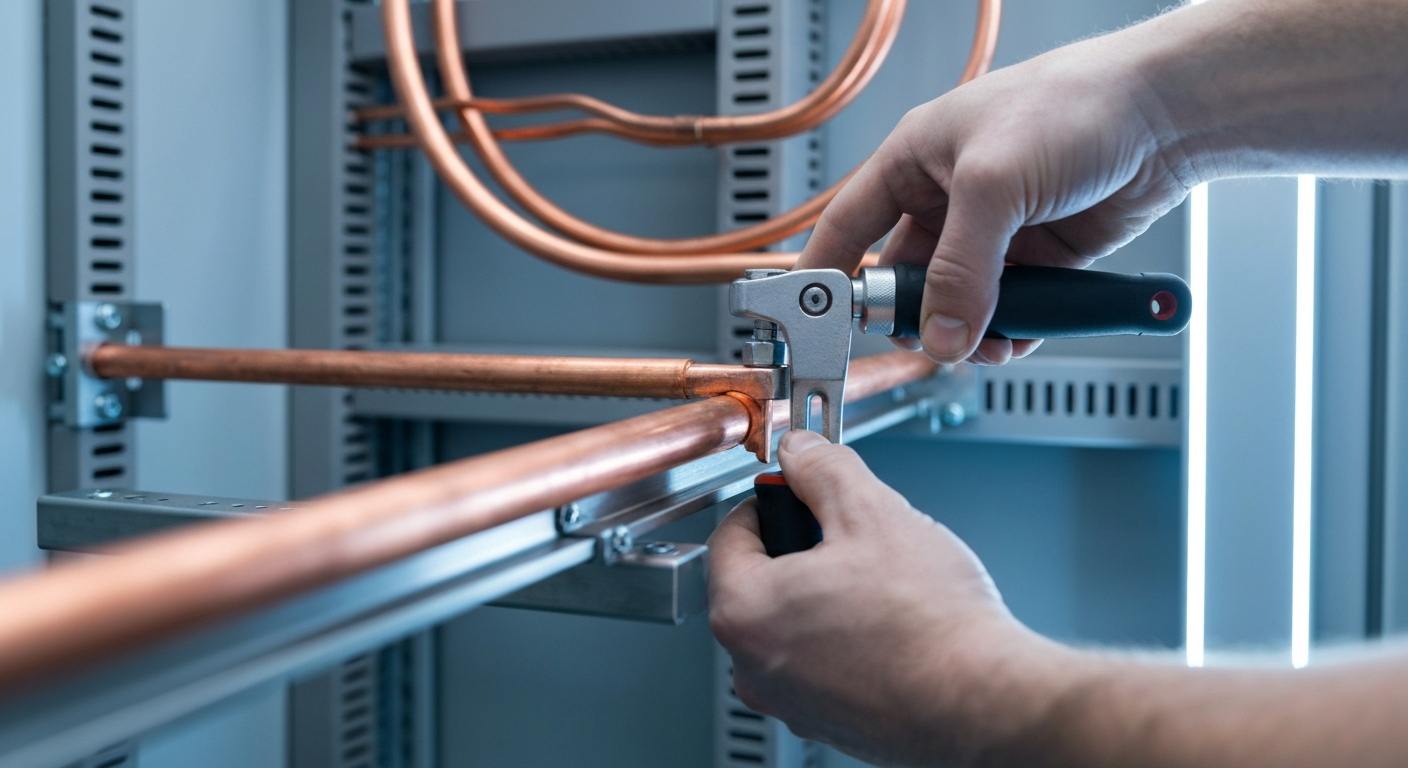
Using NEC Table 250.102(C)(1) for Supply-Side Bonding Jumpers
Using NEC Table 250.102(C)(1) for Sizing Supply-Side Bonding Jumpers
Properly sizing supply-side bonding jumpers is a fundamental requirement of a safe electrical installation, and for this, electricians turn to the National Electrical Code (NEC). NEC Table 250.102(C)(1) is the authoritative reference for these calculations, ensuring a low-impedance effective ground-fault current path. Sizing is based on the size of the ungrounded conductor or the equivalent area for parallel conductors. This table is crucial for any journeyman electrician or master electrician, as it governs the sizing for the grounded conductor, main bonding jumper, system bonding jumper, and supply-side bonding jumper. Understanding the difference between these components, such as the main bonding jumper vs. system bonding jumper, and their correct sizing is a core competency that prevents equipment damage and, more importantly, protects lives. This knowledge is a key part of any professional electrician training program and is essential for code compliance.
What is Bonding? The Foundation of Electrical Safety
Before diving into the specifics of the table, it’s vital to understand the core concept: bonding what is it? In simple terms, bonding is the act of connecting all non-current-carrying metallic components of an electrical system together. The goal, as outlined in NEC Article 250 requirements, is to create an uninterrupted, low-impedance path for fault current to travel back to its source. This path is known as the effective ground-fault current path. If a fault occurs, this path allows a massive amount of current to flow, which trips the overcurrent protective device (like a circuit breaker) and de-energizes the circuit. Without proper bonding, fault current could energize metal enclosures, raceways, and equipment, creating a severe shock hazard. Bonding ensures electrical continuity and conductivity among all these parts. It’s important not to confuse this with grounding. While closely related, grounding and bonding serve different primary purposes.
The Critical Role of the Supply-Side Bonding Jumper
A supply-side bonding jumper (SSBJ) is a conductor installed on the supply side of a service disconnect. Its job is to connect metallic parts—like conduits or enclosures—before the main protective device so they are all effectively bonded together and to the grounded service conductor. This jumper is distinct from other components:
- Main Bonding Jumper (MBJ): A connection at the service disconnect that bonds the equipment grounding conductor bus to the grounded conductor (neutral) bus.
- System Bonding Jumper (SBJ): Performs a similar function to the MBJ but is used for separately derived systems, like a transformer.
- Equipment Grounding Conductor (EGC): A conductor that runs with the circuit conductors on the load side of the overcurrent device to bond non-current-carrying metal parts of equipment. EGCs are sized using NEC Table 250.122, not 250.102(C)(1).
- Grounding Electrode Conductor (GEC): This conductor connects the grounded service conductor, equipment, and service enclosure to the grounding electrode system (e.g., a grounding rod). A GEC is sized according to NEC Table 250.66 and is not intended to carry fault current, unlike a bonding jumper.
The SSBJ is critical because it is installed on the line side of service protection, where there is no overcurrent device to limit the magnitude of a potential fault. It must be sized and installed so it will perform reliably for the available fault currents shown for that service configuration.
How to Perform NEC 250.102(C)(1) Calculations
Sizing a supply-side bonding jumper using the table is a straightforward process that every electrician must master. The size of the jumper is directly related to the size of the ungrounded service entrance conductors. The larger the service conductors, the larger the potential fault current, and therefore, the larger the required bonding jumper.
- Determine the Size of the Largest Ungrounded Conductor: Identify the size of the ungrounded conductors supplying the service. If the conductors are in parallel, you must calculate the total circular mil area per phase.
- Reference NEC Table 250.102(C)(1): Locate the row in the table that corresponds to your ungrounded conductor size or the equivalent circular-mil area for parallel sets.
- Select the Minimum Bonding Jumper Size: The appropriate column in the table provides the minimum size required for the bonding jumper and related supply-side conductors. Always verify the value directly in the NEC table for the exact row and conductor material (copper vs. aluminum).
Practical note: Because NEC tables are precise and may include notes and exceptions, always read the entire table and accompanying notes before choosing a final conductor size. Do not rely on memory for exact conductor-size mappings; consult the table on-site or in the NEC reference.
Beyond the Table: The 12.5 Percent Rule NEC
What happens when the service conductors are larger than what’s listed in the table? Note 1 to Table 250.102(C)(1) provides the answer with what is commonly known as the “12.5 percent rule NEC“.
If the total equivalent area of the ungrounded supply conductors in parallel exceeds the table’s maximum equivalent area (the table notes use 1100 kcmil for copper and 1750 kcmil for aluminum as thresholds), the supply-side bonding jumper must have a cross-sectional area of at least 12.5% of that total equivalent area. This rule ensures that for very large services, the bonding jumper scales appropriately to handle massive fault currents.
Example Calculation (illustrative): For four parallel 600 kcmil copper conductors per phase the total equivalent area is 4 × 600 = 2400 kcmil. Because that total exceeds the threshold in the table notes, apply the 12.5% rule: 2400 × 0.125 = 300 kcmil required minimum area. Select a standard conductor size that meets or exceeds that computed area. Always confirm the final conductor size with the NEC table, chapter-9 conductor properties, and the authority having jurisdiction.
Important Considerations for Installation
Correctly sizing the conductor is only half the battle. Proper installation is just as critical for creating a reliable safety system. It is widely accepted in the industry that many power-quality and safety issues on the customer side result from installation practices, so meticulous work is required on the customer’s side of the meter.
- Parallel Installations: Per NEC 250.102(C)(2), if you have parallel runs in multiple raceways, you can either install an individual bonding jumper in each raceway sized to the conductors in that specific raceway, or install a single common bonding jumper sized for the total equivalent area of the parallel conductors.
- Material and Method: Bonding jumpers must be made of copper, aluminum, or other corrosion-resistant material permitted by the NEC and installed using approved methods such as listed pressure connectors, terminal bars, exothermic welds, or other recognized connections described in NEC 250.8.
- Distinguishing from Load-Side Bonding: Never confuse supply-side requirements with load-side bonding. Bonding jumpers on the load side of a breaker are sized differently — EGCs are sized using NEC Table 250.122.
- Grounded Conductor Sizing: NEC Table 250.102(C)(1) also identifies appropriate sizes for the grounded conductor on the supply side. For grounding electrode conductors, Table 250.66 is the reference.
Primary Sources
- NFPA 70, National Electrical Code (NEC), 2023 Edition
- Industry guidance and technical articles from recognized training providers and manufacturers
Frequently Asked Questions (FAQ)
- What is the primary purpose of NEC Table 250.102(C)(1)?
- The primary purpose of NEC Table 250.102(C)(1) is for sizing supply-side bonding jumpers, main bonding jumpers, system bonding jumpers, and grounded conductors for AC systems. Sizing is based on the size of the ungrounded service conductors to ensure the jumper can handle potential fault current. Always consult the table directly for the exact size mapping.
- When do I use the 12.5 percent rule NEC instead of Table 250.102(C)(1)?
- You must use the 12.5 percent rule NEC when the total equivalent area of ungrounded conductors in parallel exceeds the table’s threshold (the table note uses the 1100 kcmil copper and 1750 kcmil aluminum thresholds). For these very large services, the bonding jumper must have an area of not less than 12.5% of the equivalent area of the ungrounded conductors; then select a standard conductor size that meets that area.
- Can I use Table 250.102(C)(1) to size an Equipment Grounding Conductor (EGC)?
- No. An Equipment Grounding Conductor (EGC) is on the load side of an overcurrent device and must be sized according to NEC Table 250.122. Table 250.102(C)(1) is for supply-side conductors where the potential fault currents are larger because there is no overcurrent device on the supply side.
- How are NEC 250.102(C)(1) calculations different for parallel conductor installations?
- For parallel conductor installations, you have two options per NEC: install one bonding jumper in each raceway sized to the largest conductor in that raceway, or use a single common bonding jumper sized based on the sum of the circular-mil areas of the parallel conductors. If that total area exceeds the table’s limits, the 12.5% rule applies. Always document the method you used and keep calculations available for the authority having jurisdiction.
Continuing Education by State
Select your state to view board-approved continuing education courses and requirements:

Disclaimer: The information provided in this educational content has been prepared with care to reflect current regulatory requirements for continuing education. However, licensing rules and regulations can vary by state and are subject to change. While we strive for accuracy, ExpertCE cannot guarantee that all details are complete or up to date at the time of reading. For the most current and authoritative information, always refer directly to your state’s official licensing board or regulatory agency.
NEC®, NFPA 70E®, NFPA 70®, and National Electrical Code® are registered trademarks of the National Fire Protection Association® (NFPA®)
You may also like

Colorado Electrical Licensing Requirements and Reciprocity Guide
Standby Generators in DE: Navigating Coastal Storm Regulations

 Login with Google