
NEC 705 Explained: Interconnecting Power Production Sources
NEC 705 Explained: Interconnecting Power Production Sources
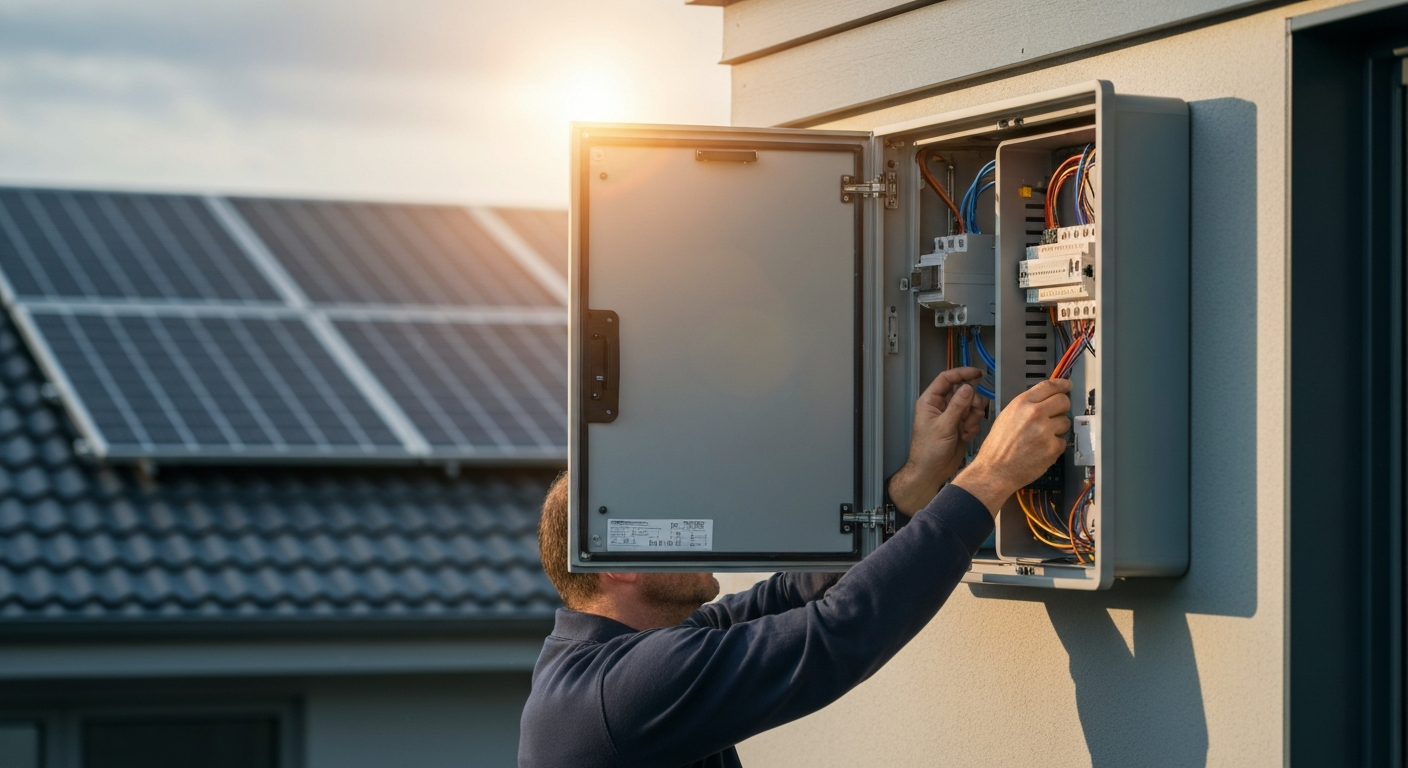
An electrician installing a solar panel system on a residential roof with the breaker panel visible.
The rules for a compliant nec 705 interconnection govern how power production sources like solar, wind, and generators can safely operate in parallel with the electric utility grid. As the demand for renewable energy and backup power grows, Article 705 of the National Electrical Code (NEC) has become one of the most critical sections for any master electrician or journeyman electrician to master. It primarily outlines two methods for connection: NEC 705.11 supply-side connections, made before the main service disconnect, and NEC 705.12 load-side connections, which are made at the breaker panel. Understanding these, along with modern solutions like Power Control Systems (PCS) (a type of Energy Management System, see below) and the proper use of a transfer switch for a generator, is essential for safety, compliance, and system efficiency. Recent updates to the nec code book have further clarified these rules to accommodate new technologies and improve safety protocols.
The Growing Need for Interconnection Expertise
The electrical landscape is rapidly changing. Driven by a push for decarbonization and grid resilience, the adoption of Distributed Energy Resources (DERs) like rooftop solar and battery storage is surging. This has led to a steep increase in the number of requests to interconnect new power sources to the grid. For licensed electricians, this trend represents a significant opportunity, but it also demands a deep understanding of the governing codes. A home with a new solar powered generator for home or a commercial building with a large standby generator both fall under the rules of NEC Article 705 (and related articles). Proper interconnection prevents dangerous back-feeding onto the grid, protects utility workers, and ensures the safety and stability of the customer’s electrical system.
What is NEC Article 705? A Foundation for Safe Interconnection
NEC Article 705 provides the essential requirements for the installation of electric power production sources that operate in parallel operation with a primary power source, typically the utility grid. Whether you’re installing a small residential PV system or a large commercial generator, this article is your guide. As any professional knows, the official nec code book is the ultimate source of truth, and staying current with its latest edition is non-negotiable. For a deeper dive into navigating the latest code, our article on how to navigate the 2023 NEC code book is an excellent resource. These rules ensure that all interconnections are performed safely, preventing hazards like overloaded conductors and equipment failure.
The Two Main Points of Connection: Supply-Side vs. Load-Side
Article 705 establishes two primary locations for making an interconnection: on the supply side or the load side of the main service disconnecting means. The choice between these methods depends on the size of the power source, the capacity of the existing electrical service, and site-specific conditions.
NEC 705.11: Supply-Side Connections Explained
A supply-side connection, as detailed in NEC 705.11 supply-side connections, involves tapping into the conductors between the utility meter and the main service disconnect or another approved supply-side point. This method is often chosen for larger PV systems because the 705.12 busbar calculations that govern load-side connections do not directly apply; however, supply-side connections are still governed by 705.11 and Article 230 and require properly sized conductors, overcurrent protection, equipment evaluation, grounding, and usually utility approval. The conductors used for these feeder taps must be sized appropriately and protected by their own overcurrent device as required by the Code. Furthermore, these connections directly involve the service entrance conductors, a critical component of the electrical system that demands careful work. You can review the specifics of these components in our guide to service entrance conductors.
NEC 705.12: Load-Side Connections and the “120%” Options
The more common method for residential systems is the NEC 705.12 load-side connections, where the power source is connected to a dedicated breaker in the main breaker panel. NEC provides several methods for determining whether the installed sources and overcurrent devices are acceptable for connection to panel busbars. The basic (conservative) check requires that the rating of the overcurrent device protecting the busbar plus 125% of the power-source output circuit current does not exceed the busbar ampacity. NEC also provides permissive options (used under defined conditions) that allow alternate comparisons to 120% of the busbar ampacity when the panel and source locations meet the conditions in 705.12 (for example, when sources are located at opposite ends of the busbar or for certain center-fed panels). Which method applies depends on the specific panel configuration and the options listed in 705.12; you must determine the correct method before calculating available capacity.
How to Approach the Panel Limit Options (High Level)
- Identify Applicable 705.12 Method: Determine whether the standard busbar check or one of the permissive options applies for the specific panel configuration.
- Standard (Conservative) Check: Ensure the rating of the device protecting the busbar plus 125% of the inverter output does not exceed the busbar ampacity. In many single-main-panel situations that means no additional inverter capacity is allowed unless other options are used.
- Permissive 120% Option (Conditional): If the conditions for an allowed 120% comparison are met (see NEC 705.12 for the specific configurations), you may multiply the busbar rating by 1.20, subtract the rating of the overcurrent device protecting the busbar, and divide the remainder by 1.25 to estimate the maximum continuous inverter output allowed under that permissive method. This calculation only applies where the code explicitly permits the 120% approach for the given equipment arrangement.
If the allowed capacity under the applicable method does not permit the desired inverter size, a supply-side connection, a listed solution, a power control (EMS) strategy, or a service upgrade are common alternatives. Navigating these overcurrent protection requirements is a core skill; you can sharpen your knowledge by reviewing how the 2023 NEC simplifies overcurrent protection.
Essential Equipment and Modern Solutions in NEC 705
Beyond the connection point, specific equipment is required to ensure a safe and compliant system. The 2023 NEC has expanded on these requirements, particularly for transfer equipment and intelligent power management.
Transfer Switches and Interlock Kits
For systems intended to provide backup power during an outage, like a standby generator, a means to disconnect the power production source from the utility is required to prevent dangerous backfeed. A transfer switch for a generator is a device that transfers the electrical load from the utility to the generator, physically preventing simultaneous connection to the grid. An alternative is a generator interlock kit, a mechanical device that prevents the main breaker and the generator breaker from being on at the same time. While often more affordable, an interlock kit requires manual operation and must be installed per the manufacturer’s listing and the Authority Having Jurisdiction’s requirements. In all cases, using listed and labeled equipment that meets safety standards (for example, UL 1741 for inverter/interconnection equipment) and complying with the NEC requirements is fundamental. For more details, explore our lesson on how the NEC updates interconnection and transfer equipment requirements.
Power Control Systems (PCS) — The Smart Evolution
NEC 705.13 addresses Energy Management Systems (EMS). A listed power control system (often called a PCS) is one type of EMS. These systems can actively monitor power flow and, when listed or field-evaluated for the intended application, limit inverter or storage output in real time to prevent exceeding bus or conductor limits. When properly listed/field-evaluated and installed in accordance with NEC requirements, EMS/PCS offer a flexible, code-compliant alternative to some panel modifications or service upgrades.
Advanced Topics: Microgrids, Island Mode, and System Protection
As interconnection technology evolves, the NEC continues to adapt by addressing more complex systems and the standards that govern them.
Microgrid Systems and Island Mode
The 2023 NEC provides expanded guidance for microgrid systems. A microgrid is a local energy grid with control capability, which means it can disconnect from the traditional grid and operate autonomously in what is known as island mode. These systems must comply with interoperability and interconnection standards such as IEEE 1547 and the NEC provisions that address interactive and multimode equipment.
Key Takeaways for the Professional Electrician
- Always Verify the Point of Connection: Determine whether a supply-side (705.11) or load-side (705.12) connection is more appropriate for the project based on system size, equipment listing, and existing service equipment.
- Master the Busbar Options (including the “120%” permissive methods): For load-side connections, understand which 705.12 method applies so you can accurately calculate allowable back-fed breaker size or determine whether alternative solutions (supply-side tap, EMS/PCS, or service upgrade) are needed.
- Use Listed and Labeled Equipment: Ensure all inverters, transfer switches, and controllers are certified to relevant standards (for example, UL 1741 for inverters/interactive equipment) or are field-evaluated and labeled per NEC 705.6.
- Understand EMS/PCS: Recognize that an EMS/PCS (a listed power control system or equivalent field evaluation) permitted by 705.13 can be used to manage bus and conductor loading in many installations.
- Prioritize Ground-Fault Protection: Ground-fault protection of equipment and the correct location of connections relative to ground-fault protection are governed by NEC (see 705.32 and related sections); ensure proper protection to mitigate shock hazards.
- Identify the Disconnecting Means: A readily accessible disconnect or disconnecting means is required for power production sources at the point of connection; follow the NEC requirements for type, accessibility, and marking.
Understanding these rules is non-negotiable for a modern electrician. For those looking to deepen their expertise through structured online electrical courses, we invite you to explore our comprehensive training. Master the critical link between PV and the grid. Study NEC 705 with us.
Primary Sources
This article is based on the requirements found in the National Electrical Code (NFPA 70), with technical context from industry standards (for example, IEEE 1547 and UL 1741) and the NEC itself. For official code language, always refer to the latest edition published by the National Fire Protection Association (NFPA).
Frequently Asked Questions about NEC 705 Interconnection
What is the main difference between NEC 705.11 supply-side connections and 705.12 load-side connections?
A NEC 705.11 supply-side connection is made to the service conductors between the utility meter and the main service disconnect or to another approved supply-side point. It is not controlled by the 705.12 load-side busbar calculations, but it must meet the requirements of 705.11 and Article 230 (conductor sizing, overcurrent protection, grounding, labeling, and usually utility coordination). A NEC 705.12 load-side connection is made via a breaker inside the main breaker panel and is subject to the busbar check methods described in 705.12 (the basic 125% + rating comparison or the permissive 120% options under specified conditions).
Can I use a generator interlock kit instead of a transfer switch for a standby generator?
Yes, in many cases, a generator interlock kit is a permitted alternative to a transfer switch for a generator for manual transfer installations, provided the interlock is installed per the manufacturer’s instructions, the equipment is suitable for the application, and the installation meets the Authority Having Jurisdiction’s requirements. Transfers intended to be automatic or that are meter-side mounted have additional listing and application requirements; always use listed equipment when required by the NEC and local rules.
How do Power Control Systems (PCS) change the rules for a nec 705 interconnection?
Power Control Systems (PCS) functionality is addressed in NEC 705.13 under Energy Management Systems (EMS). A listed PCS (a type of EMS) can actively monitor conductor and busbar loading and limit the output of a power production source in real time. When the EMS/PCS is listed or field-evaluated for the application and installed in compliance with NEC equipment requirements, it may be used as an approved means to avoid exceeding busbar ampacity or trigger other protective measures, potentially allowing larger on-site generation without a service upgrade. Always confirm the listing/field evaluation, labeling, and limitations for the specific EMS/PCS in use.
Continuing Education by State
Select your state to view board-approved continuing education courses and requirements:

Disclaimer: The information provided in this educational content has been prepared with care to reflect current regulatory requirements for continuing education. However, licensing rules and regulations can vary by state and are subject to change. While we strive for accuracy, ExpertCE cannot guarantee that all details are complete or up to date at the time of reading. For the most current and authoritative information, always refer directly to your state’s official licensing board or regulatory agency.
NEC®, NFPA 70E®, NFPA 70®, and National Electrical Code® are registered trademarks of the National Fire Protection Association® (NFPA®)
You may also like

Colorado Electrical Licensing Requirements and Reciprocity Guide
Standby Generators in DE: Navigating Coastal Storm Regulations

 Login with Google