
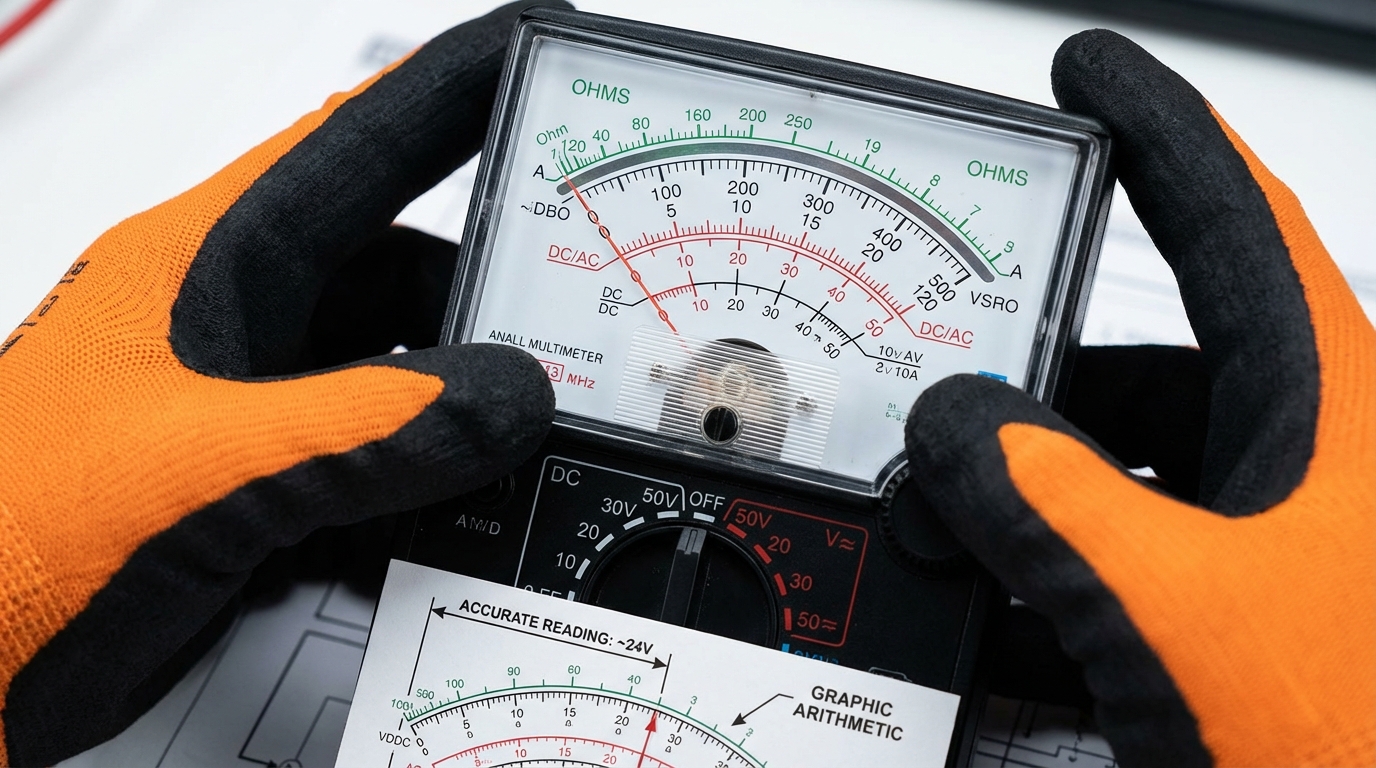
How to Read Scales and Dials for Graphic Arithmetic Questions
Mastering Measurement: How to Read Scales and Dials for Graphic Arithmetic Questions
Effectively knowing how to read scales and dials is a fundamental skill that separates novice technicians from seasoned professionals. For both a journeyman electrician and master electrician, this proficiency is crucial for accurate diagnostics, ensuring safety, and passing certification exams. While digital meters are now standard, a deep understanding of analog multimeter interpretation remains vital for troubleshooting dynamic electrical systems where observing trends is key. This skill extends beyond simple voltage checks to complex tasks like performing a transformer load calculation, interpreting a wire ampacity chart, and conducting insulation resistance testing. Mastering electrical dial reading proficiency is a cornerstone of electrician training and a key component of Journeyman electrician exam prep, ensuring you can solve graphic arithmetic questions with speed and accuracy.
The Enduring Importance of Analog Skills in a Digital World
The electrical industry has largely embraced digital multimeters (DMMs) for their precision and ease of use. However, the ability to read an analog meter is far from obsolete. This skill, often covered in NCCER curriculum and electrician training programs, remains a critical competency for several reasons. For experienced electricians engaged in analog meter troubleshooting, the smooth swing of a needle can reveal voltage sags, current spikes, or signal fluctuations more intuitively than a rapidly changing digital display. This real-time feedback is invaluable when diagnosing intermittent problems in motors or control circuits.
Furthermore, certain diagnostic tools, most notably the megohmmeter, still rely on analog dials. Correctly performing insulation resistance testing requires precise megohmmeter reading to assess the integrity of motor windings or cable insulation. For apprentices and those preparing for exams, learning to read scales builds a foundational understanding of electrical principles that digital “auto-ranging” meters can sometimes obscure. It forces a deeper engagement with the concepts of voltage, current, and resistance.
A Step-by-Step Guide to Analog Multimeter Interpretation
Reading an analog multimeter accurately is a systematic process. Rushing this process or skipping a step is a common source of errors, both in the field and on an exam. Developing a repeatable method for electrical dial reading proficiency is essential.
- Select the Correct Function and Range: Before connecting the leads, first turn the rotary dial to the correct function: VAC (Volts AC), VDC (Volts DC), Ohms (Ω), or mA (milliamps). Then, select a range that is higher than the maximum expected reading. For example, if you expect to measure around 90V, choose the 250V range, not the 50V range. This protects the meter’s delicate movement from damage.
- Identify the Corresponding Scale: Look at the meter’s face. There will be multiple arcs of numbers. These scales correspond directly to the function and range you selected on the dial. A common setup includes separate scales for resistance, DC voltage/current, and AC voltage. For example, if you set the dial to 250 VAC, you must find the scale on the face that ends in “250”.
- Determine the Value of Each Division: This is the core of graphic arithmetic for electricians. Look at the major numbered markings on the correct scale. Count the number of smaller, unnumbered lines between two major markings. Divide the difference between the major markings by the number of intervals. For example, on a 0-50V scale, between the “30” and “40” mark, there might be 4 small lines, creating 5 intervals. The difference is 10V (40 – 30), so each interval represents 10V / 5 = 2V.
- Read the Needle’s Position and Calculate the Value: Observe where the needle has settled. Identify the last major marking it passed and count the number of small divisions beyond it. Multiply the number of divisions by the value you calculated in the previous step and add it to the major marking’s value. If the needle is three intervals past 30V in our example, the reading is 30V + (3 * 2V) = 36V.
- Factor in the Range Multiplier (If Applicable): Some ranges, particularly for resistance, require you to multiply the scale reading by a factor (e.g., x1, x100, x1k). Always check the range selector dial to see if a multiplier applies to your measurement.
Common Pitfalls in Reading Dials
Even experienced technicians can make mistakes. When performing analog meter troubleshooting or facing exam questions, be wary of parallax error—viewing the needle from an angle, which skews the reading. Always look at the meter face directly. Another common mistake is reading the correct value from the wrong scale. Double-check that the scale you are using matches the function and range selected on the dial.
Applying Graphic Arithmetic Beyond the Multimeter
On Journeyman and Master electrician exam questions, “graphic arithmetic” often refers to more than just reading a meter. It encompasses a wider set of skills related to interpreting visual data, which is central to an electrician’s daily work. This includes electrical schematic analysis, where you must read and understand layouts, symbols, and wiring paths. Interpreting electrical diagrams, from complex control circuits to one-line power distribution plans, is a form of graphic arithmetic.
A classic example is using a wire ampacity chart from the NEC code book. This requires you to cross-reference multiple data points—such as ambient temperature, conductor type, and the number of current-carrying conductors—to arrive at a final ampacity value. This directly impacts NEC code compliance and safety. While many now use a digital voltage drop calculator, understanding the charts and formulas behind it is essential. For more complex problems, check out our guide to Journeyman electrician exam calculations.
Specialized Scales: The Megohmmeter and Protective Relays
Certain tests require proficiency with unique scales. A prime example is the megohmmeter, a critical tool for insulation resistance testing. Unlike a standard ohmmeter, a megohmmeter’s scale is non-linear, with markings compressed at the high-resistance (infinity) end. Determining the polarization index (PI), a key indicator of insulation health, involves taking a continuous reading and calculating the ratio of the insulation resistance at 10 minutes to the resistance at 1 minute, a standard defined in IEEE Std 43. To learn the full procedure, our detailed guide explains how to use a megohmmeter for reliable testing.
For a master electrician, advanced skills may be needed for protective relay testing. These devices have highly complex dials and settings that must be interpreted and calibrated precisely to protect expensive equipment from faults. This work demands the highest level of electrical dial reading proficiency and a deep understanding of power systems. In all these applications, regular electrical test equipment calibration is non-negotiable to ensure the readings you depend on are accurate.
Ready to master these skills for your exam? Sharpen your measurement skills with our focused practice modules. Explore our range of online electrical courses designed for professionals.
Key Considerations for Accuracy and Exam Success
Whether in the field or in an exam setting, accuracy is paramount. Keep these key takeaways in mind to improve your ability to read scales and dials correctly.
- Always Verify Zero: Before taking a resistance measurement with an analog meter, touch the leads together and use the “Zero Adjust” knob to align the needle perfectly with the “0” mark on the ohms scale.
- Understand the Exam Question: Master electrician exam questions are often multi-layered. Read the question carefully to determine if it’s asking for a direct reading, a calculated value based on a reading (e.g., using Ohm’s Law), or an interpretation related to NEC code compliance.
- Practice with Formulas: Many graphic-based questions combine a measurement with a calculation. Be fluent in essential electrical calculation formulas for power, voltage drop, and transformer load calculation.
- Code is King: While a meter gives you a value, the NEC code book gives you the standard. Your interpretation of a reading from a wire ampacity chart or other test must always lead to a decision that ensures NEC code compliance.
- Balance Your Skills: While analog proficiency is a valuable diagnostic skill, fluency with modern digital tools is just as important for efficiency and precision in the modern electrical trade.
Frequently Asked Questions (FAQ)
Why do I need to learn to read scales and dials when most tools are digital?
Learning to read scales and dials is essential for several reasons. It’s crucial for troubleshooting dynamic systems where a needle’s swing shows trends better than a digital display, for using specialized equipment like a megohmmeter for insulation resistance testing, and because it’s a core skill tested during Journeyman electrician exam prep.
What is the hardest part of Analog multimeter interpretation?
For most new users, the most challenging aspect is correctly identifying the proper scale on the meter’s face that corresponds to the selected function and range. Following that, accurately calculating the value of the small, unnumbered divisions between the major markings requires careful attention to detail.
How does reading a wire ampacity chart relate to graphic arithmetic?
Reading a wire ampacity chart is a key form of graphic arithmetic. It requires you to locate and cross-reference multiple data points on a table (a graphical format), such as temperature correction factors and conductor bundling adjustments, to determine the final allowable ampacity. This is a critical skill for electrical schematic analysis and ensuring NEC code compliance.
Are there specific Master electrician exam questions that focus on reading dials?
Yes, while journeyman exams focus on basic multimeter readings, Master electrician exam questions may present more complex scenarios. These can involve interpreting the sophisticated dials used in protective relay testing, calculating values from non-linear scales, or using a reading as the first step in a multi-part transformer load calculation problem.
Continuing Education by State
Select your state to view board-approved continuing education courses and requirements:

Disclaimer: The information provided in this educational content has been prepared with care to reflect current regulatory requirements for continuing education. However, licensing rules and regulations can vary by state and are subject to change. While we strive for accuracy, ExpertCE cannot guarantee that all details are complete or up to date at the time of reading. For the most current and authoritative information, always refer directly to your state’s official licensing board or regulatory agency.
NEC®, NFPA 70E®, NFPA 70®, and National Electrical Code® are registered trademarks of the National Fire Protection Association® (NFPA®)
You may also like

Colorado Electrical Licensing Requirements and Reciprocity Guide

Standby Generators in DE: Navigating Coastal Storm Regulations

 Login with Google