
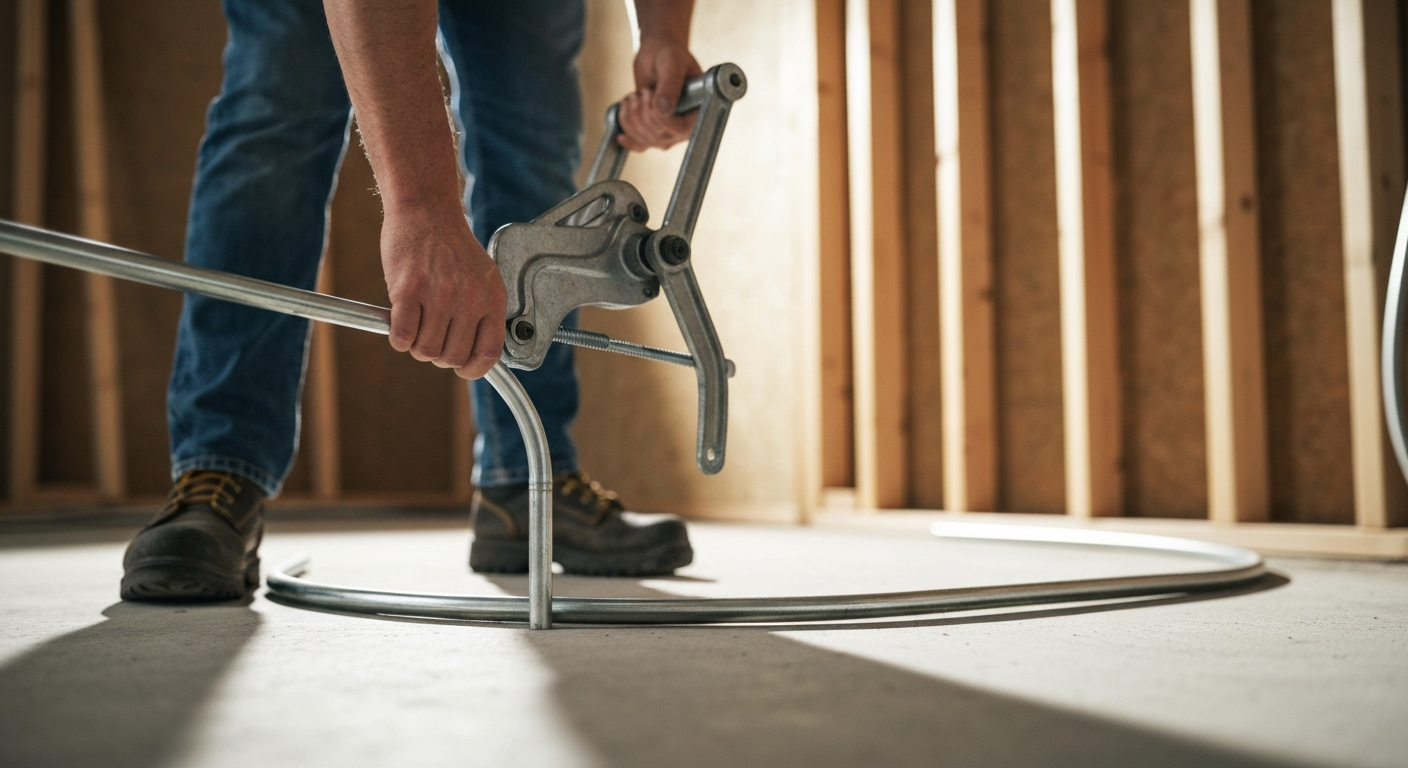
How to Make a 90-Degree Stub Bend with an EMT Bender
How to Make a 90-Degree Stub Bend with an EMT Bender
Learning how to bend EMT conduit is a fundamental skill for every professional in the electrical trade, from those in an electrician school to a licensed master electrician. The 90-degree stub-up is the most common bend you will make, used to turn a conduit run vertically up a wall or into an enclosure. Mastering this bend requires understanding the simple but critical concept of “take-up.” To perform the bend, you must calculate the correct starting point by subtracting the bender’s “take-up” measurement (also called the deduct) from your desired stub-up height. This ensures the front of the bend lands precisely at your target. Using a quality EMT conduit bender and marking the conduit accurately are key to creating clean, professional installations that meet NEC code book standards and avoid costly material waste.
The Essential Tools and Terminology for Bending EMT Conduit
Before making your first bend, it’s crucial to gather the right tools and understand the language of conduit bending. This foundational knowledge, a core part of any serious electrician training program, prevents common errors and ensures precise, repeatable results on the job site.
Your Bending Toolkit
A professional job starts with professional tools. Here’s what you’ll need:
- EMT Conduit Bender: This is your primary tool. The head of the bender, or conduit shoe, is specifically shaped to bend a certain size of EMT without deforming it. Ensure your bender matches the diameter of the EMT conduit you are working with.
- Tape Measure: Accuracy is non-negotiable. A reliable tape measure is essential for all measurements.
- Marker or Pencil: For making clear, precise bending marks on the conduit.
- Level: A torpedo level is perfect for verifying that your stub-up is perfectly plumb (vertical) and your 90-degree bend is accurate.
- Conduit Reamer: A critical safety tool used to deburr the inside and outside edge of cut conduit, preventing wire insulation from being stripped during a pull. This is a requirement for a code-compliant installation.
Understanding Key Bending Terms
The numbers and symbols on your bender aren’t just for decoration. They are a roadmap to a perfect bend. Here are the terms every journeyman electrician must know:
- Take-Up (Deduct): This is the most important concept for a 90-degree bend. It is the fixed amount of conduit that is “used up” by the bender to create the radius of the bend. To find your starting mark, you subtract this value from your desired stub length. The take-up value is typically stamped on the EMT conduit bender itself and varies by bender size and manufacturer (e.g., 5″ for 1/2″ EMT, 6″ for 3/4″ EMT).
- Center of Bend: Often marked with a star or notch on the bender shoe, this mark helps locate the center of a 45-degree bend, which is essential for creating an offset bend or a saddle bend.
- Gain on Bend: Because conduit bends in an arc, the total length of conduit required for a 90-degree corner is actually less than the sum of the two straight measurements (A + B). This “saved” length is the gain. Understanding gain on bend is critical for complex layouts and back to back bend scenarios.
- Springback: Metal has memory. After you bend conduit to 90 degrees and release pressure, it will slightly “spring back” to a lesser angle (e.g., 88 or 89 degrees). To compensate, you must bend the conduit slightly past the 90-degree mark.
Step-by-Step Guide: How to Bend a 90-Degree Stub-Up
The 90-degree stub bend is a foundational skill. Follow these steps methodically to achieve a perfect bend every time. The core formula to remember is: Desired Stub-Up Height – Bender Take-Up = Measurement for Your Mark.
- Determine Your Desired Stub-Up Height: Measure from the floor to the point where you want the end of the conduit to terminate (e.g., entering the bottom of a junction box). Let’s say you need a 12-inch stub-up.
- Identify Your Bender’s Take-Up (Deduct): Look at the side of your EMT conduit bender. Find the take-up value for a 90-degree bend. For this example using 1/2″ EMT, we’ll assume the take-up is 5 inches.
- Calculate and Mark the Conduit: Subtract the take-up from your desired height. 12 inches (Desired Height) – 5 inches (Take-Up) = 7 inches. Measure 7 inches from the end of the EMT conduit and make a clear, sharp mark.
- Align and Position the Bender: Place the conduit on the floor. Slide the bender onto the conduit with the handle pointing up. Align the arrow symbol on the bender’s shoe directly with your 7-inch mark. Ensure the conduit is fully seated in the shoe’s groove.
- Perform the Bend: Place firm pressure with your foot on the bender’s heel. Pull the handle smoothly and steadily towards the floor. Keep your eyes on the bender’s built-in level or angle markings.
- Account for Springback: To compensate for springback, you must bend the conduit slightly past the 90-degree mark. Continue pulling the handle smoothly until the stub-up is vertical, and then pull slightly further until the handle is nearly on the floor. This over-bending ensures the conduit settles at a true 90-degree angle after you release pressure.
- Verify the Bend: Remove the bender and place the stub-up against a wall or use a square. Use your level to check that the stub is plumb and the bend is a true 90 degrees. If it’s under-bent, you can place it back in the bender to adjust. If it’s over-bent, do not stand on the pipe, as this can cause damage. Instead, a professional technique is to insert the conduit into the bender’s handle, which is often flared for this purpose, and use the leverage to carefully remove the excess bend.
- Ream the Conduit: Once cut to its final length, always use a conduit reamer to deburr the sharp edges. This protects wire insulation and is a key step for professional, code-compliant work.
Common Mistakes to Avoid and Pro Tips
Even experienced electricians can make mistakes. Being aware of common pitfalls is key to minimizing waste and producing high-quality work.
- Problem: Kinking Conduit. This often happens from applying pressure too quickly or if the conduit is not properly seated in the conduit shoe. Use steady, even force throughout the bend.
- Problem: Inaccurate Stub Height. The number one cause is using the wrong take-up value or making an imprecise mark. Always double-check the deduct stamped on your bender and measure twice.
- Problem: “Dog Legs” (Out-of-Plane Bends). This occurs when the conduit twists inside the bender. Ensure the conduit remains flat relative to the floor during the entire motion.
- Pro Tip: Consistent Bends. For multiple identical stub-ups, make all your marks first, then perform all your bends in a batch to improve efficiency and consistency.
Beyond the 90-Degree Bend: Next Steps in Your Electrician Training
Mastering the 90-degree stub-up is the gateway to more complex and valuable skills. Once you are comfortable with this foundational bend, you can move on to the offset bend (for navigating around obstacles), the back to back bend, and the three- and four-point saddle bend (for crossing over existing pipes or conduits). These advanced techniques use different bending marks on your bender, such as the center-of-bend star. Mastering these requires practice and a solid understanding of bending principles. Learn more advanced bends in our complete guide to bending EMT.
It is also important to note the difference between bender types. While an EMT conduit bender is designed for thin-wall conduit, heavier raceways require different tools. Bending rigid metal conduit often requires a hickey bender for short segments or a mechanical/hydraulic bender for larger sizes and sweeps. These raceways also have different installation requirements; you can explore this in our guide to installing RGS conduit.
Code Compliance and Professional Standards
Properly bending and installing electrical conduit systems is not just about craftsmanship; it’s about safety and code compliance. The NEC code book provides extensive guidelines on supporting conduit, the maximum number of bends between pull points (360 degrees), and reaming requirements. Many electricians use a conduit fill calculator to ensure they do not exceed the maximum number of conductors allowed in a specific conduit size, which is critical for preventing overheating. Furthermore, while the NEC provides a national baseline, many local jurisdictions have their own specific rules. Always verify with local codes, as some jurisdictions have unique requirements, as seen in this overview of Alaska’s NEC amendments. Your choice of conduit material also impacts installation, with different rules for various applications, such as the 2023 NEC rules for PVC conduit in concrete.
Frequently Asked Questions (FAQ)
What is the most important measurement for a 90-degree stub bend?
The single most important measurement is the take-up or deduct of your specific bender. This value, usually stamped on the tool itself, is the amount you must subtract from your desired stub height to determine where to place your mark on the conduit.
How do you prevent kinking conduit when using an EMT conduit bender?
To avoid kinking conduit, ensure the pipe is fully seated in the bender’s groove (the conduit shoe). Apply firm, steady pressure with your foot on the bender’s heel and pull the handle in a smooth, continuous motion. Avoid jerky movements, which are a common cause of kinks.
What is the difference between an offset bend and a saddle bend?
An offset bend consists of two bends of the same angle (e.g., 30 degrees) to shift the conduit run to a new parallel plane, commonly used to enter a surface-mounted box. A saddle bend typically uses three or four bends to allow the conduit to go up and over an obstruction, like an existing pipe, before returning to its original plane.
Can I use an EMT bender for rigid conduit?
No, an EMT conduit bender should not be used for rigid metal conduit (RMC). EMT benders are designed for thin-wall conduit, and using one on heavy-wall rigid pipe will likely damage the bender and kink the pipe. Bending rigid conduit requires a hickey bender, which has a shorter bending shoe for more concentrated pressure, or a mechanical/hydraulic bender for larger sizes.
Continuing Education by State
Select your state to view board-approved continuing education courses and requirements:

Disclaimer: The information provided in this educational content has been prepared with care to reflect current regulatory requirements for continuing education. However, licensing rules and regulations can vary by state and are subject to change. While we strive for accuracy, ExpertCE cannot guarantee that all details are complete or up to date at the time of reading. For the most current and authoritative information, always refer directly to your state’s official licensing board or regulatory agency.
NEC®, NFPA 70E®, NFPA 70®, and National Electrical Code® are registered trademarks of the National Fire Protection Association® (NFPA®)
You may also like

Colorado Electrical Licensing Requirements and Reciprocity Guide
Standby Generators in DE: Navigating Coastal Storm Regulations

 Login with Google