
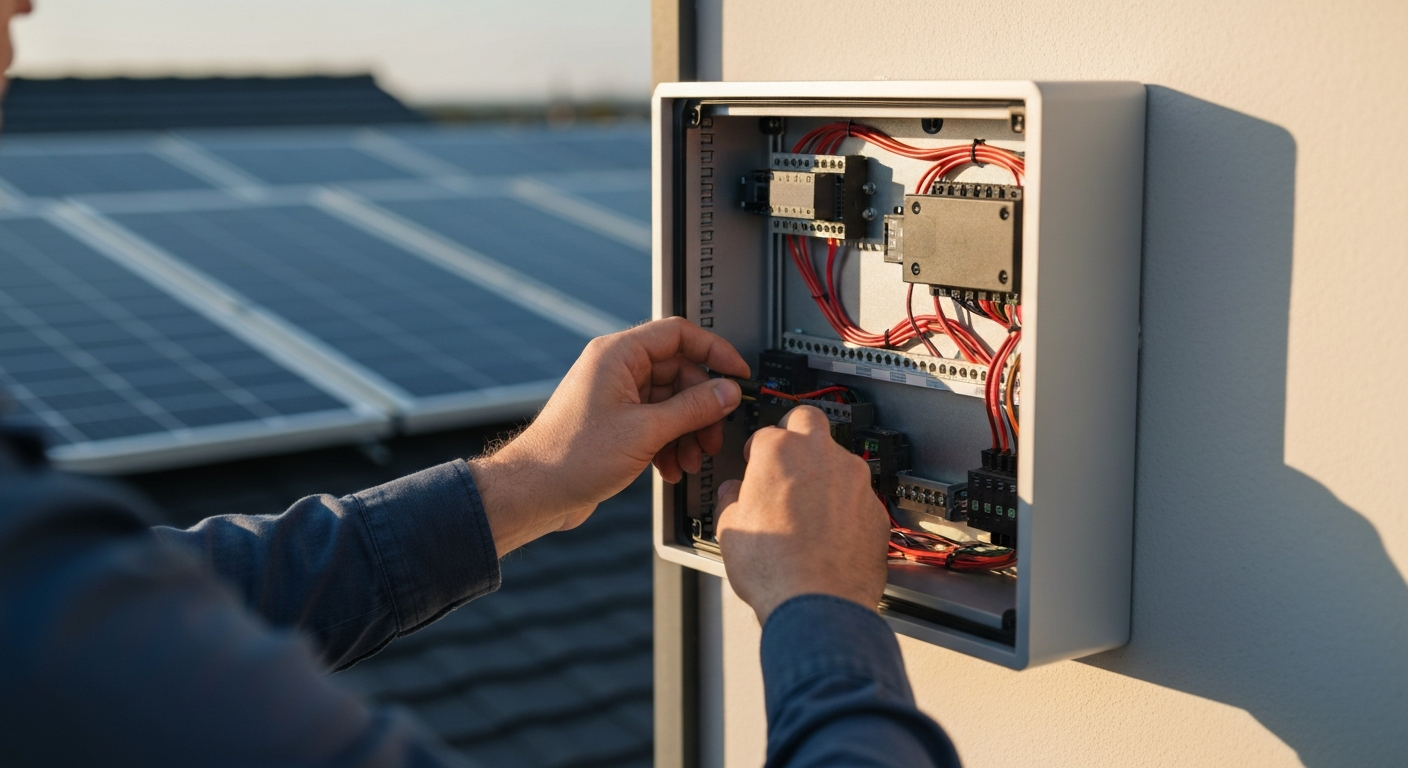
A Guide to NEC Article 690: Solar Photovoltaic (PV) Systems
A Guide to NEC Article 690: Solar Photovoltaic (PV) Systems
For any journeyman electrician or master electrician working in the rapidly growing solar industry, a deep understanding of NEC Article 690 is non-negotiable. This article within the National Electrical Code is the definitive standard for the safe installation of solar photovoltaic (PV) systems. It governs everything from circuit requirements and voltage calculations to crucial safety mechanisms like the rapid shutdown system (RSS) and ground-fault protection. Properly applying NEC Article 690 ensures that a solar panel generator is not only efficient but also safe for homeowners, maintenance personnel, and first responders. Key areas of focus include disconnecting means, conductor sizing, and the proper interconnection with utility services, which often involves NEC 705. As technology evolves, so does the code, with recent updates clarifying rules for energy storage systems (ESS) and introducing standards for emerging applications like floatovoltaics.
Understanding the Scope of NEC Article 690
NEC Article 690 is the foundational chapter in the NEC code book for most solar electric installations. It applies to the installation of solar PV systems that may be interactive with other power sources (like the utility grid) or standalone. As part of the broader NFPA 70 standard, its primary goal is the practical safeguarding of persons and property from hazards arising from the use of electricity. Recent editions of the code have focused on improving safety, streamlining requirements, and adapting to new technology. A key change, for example, has been to move many definitions out of Article 690 and into Article 100 to ensure consistency across the entire code. For electricians, knowing how to efficiently find and apply these rules is paramount, making skills in navigating the 2023 NEC code book more critical than ever.
Key Safety Systems Mandated by Article 690
Safety is the driving force behind many of the prescriptive requirements in Article 690. From fire prevention to shock hazard mitigation, the code outlines several non-negotiable systems that must be installed correctly.
Rapid Shutdown System (RSS) for Firefighter Safety
One of the most significant safety requirements is the rapid shutdown system (RSS), detailed in NEC 690.12. The purpose of RSS is to reduce shock hazards for firefighters by de-energizing specific parts of the PV system. The code defines a boundary around the PV array; inside this boundary, the voltage of controlled conductors must be reduced to 80 volts or less within 30 seconds of RSS initiation. Conductors outside the boundary must be de-energized to less than 30 volts. The 2020 and 2023 NEC editions have evolved this concept, sometimes referred to as a PV hazard control system (PVHCS), to provide more robust and reliable protection.
Ground-Fault and Arc-Fault Protection
Two other critical safety mechanisms are ground-fault and arc-fault protection.
- Ground-Fault Protection: As required by 690.41(B), DC PV systems are required to have a ground-fault protection device (GFP or GFDI). This device is designed to detect and interrupt a ground fault, which occurs when a current-carrying conductor makes unintended contact with grounded equipment, preventing serious shock hazards.
- Arc-Fault Protection: NEC 690.11 mandates a DC arc-fault circuit interrupter (AFCI) for DC PV systems operating at 80 volts or more. A listed arc fault circuit breaker or other device provides this protection, which is designed to detect series arcs that can be caused by loose connections or damaged conductors. These arcs are a major fire hazard, and AFCI technology is crucial for mitigation.
PV System Design and Sizing Calculations
Correctly sizing system components is essential for both safety and performance. Article 690 provides the methodology for the necessary calculations that every master electrician and journeyman electrician must know.
Calculating Maximum System Voltage
The maximum system voltage dictates the voltage rating of all DC components, from wiring to inverters. It is not simply the sum of panel voltages; it must be corrected for cold temperatures, which cause voltage to rise. According to NEC 690.7, the calculation involves the following steps:
- Find the open-circuit voltage (Voc) of a single PV module from its datasheet.
- Determine the number of modules connected in a series vs parallel circuit configuration to create a PV string circuit. Multiply the single-module Voc by this number.
- Find the coldest expected ambient temperature for the installation location. Many jurisdictions define this value.
- Select the temperature correction factor from Table 690.7(A) that corresponds to the lowest expected ambient temperature for crystalline silicon modules.
- Multiply the total string Voc by this correction factor to determine the maximum system voltage. This final value must not exceed the voltage rating of the system equipment (e.g., 600V, 1000V, or 1500V).
Sizing Conductors and Using a Voltage Drop Calculator
Conductors for both the DC side (PV source and output circuits) and the AC inverter output circuit must be sized to handle the maximum possible current. Ampacity calculations are based on the module’s short-circuit current (Isc) with safety factors applied. For long conductor runs, especially on large ground-mount systems, voltage drop becomes a significant concern. While the NEC doesn’t mandate a specific percentage, a high voltage drop reduces system efficiency. Professionals often use a voltage drop calculator to ensure losses are kept to a minimum, typically below 2-3%. When sizing conductors, it is essential to consult the key NEC tables for reference on ampacity and correction factors.
Grounding and Bonding: The Foundation of PV Safety
Proper grounding and bonding are fundamental to protecting against shock and equipment damage. Article 690, Part V, provides detailed requirements.
PV System Bonding and the Equipment Grounding Conductor (EGC)
PV system bonding is the process of electrically connecting all exposed, non-current-carrying metal parts (module frames, racking, enclosures) to form an equipotential plane. This is achieved using an equipment grounding conductor (EGC). If any part becomes accidentally energized, the EGC provides a low-impedance path for fault current to flow, which allows an overcurrent device or GFP device to operate and clear the fault. The EGC is one of the most critical safety components in the entire solar panel generator system.
System Grounding and the Grounding Rod
System grounding involves connecting one of the current-carrying conductors (typically the negative) to ground. This is distinct from equipment grounding. Modern transformerless (non-isolated) inverters often require the DC system to be ungrounded, while older or specific system types may be functionally grounded. When system grounding is required, it must be connected to a grounding electrode system, which could include a grounding rod, to establish a reference to the earth.
Interconnection, Disconnecting Means, and Modern Applications
A PV system does not exist in a vacuum. It must be installed with proper serviceability and interface correctly with other electrical systems.
- Disconnecting Means: Article 690, Part III, requires specific types of disconnecting means at various points in the system to allow for isolation during maintenance or emergencies. This includes a disconnect for the PV system, the inverter, and potentially others.
- NEC 705 Interconnection: When a PV system connects to a building that is also supplied by a utility grid, the installation must also comply with NEC 705 interconnection rules. This article covers how to safely connect power production sources to a primary source, such as through a backfed breaker or a supply-side connection.
- PV Wire Management: Proper PV wire management is crucial for the longevity of the system. Conductors must be secured and protected from physical damage, sunlight, and sharp edges to prevent insulation failure, which can lead to ground faults or arc faults.
- Emerging Technologies: The code is adapting to new innovations. Rules for energy storage systems (ESS) are now primarily in Article 706, which works in conjunction with Article 690. The 2023 NEC also addresses floatovoltaics (PV systems on water), with relevant provisions found in sections like 690.4(G) for general requirements and 690.12 for rapid shutdown.
The NEC is constantly evolving. As a professional master electrician or journeyman electrician, staying current is non-negotiable. Stay code-compliant on every solar job. Get our online electrical courses covering the latest NEC Updates.
Frequently Asked Questions about NEC Article 690
What is the main purpose of a rapid shutdown system (RSS) in a solar panel generator?
The primary purpose of a rapid shutdown system (RSS), as required by nec article 690, is to enhance firefighter safety. It provides a method to quickly de-energize the high-voltage DC conductors of a PV array, reducing the risk of electric shock to first responders during an emergency.
How does nec article 690 handle ground-fault protection?
NEC Article 690.41 mandates that DC PV systems include ground-fault protection. This system is designed to detect an unwanted connection between a current-carrying conductor and grounded equipment. Upon detection, it interrupts the fault path, which is critical for preventing shock hazards on metal components like module frames and racking.
What is the difference between an equipment grounding conductor (EGC) and system grounding?
An equipment grounding conductor (EGC) is a safety wire that bonds all non-current-carrying metal parts of the system together and connects them to the grounding system. Its job is to provide a path for fault current. System grounding, on the other hand, is the intentional connection of one of the current-carrying (power) conductors to ground, establishing a ground reference for the system. Many modern PV systems are ungrounded, but they still require an EGC.
Continuing Education by State
Select your state to view board-approved continuing education courses and requirements:

Disclaimer: The information provided in this educational content has been prepared with care to reflect current regulatory requirements for continuing education. However, licensing rules and regulations can vary by state and are subject to change. While we strive for accuracy, ExpertCE cannot guarantee that all details are complete or up to date at the time of reading. For the most current and authoritative information, always refer directly to your state’s official licensing board or regulatory agency.
NEC®, NFPA 70E®, NFPA 70®, and National Electrical Code® are registered trademarks of the National Fire Protection Association® (NFPA®)
You may also like

Colorado Electrical Licensing Requirements and Reciprocity Guide
Standby Generators in DE: Navigating Coastal Storm Regulations

 Login with Google