
Grounding Separately Derived Systems: A Guide to NEC 250.30
Grounding Separately Derived Systems: A Guide to NEC 250.30
Properly grounding separately derived systems is one of the most critical safety tasks for any master or journeyman electrician. Governed by NEC 250.30, this process ensures the creation of an effective ground-fault current path, which is essential for clearing faults and preventing shock or fire hazards. A separately derived system, such as an electrical transformer or a standby generator with a switching transfer switch, is an electrical source with no direct connection to another system’s circuit conductors. The key to correct installation is establishing a new neutral-to-ground bond using a System Bonding Jumper. This jumper, along with a properly sized Grounding Electrode Conductor connected to a suitable grounding electrode, stabilizes the system’s voltage to ground and provides the low-impedance path needed for overcurrent devices to operate instantly during a ground fault. Misunderstanding these rules is a common issue that can lead to dangerous parallel paths for neutral current and failed inspections.
What is a Separately Derived System?
The National Electrical Code (NEC) in Article 100 defines a separately derived system as a premises wiring system whose power is derived from a source other than a service, with no direct electrical connection to the circuit conductors of any other source. Common examples that every electrician will encounter include:
- An electrical transformer, like those used in various 3-phase transformer configurations, where the primary and secondary windings are electrically isolated.
- A standby generator connected via a transfer switch for generator that opens and closes the neutral conductor.
- Solar photovoltaic (PV) systems or battery/inverter setups that are completely off-grid.
The determining factor is the absence of a direct connection, especially the grounded (neutral) conductor, between the new source and the original source. If the neutral is solidly connected and not switched, the system is considered non-separately derived.
The Core Principle: Establishing an Effective Ground-Fault Current Path
The primary goal of NEC 250.30 is safety. When a ground fault occurs (i.e., a hot conductor touches a metal enclosure), a massive amount of current needs a clear, low-impedance path back to its source to trip the circuit breaker or blow the fuse. This path is known as the effective ground-fault current path. For a separately derived system, you must create a new reference to ground and a new path back to that new source. Without this, fault current could travel through unpredictable paths, including building steel, piping, or even people, without ever tripping the overcurrent device. This is where the concepts of grounding and bonding become critical. A deep understanding of these topics, including the difference between grounding vs. bonding, is essential for every professional in the electrical trade.
Key Components for Grounding Separately Derived Systems per NEC 250.30
To correctly ground a new system, the nec code book outlines several critical components that work together. Failure to install or size any of these correctly compromises the entire safety system.
The System Bonding Jumper: Creating the Neutral-to-Ground Bond
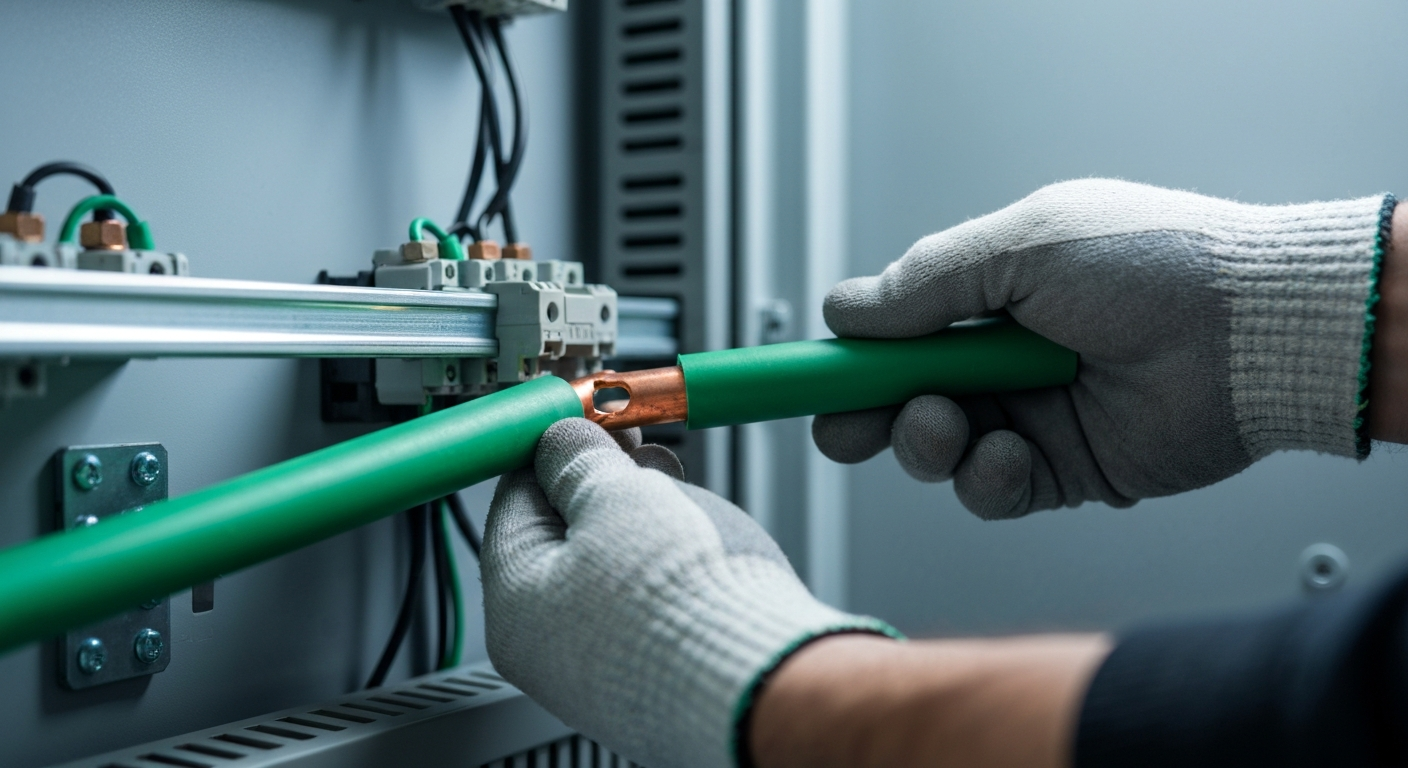
The System Bonding Jumper is the heart of a grounded separately derived system. Its job is to create the required neutral-to-ground bond by connecting the system’s grounded conductor (neutral) to the equipment grounding conductor(s) and the system’s enclosure. This connection can be made at the source itself or at the first system disconnecting means. It performs the same function as a main bonding jumper in a service, but its location and name are different. It’s crucial to understand the main bonding jumper vs system bonding jumper distinction: the main bonding jumper is only for services, while the system bonding jumper is exclusively for separately derived systems. Sizing for wire-type bonding jumpers is based on NEC Table 250.102(C).
The Grounding Electrode Conductor: Connecting to Earth
The Grounding Electrode Conductor (GEC) connects the newly established grounded point of the derived system to the grounding electrode system. This connection to earth stabilizes the voltage during normal operation and helps dissipate energy from events like lightning. The GEC must be connected at the same point where the system bonding jumper is installed. For sizing the GEC, electricians must refer to NEC Table 250.66, which bases the conductor size on the size of the derived ungrounded conductors. For any electrician training or exam prep, memorizing how to use this table is fundamental. Recent updates to the NEC emphasize using the building’s existing grounding electrode system (like structural steel or a water pipe) for the connection, even if it’s not physically close to the transformer. To learn more about recent changes, our lesson on how 2023 NEC grounding electrode conductor rules affect transformer installations provides in-depth details.
Step-by-Step: Grounding a Common Separately Derived System
Whether you’re a journeyman electrician on a commercial job or a master electrician overseeing a complex project, the process follows a clear, methodical path. Here is a step-by-step guide for grounding a typical dry-type transformer:
- Identify the System: Confirm the transformer is a separately derived system (i.e., not an autotransformer).
- Locate and Install the System Bonding Jumper: Determine the location for the neutral-to-ground bond. This will be either in the transformer enclosure itself or in the first disconnecting means downstream from the transformer. Install the System Bonding Jumper to connect the grounded conductor (X0 terminal) to the equipment grounding bus/enclosure.
- Size the System Bonding Jumper: Using the size of the secondary ungrounded conductors, consult NEC Table 250.102(C) to determine the minimum size for your wire-type jumper.
- Establish the Grounding Electrode Conductor Connection: Plan the route for the Grounding Electrode Conductor (GEC). It will originate from the same point where the system bonding jumper is connected (either the neutral bus in the source or the first disconnect).
- Connect to the Grounding Electrode System: Per NEC 250.30(A)(4), the GEC must connect to the building’s grounding electrode system. This could be structural steel, a metal water pipe, or a connection to the main service’s GEC. A separate grounding rod is typically not the preferred or required primary electrode if others exist.
- Size the Grounding Electrode Conductor: Use NEC Table 250.66 to size the GEC based on the total circular mil area of your ungrounded secondary conductors.
- Verify the Path: Ensure all non-current-carrying metal parts associated with the system (raceways, enclosures) are properly bonded together and to the system’s equipment grounding conductor, forming a continuous, effective ground-fault current path back to the source. This also involves correctly sizing equipment bonding jumpers between enclosures using NEC Table 250.122.
Handling Specific Scenarios
Standby Generators and Transfer Switches
A standby generator is considered a separately derived system only if the transfer switch for generator switches the neutral conductor (typically a 4-pole switch). If the transfer switch is a 3-pole model that leaves the neutral solidly connected, the generator is a non-separately derived system, and no system bonding jumper should be installed at the generator. Proper transfer switch grounding is critical to prevent objectionable current and ensure proper operation of ground-fault protection. For a detailed guide on this component, see our article on how to install a manual transfer switch.
Multiple Separately Derived Systems
When a facility has multiple separately derived systems, the NEC permits the use of a common grounding electrode conductor. Taps are run from each individual system to this common conductor. The common GEC is sized based on the requirements in NEC 250.30(A)(6), which often references the requirements for a single GEC from Table 250.66.
Special Cases: Ungrounded and High-Impedance Systems
While most systems are solidly grounded, the NEC does allow for ungrounded derived systems (covered in 250.30(B)) and High-impedance grounded neutral systems (covered in 250.36 and 250.187). These are typically found in industrial facilities where continuity of service is paramount. In a high-impedance system, a resistor is placed in the bonding jumper path to limit ground-fault current to a very low level (e.g., 1-10 amps), which triggers an alarm instead of tripping a breaker on the first fault. These specialized systems require advanced electrician training. For more, see our lesson on how the 2023 NEC updates impedance grounding.
Important Considerations for Field Installations
- Always establish a single neutral-to-ground bond for each separately derived system. Multiple bonds create dangerous parallel paths for neutral current.
- The System bonding jumper is the key to creating an effective ground-fault current path; never omit it.
- Properly size all conductors (GEC, bonding jumpers, Supply-side bonding jumper) according to the latest nec code book.
- For an electrical transformer with ground fault protection for transformers, incorrect grounding can cause nuisance tripping.
- Adhere to Outdoor source grounding requirements in 250.30(C), which often mandate a local grounding electrode at the outdoor source location.
Correctly applying the rules in NEC 250.30 is a hallmark of a knowledgeable and safe electrician. Confidently handle complex installations. Enroll in our advanced NEC courses.
Primary Sources
- NFPA 70, National Electrical Code (NEC), Article 250
Frequently Asked Questions (FAQ)
What is the difference between a main bonding jumper vs system bonding jumper?
A Main Bonding Jumper (MBJ) is used only at the service equipment to create the primary neutral-to-ground connection for the premises. A System Bonding Jumper (SBJ) serves the same purpose but is used exclusively at a separately derived system, like a transformer or generator, to establish a new, independent neutral-to-ground bond for that system.
When is a standby generator considered a separately derived system?
A standby generator is a separately derived system only when the transfer switch used to connect it to the load disconnects, or “switches,” the grounded (neutral) conductor along with the ungrounded (hot) conductors. This is typically done with a 4-pole transfer switch for generator. If the neutral is not switched (as with a 3-pole switch), it is not a separately derived system.
How do I size the Grounding Electrode Conductor for an electrical transformer?
You must size the Grounding Electrode Conductor for an electrical transformer (a separately derived system) using NEC Table 250.66. The size is based on the total cross-sectional area of the largest ungrounded conductors on the secondary (load) side of the transformer.
Can I use the building steel for grounding separately derived systems?
Yes. In fact, NEC 250.30(A)(4) requires using the building or structure’s existing grounding electrode system. If effectively grounded structural metal frame is available, it must be used as the grounding electrode for the separately derived system, connected via the Grounding Electrode Conductor.
Continuing Education by State
Select your state to view board-approved continuing education courses and requirements:

Disclaimer: The information provided in this educational content has been prepared with care to reflect current regulatory requirements for continuing education. However, licensing rules and regulations can vary by state and are subject to change. While we strive for accuracy, ExpertCE cannot guarantee that all details are complete or up to date at the time of reading. For the most current and authoritative information, always refer directly to your state’s official licensing board or regulatory agency.
NEC®, NFPA 70E®, NFPA 70®, and National Electrical Code® are registered trademarks of the National Fire Protection Association® (NFPA®)
You may also like
Colorado Electrical Licensing Requirements and Reciprocity Guide
Standby Generators in DE: Navigating Coastal Storm Regulations

 Login with Google