
Grounding and Bonding for PV Systems: NEC 690 Part V
Grounding and Bonding for PV Systems: A Comprehensive Guide to NEC 690 Part V
Properly grounding solar PV systems is one of the most critical aspects of a safe and reliable installation, governed by Part V of NEC Article 690. This process involves two distinct but related concepts: system grounding, which provides a reference to earth for the electrical system (stabilizing voltages and assisting in clearing certain faults), and equipment grounding, which bonds all normally non-current-carrying metallic parts to provide a low-impedance path for fault current. Key components in this process include the Equipment Grounding Conductor (EGC) for fault current paths and, in some cases, a Grounding Electrode Conductor (GEC) to connect to a grounding rod or the premises grounding electrode system. Many modern grid-tied installations use ungrounded PV arrays paired with transformerless (non-isolated) inverters that establish a functional ground reference and rely on electronic ground-fault detection. Solidly grounded PV source circuits remain a permitted configuration and are still used in some systems. Adhering to the NEC ensures that listed grounding and bonding devices are used to maintain electrical continuity, protecting both people and the solar generator equipment.
The Foundation: Grounding vs. Bonding in Solar Installations
For any master electrician or journeyman electrician, understanding the distinction between grounding and bonding is fundamental. While often used interchangeably, they serve different purposes under the National Electrical Code. Grounding is the act of connecting an electrical system to the earth to provide a reference and help limit voltage from lightning or system transients; bonding is the process of connecting normally non-current-carrying metallic parts together to create an effective fault-current path. If you need a refresher, our articles offer a deep dive into grounding vs. bonding as defined by NEC 250 and the specifics within NEC Article 250.
In a solar PV system, the goal of this combined effort is twofold: personnel safety and equipment protection. Proper bonding ensures that if a fault occurs and a metal frame becomes energized, the current has an immediate path back to the source, tripping the overcurrent device and preventing a dangerous shock hazard. Grounding helps stabilize the system’s voltage relative to the earth. While Article 250 provides the general rules, NEC Article 690, Part V, modifies and adds specific requirements for PV generators and their unique characteristics.
Decoding NEC 690 Part V: System Grounding Approaches
NEC 690.41 outlines the permitted PV system grounding configurations, giving installers different approaches based on system design and equipment used. The choice between these systems impacts everything from safety-device selection to how grounding conductors are routed and connected.
Solidly Grounded Systems
A solidly grounded system is a traditional design where one of the DC conductors is intentionally connected to ground. This approach is addressed in NEC 690.41 and, for PV source circuits that exceed the voltage and current thresholds, requires ground-fault detection/protection – commonly implemented as a listed ground-fault detector-interrupter (GFDI) per the code. The GFDI is designed to detect ground-fault conditions that might not be large enough to trip a standard overcurrent device and to automatically isolate the faulted circuit.
Ungrounded PV Arrays and the Functionally Grounded Inverter
Many modern residential and commercial systems use an ungrounded PV array with a transformerless inverter. The PV array conductors are not solidly connected to earth; instead the inverter provides a functional ground reference and ground-fault monitoring. The inverter’s electronics detect ground faults or imbalances and perform protective actions when necessary. This non-isolated approach has become common because of improved inverter efficiencies and lower component counts, but the installer still must meet the grounding and fault-detection requirements in NEC Article 690.
Equipment Grounding: Ensuring Electrical Continuity
NEC 690.43 requires exposed non-current-carrying metal parts of PV module frames, mounting systems, enclosures, and associated metal equipment to be bonded and connected to an equipment grounding conductor (EGC). These bonding and grounding connections are commonly inspected and are important for safety and code compliance.
The Critical Role of the Equipment Grounding Conductor (EGC)
The Equipment Grounding Conductor (EGC) provides the low-impedance path that allows an overcurrent protective device to operate on fault. Where NEC requires it, the EGC must be sized in accordance with NEC 250.122 based on the rating of the overcurrent device protecting the circuit. An undersized or poorly terminated EGC can fail to carry fault current safely and jeopardize protective-device operation.
Array Mounting System Bonding and Listed Devices
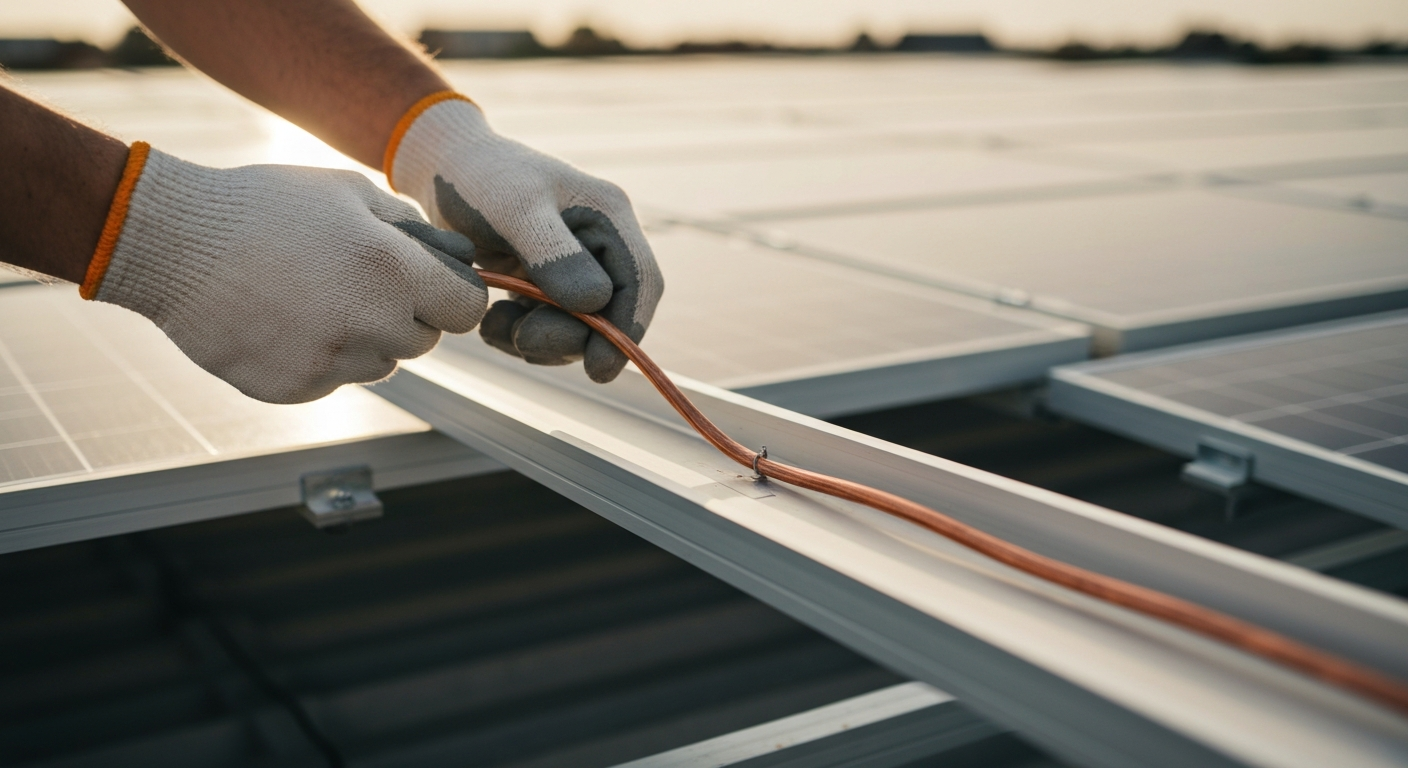
Ensuring PV module grounding and proper array mounting system bonding is crucial for maintaining electrical continuity across the entire array. Historically installers ran discrete bonding wires to module frames. Today the industry commonly uses listed grounding/bonding components integrated into racking and module assemblies (listed to standards such as UL 2703) to simplify installation while maintaining continuity. Follow manufacturer instructions and use listed devices to preserve the assembly listing and ensure a reliable bond from module frames to the main equipment grounding conductor.
Avoid common grounding mistakes that can lead to failed inspections and safety hazards. ExpertCE provides comprehensive online electrical courses to help you master the code and advance your career. Learn the code with ExpertCE.
The Grounding Electrode System (GES)
The Grounding Electrode System (GES) connects the electrical system to earth through one or more grounding electrodes such as driven rods, concrete-encased electrodes, or other electrodes permitted by Article 250. NEC 690.47 explains how the PV array equipment grounding conductors must be connected to the premises grounding electrode system when the PV equipment is mounted on or attached to buildings.
Sizing the Grounding Electrode Conductor (GEC)
When a DC grounding electrode conductor is required, its sizing follows the rules in Article 250 (including 250.66). Practical guidance and walkthroughs on GEC sizing and use of the tables are available in technical guides and training articles such as our GEC sizing walkthrough and table-based examples.
Do PV Systems Need a Separate Grounding Rod?
A common point of confusion is whether a separate grounding rod is required at the array. NEC 690.47 permits the PV array equipment grounding conductors to connect to a building’s existing grounding electrode system when the array is attached to the building and the equipment grounding conductor provides the connection to the premises GES. Installing an auxiliary electrode at the array is permitted but is not always required; if an auxiliary electrode is installed, it must be bonded into the main grounding electrode system to avoid potential differences between electrodes.
Step-by-Step: Verifying an Equipment Grounding Path
- Identify Components: Systematically identify all metallic components that must be bonded. This includes PV module frames, racking rails, the DC combiner box, inverter chassis, and any metal enclosures for components like a DC-to-DC converter.
- Confirm Listed Devices: Verify that all hardware used for bonding—such as clamps, lugs, and splices—are listed grounding and bonding devices certified to UL 2703 and are being used according to the manufacturer’s installation manual.
- Check Mechanical Connections: Physically inspect all bonding connections. Ensure that mounting clamps, bonding jumpers, and lugs are torqued to the manufacturer’s specifications. Loose connections are a primary cause of failure.
- Test for Electrical Continuity: Use an appropriate low-resistance tester (DLRO or equivalent) to verify continuity from a module frame back to the grounding bus or equipment grounding conductor. NEC does not mandate a single numeric resistance value for bonding continuity, so installers should follow manufacturer and listing instructions or accepted industry practice when interpreting low-resistance measurements. Photographs and documented readings help during inspection.
- Inspect the EGC: Visually inspect the main Equipment Grounding Conductor (EGC) from the array to the point of connection with the premises grounding system. Confirm it is correctly sized per NEC 250.122 and that its terminations are secure and listed for the materials used.
- Document for Inspection: Take photos and make notes of the grounding methods used. This documentation is invaluable for demonstrating code compliance to the AHJ (Authority Having Jurisdiction).
Key Considerations and Common Pitfalls
Proper electrician training must emphasize avoiding common installation errors. Poor wire management and unsecured conductors are frequent causes of field defects on PV installations; these issues can lead to insulation abrasion, ground faults, and reliability problems that jeopardize safety and performance. Here are key points to watch:
- Improperly Secured Conductors: Wires rubbing against sharp edges of the racking or module frames due to wind or thermal movement can lead to insulation failure and ground faults.
- Ignoring Manufacturer Instructions: Using listed components incorrectly, such as over-torquing a bonding lug or using it with an incompatible module frame, voids the listing and creates a weak point.
- Corrosion: Using incompatible metals (e.g., copper directly on aluminum without approved plating or isolation) can cause galvanic corrosion; use manufacturer-recommended, corrosion-resistant hardware and plated or stainless fasteners where required.
- Incorrect EGC Sizing: Failing to size the EGC in accordance with NEC 250.122 for the overcurrent device is a critical safety mistake.
- Misunderstanding System Type: Confusing the requirements for a solidly grounded system with those of an ungrounded PV array can lead to missing or incorrect protective components (for example, GFDI where required).
Primary Sources
- NFPA 70, National Electrical Code (NEC), Article 690
- UL 2703, Standard for Mounting Systems, Mounting Devices, Clamping/Retention Devices, and Ground Lugs for Use with Flat-Plate Photovoltaic Modules and Panels
Frequently Asked Questions (FAQ)
What is the difference between an EGC and a GEC in grounding solar PV systems?
The Equipment Grounding Conductor (EGC) bonds all metallic, non-current-carrying parts of the system together and provides a path for fault current to return to the source so the overcurrent device can operate. The Grounding Electrode Conductor (GEC) connects the system’s grounded conductor (when present) or the equipment-grounding system to the earth via a grounding electrode (such as a driven rod or concrete-encased electrode) in accordance with Article 250.
What is bonding, and does it mean the same as grounding in a solar panel generator system?
No. Bonding connects metallic parts to each other to ensure they are at the same electrical potential. Grounding connects the system to the earth. Proper bonding enables the EGC to carry fault current and clear the fault, while grounding provides the earth reference and helps manage external overvoltage events. You can explore this topic in-depth in our article comparing grounding and bonding.
Is a separate grounding rod always required for a PV array?
No. For many grid-tied systems attached to a building, the array equipment grounding is achieved via the EGC run with the output circuit back to the building’s service grounding electrode system. An additional electrode at the array is permitted by NEC 690.47(B) but is not automatically required when the array is connected to the building GES; any auxiliary electrode must be bonded into the same grounding electrode system to avoid potential differences.
How does the 2023 NEC code book change PV grounding requirements?
The 2023 NEC clarifies and updates a number of wiring-method and grounding topics for PV systems. Installers should review the wiring-method permissions in 690.31 (cable and conductor types inside arrays) and the grounding-electrode rules in 690.47 alongside Article 250 requirements such as 250.122 and 250.134 for routing and terminations. The code continues to require that equipment grounding conductors and grounding electrode connections comply with Article 250 whenever PV circuits interface with the premises wiring.
Continuing Education by State
Select your state to view board-approved continuing education courses and requirements:

Disclaimer: The information provided in this educational content has been prepared with care to reflect current regulatory requirements for continuing education. However, licensing rules and regulations can vary by state and are subject to change. While we strive for accuracy, ExpertCE cannot guarantee that all details are complete or up to date at the time of reading. For the most current and authoritative information, always refer directly to your state’s official licensing board or regulatory agency.
NEC®, NFPA 70E®, NFPA 70®, and National Electrical Code® are registered trademarks of the National Fire Protection Association® (NFPA®)
You may also like
Colorado Electrical Licensing Requirements and Reciprocity Guide
Standby Generators in DE: Navigating Coastal Storm Regulations

 Login with Google