
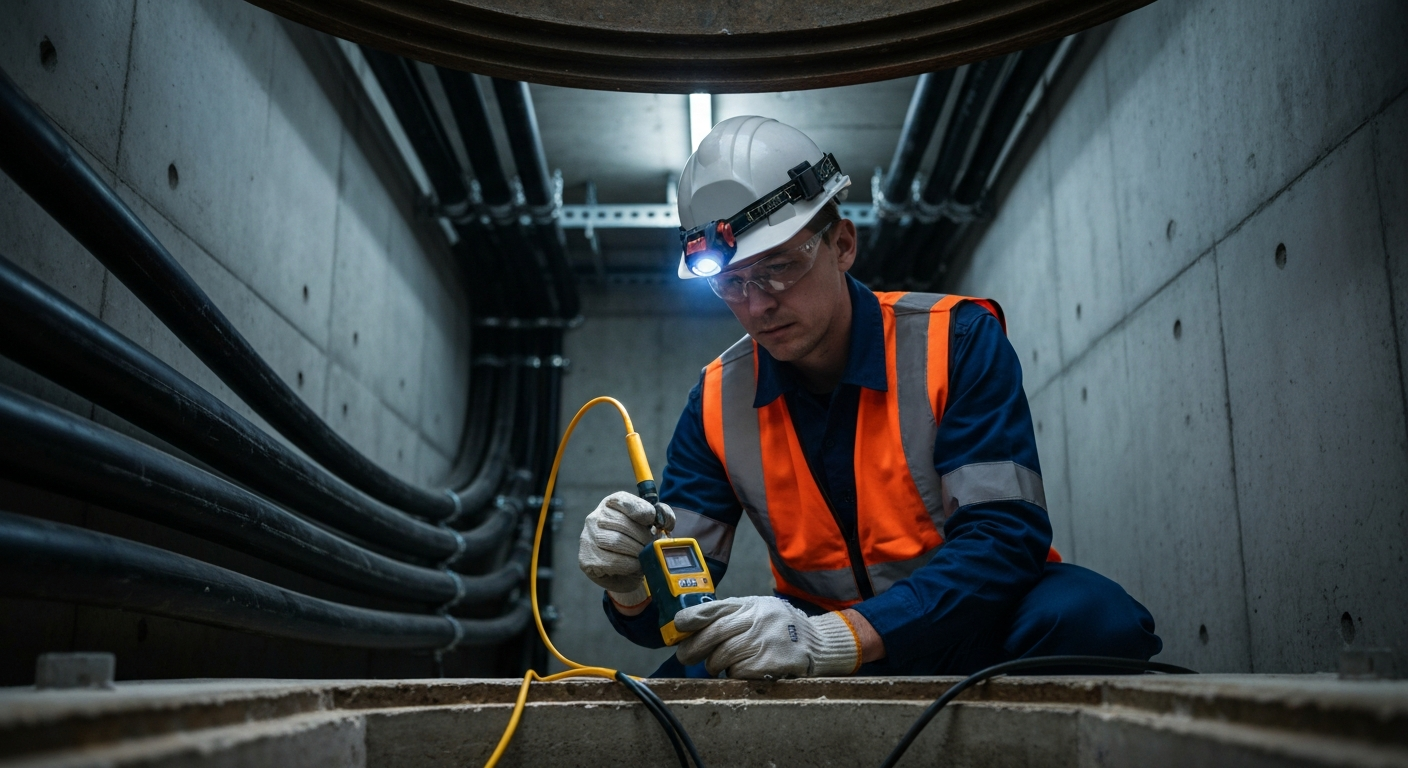
Working in Confined Spaces: Vaults and Manholes
Working in Confined Spaces: A Guide for Electrical Professionals on Vaults and Manholes
Working in confined spaces like vaults and manholes presents some of the most significant risks any electrician will face. These underground electrical installations are governed by strict safety standards, primarily OSHA 1910.146, which defines procedures for permit-required entries. For a journeyman electrician or master electrician, understanding these rules is not optional—it’s essential for survival. Before entry, a comprehensive plan involving a Confined space permit, rigorous atmospheric testing, and robust electrical safety protocols like lockout/tagout is mandatory. The primary goal is to ensure the space is free from a hazardous atmosphere and that all electrical equipment is verified as de-energized. This requires specialized electrician training for every qualified electrical worker on the team, covering everything from using monitoring equipment to executing a manhole rescue. The unique combination of atmospheric and electrical dangers makes this work exceptionally hazardous.
What Defines a Permit-Required Confined Space? The OSHA 1910.146 Standard
For electricians, an underground vault or manhole is more than just a tight workspace; it’s a highly regulated environment. According to OSHA’s standard 1910.146, a confined space is any area that is large enough for an employee to enter, has limited means of entry or exit, and is not designed for continuous occupancy. However, the game changes when that space becomes “permit-required.” A space falls into this category if it has one or more of the following hazards: the potential to contain a hazardous atmosphere, a material that could engulf an entrant, a configuration that could trap someone, or any other recognized serious safety or health hazard. Electrical vaults and manholes commonly meet these criteria due to the dual threats of atmospheric dangers and the presence of high-voltage equipment like an electrical transformer or spliced cables.
The Critical First Step: Atmospheric Testing and Ventilation
Before any part of a worker’s body breaks the plane of entry, atmospheric testing is mandatory. A hazardous atmosphere can be deadly in seconds and can include oxygen deficiency (below 19.5%), oxygen enrichment (above 23.5%), the presence of flammable gases, or toxic contaminants like hydrogen sulfide and carbon monoxide. These gases can leak from adjacent sewers, be byproducts of decaying organic matter, or result from faults in the electrical system. Opening a manhole can change atmospheric conditions (for example by introducing oxygen or disturbing stratified gases), so mechanical ventilation and testing are required before entry. Because of these invisible threats, a calibrated multi-gas monitor is an essential tool for every entry team.
Step-by-Step Atmospheric Testing Procedure
A qualified electrical worker must follow a strict testing protocol as mandated by OSHA. This process is not a one-time check but a continuous effort to ensure safety.
- Test Before Entry: With all personnel safely outside, use a properly calibrated gas monitor with a probe or hose to sample the air inside the vault. Never rely on your senses to detect hazardous gases.
- Test in Order: Testing should follow the generally accepted sequence: first oxygen concentration, then flammability (combustible gases), and then toxic gases, because some combustible-gas instruments require sufficient oxygen to give correct readings.
- Test at All Levels: Gases can stratify. Test the atmosphere at different levels (top, middle, and bottom, or at locations appropriate for potential stratification and where workers will be positioned) to get a complete picture.
- Ventilate as Needed: If the atmosphere is found to be hazardous, mechanical ventilation must be used to purge the space and establish safe conditions. Testing must be repeated after ventilation to confirm the space is safe for entry.
- Monitor Continuously: A hazardous atmosphere can develop without warning. Therefore, monitoring must be continuous for the entire duration that workers are inside the confined space. All test results must be documented on the Confined space permit.
Electrical Safety Protocols: NFPA 70E and Lockout/Tagout
While atmospheric hazards are a primary concern, the electrical dangers in vaults and manholes are just as lethal. Simply following standard lockout/tagout (LOTO) procedures is not enough. The NFPA 70E standard, Standard for Electrical Safety in the Workplace, provides the framework for establishing an “electrically safe work condition.” This is the only acceptable state for working in such a high-risk environment. All work on or near energized equipment should be avoided. The process involves a comprehensive job safety plan to identify all potential energy sources, de-energize them, apply locks and tags, and—most importantly—verify that the equipment is truly de-energized. Performing a live-dead-live test with a properly rated meter is a non-negotiable step in this process. As detailed in recent safety updates, proper voltage verification techniques are a cornerstone of protecting electricians. Even with equipment de-energized, the risk of arc flash protection remains a concern if adjacent circuits are still live, requiring appropriate personal protective equipment (PPE).
The Team Approach: Roles of the Qualified Worker, Attendant, and Supervisor
Working in confined spaces vaults and manholes is never a one-person job. OSHA mandates a team approach with clearly defined roles:
- Authorized Entrant: The qualified electrical worker (e.g., a journeyman electrician or master electrician) who enters the space to perform the work. They must be trained on the specific hazards of the space.
- Attendant: Positioned outside the space, the attendant monitors the entrant, stays in constant communication, operates rescue equipment, and summons help if needed. The attendant should not enter the space except as part of a trained, coordinated rescue operation; OSHA notes that a significant portion of confined-space fatalities involve would‑be rescuers.
- Entry Supervisor: The person responsible for verifying that all safety precautions on the Confined space permit have been taken, that the team is properly trained, and that all conditions are safe before signing off on the entry.
Comprehensive electrician training, often validated through programs like NCCER, is crucial for ensuring every team member understands their duties and is prepared for emergencies, including manhole rescue. Rescue should be performed only by trained responders with appropriate retrieval systems and PPE.
NEC Rules and Practical Challenges in Underground Installations
The nec code book also provides guidance for underground electrical installations. Specifically, underground vaults and manholes are addressed in NEC Article 110 (Part V, sections 110.70–110.79) and other applicable articles such as Article 490 for equipment over 1000 volts. NEC working-space requirements specify minimum clearances; many NEC tables and text use 914 mm (3 ft) as the common 3‑ft working width referenced for certain low-voltage clearances in underground enclosures. Achieving full working clearances in cramped manholes can be difficult, which reinforces why establishing an electrically safe work condition is paramount. Practical challenges like a difficult cable pull through or the presence of leaking, swollen, or otherwise compromised cables must be treated as impending faults, and the affected cable must be de-energized before entry. Underground work has unique dangers. Learn confined space safety by exploring our online electrical courses designed to keep you safe and compliant. For additional guidance, refer to NEC 110.26.
Key Safety Considerations for Vault and Manhole Entry
- Always De-energize: The first and most effective control measure is to de-energize all electrical equipment within the space. Working on or near energized circuits in a confined space should be avoided.
- Continuous Atmospheric Monitoring: Conditions can change rapidly. Continuous monitoring for oxygen, flammability, and toxicity is essential throughout the entry.
- Have a Rescue Plan: A detailed manhole rescue plan must be in place before entry begins. This includes having a trained attendant and the proper retrieval equipment (e.g., tripod, harness, winch) immediately available.
- Use Appropriate PPE: All workers must be equipped with the necessary personal protective equipment (PPE), which may include a gas monitor, harness, lifeline, hard hat, and appropriate arc flash protection.
- Inspect Before Entry: Check for physical hazards like water, damaged cables, compromised structural integrity, or the presence of pests before entering.
- Never Work Alone: A trained attendant must always be present outside the manhole or vault while work is being performed inside. The attendant’s role is continuous monitoring and summoning/initiating rescue, not entering the space unless part of a planned rescue by trained responders.
Frequently Asked Questions (FAQ)
What is the most important regulation for working in confined spaces vaults and manholes?
The single most important regulation is OSHA 29 CFR 1910.146, “Permit-required confined spaces.” This standard outlines the legal requirements for identifying, evaluating, and safely entering these hazardous environments, including the mandate for a Confined space permit, atmospheric testing, and having a trained attendant.
Is atmospheric testing required every time before entering a manhole?
Yes. Atmospheric testing must be conducted before every entry to check for oxygen levels, flammable gases, and toxic substances. Furthermore, OSHA requires continuous monitoring while an employee is inside the space, as conditions can change unexpectedly.
What kind of electrician training is needed for confined space entry?
A qualified electrical worker needs specialized electrician training that goes beyond standard electrical work. This includes detailed instruction on OSHA 1910.146, hazard recognition, proper use of gas monitoring equipment, NFPA 70E safety procedures for establishing an electrically safe work condition, and hands-on drills for emergency and manhole rescue procedures.
Can a journeyman electrician work alone in an electrical vault?
No. Regardless of experience level, no one is permitted to work alone inside a permit-required confined space like a vault or manhole. OSHA explicitly requires an attendant to be stationed outside the space at all times to monitor the entrant and provide emergency assistance if needed.
Continuing Education by State
Select your state to view board-approved continuing education courses and requirements:

Disclaimer: The information provided in this educational content has been prepared with care to reflect current regulatory requirements for continuing education. However, licensing rules and regulations can vary by state and are subject to change. While we strive for accuracy, ExpertCE cannot guarantee that all details are complete or up to date at the time of reading. For the most current and authoritative information, always refer directly to your state’s official licensing board or regulatory agency.
NEC®, NFPA 70E®, NFPA 70®, and National Electrical Code® are registered trademarks of the National Fire Protection Association® (NFPA®)
You may also like
Colorado Electrical Licensing Requirements and Reciprocity Guide
Standby Generators in DE: Navigating Coastal Storm Regulations

 Login with Google