
CAST Test Prep: Understanding Center of Gravity and Stability
CAST Test Prep: A Guide to Center of Gravity and Stability
Understanding the principles of center of gravity and stability is a critical, non-negotiable skill for success and safety in the electrical trade. For aspiring electricians preparing for pre-employment aptitude tests like the CAST (Construction and Skilled Trades Selection System), mastering these mechanical concepts is essential. This knowledge forms the bedrock of safe practices, from ensuring the structural stability of a raceway to the complex process of rigging and lifting electrical components like transformers. A solid grasp of load distribution and mechanical equilibrium not only predicts success on the exam but also prepares candidates for the real-world challenges faced by a journeyman electrician or master electrician. Proper electrician training emphasizes that a stable load is a safe load, preventing accidents, equipment damage, and costly project delays.
Why Center of Gravity and Stability Matters for Electricians
While electricians work with circuits and voltage, a significant portion of the job involves interacting with physical systems. Understanding center of gravity and stability is not just for passing a test; it’s fundamental to job site safety and efficiency. This knowledge is crucial when performing tasks like heavy equipment installation, mounting large disconnects, or even organizing a work vehicle. An imbalanced load can create a tipping hazard, damage expensive equipment, or cause serious injury. The principles of physics are always at play, whether you’re pulling heavy cable, mounting an electrical panel, or positioning an aerial lift. A foundational understanding ensures that every physical installation has proper structural stability from the start.
The CAST Test Mechanical Concepts Section Explained
Many individuals entering an electrician school or apprenticeship program will first need to pass an aptitude test. The CAST test is a common screening tool used to predict on-the-job success. The “Mechanical Concepts” section specifically targets your intuitive understanding of physical principles. The section is timed and contains multiple quick visual questions that demand fast, accurate problem-solving; the exact number of questions and time limits vary by test publisher and program, so check with your test administrator for the specific format used in your screening. The questions are visual, presenting scenarios involving pulleys, levers, gears, and, critically, center of gravity and stability. Questions are primarily conceptual and visual; they typically emphasize intuitive understanding of force and torque and may include simple arithmetic, but they generally avoid complex multi-step calculations.
Core Principles of Center of Gravity and Stability
Defining Center of Gravity (CG)
The center of gravity is the theoretical point in an object where the entire weight can be considered to be concentrated. For a symmetrical object like a uniform piece of conduit, the CG is at its geometric center. However, for irregularly shaped objects, such as a large motor or a transformer with offset cooling fins, the CG will be shifted toward the heavier end. A key principle to remember is that an object will often pivot or rotate about a point determined by its constraints and support; when free to move, rotation behavior is governed by the object’s CG and the applied forces.
Understanding Stability and Mechanical Equilibrium
An object is in a state of mechanical equilibrium when it is stable. This stability is directly related to the position of its center of gravity relative to its base of support. A lower center of gravity and a wider base of support result in greater stability. Conversely, raising the CG or narrowing the base makes an object less stable and more likely to tip. When an external force is applied, the object will resist tipping as long as its CG remains above its base of support. The edge of this support base is known as the tipping axis. Once the CG moves beyond this axis, the object becomes unstable and will topple.
Key Force and Torque Principles
Force is any interaction that, when unopposed, will change the motion of an object. Torque, or a turning force, is what causes an object to rotate. When lifting an object, if the lifting force is not applied directly in line with the center of gravity, it creates torque, causing the load to tilt. Understanding these force and torque principles is essential for predicting how an object will react during rigging and lifting electrical components, ensuring a lift is controlled and safe.
Practical Applications in the Electrical Trade
The principles of stability and load management are not just abstract concepts; they are integral to the daily work of electricians. For those pursuing advanced certifications, a solid grasp of these topics is a prerequisite for success, and a comprehensive master electrician exam prep study plan will often include a review of such foundational mechanical knowledge.
Rigging and Lifting Heavy Equipment
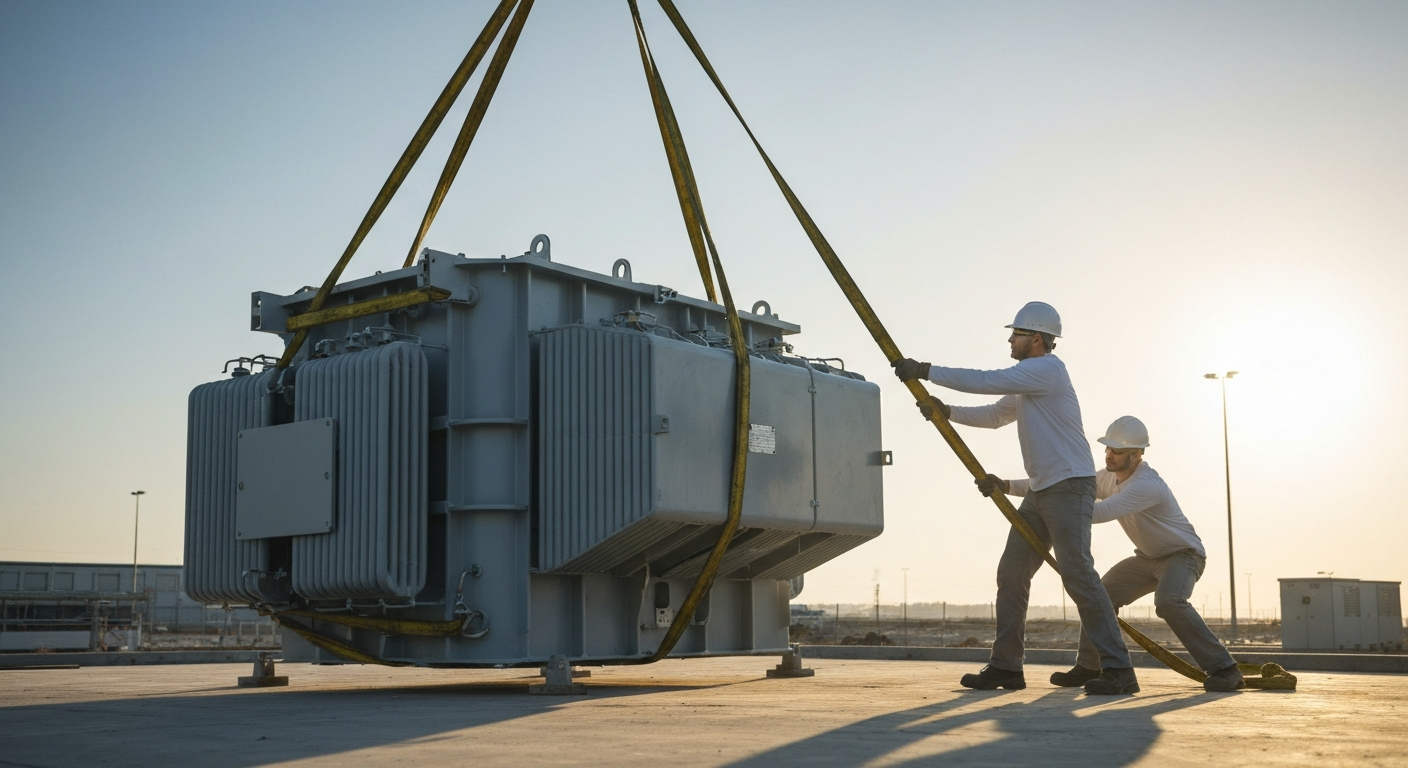
One of the most direct applications is in heavy equipment installation. When a journeyman electrician or master electrician oversees the hoisting of a switchgear cabinet, a generator, or a large transformer, they must ensure the rigging is attached correctly relative to the load’s CG. An incorrect pick point will cause the equipment to tilt dangerously once it leaves the ground, risking the safety of the crew and the integrity of the equipment.
Conduit Support, Spacing, and Raceway Structural Integrity
On a smaller scale, load distribution is critical for ensuring raceway structural integrity. When installing long runs of heavy-gauge conduit, proper conduit support and spacing prevents sagging and stress. Each support must handle its share of both static and dynamic loads (e.g., the weight of the cables and potential vibration and stability issues). An improperly supported raceway can fail over time, creating a serious safety hazard. These installation practices are often guided by the National Electrical Code (NEC), which provides minimum requirements for securing and supporting various electrical systems.
Securing Electrical Equipment
Proper electrical panel mounting is another common task where stability is key. The panel, its internal components, and the connected conduits all contribute to the final load on the wall structure. Securing electrical equipment correctly ensures it remains stable and doesn’t pose a hazard. This extends to other apparatus like large junction boxes and motor control centers. Furthermore, understanding the physical footprint and stability of equipment is related to other critical code requirements, such as those governing safe work areas, like the NEC working clearance requirements found in 110.26.
Build a stable foundation for your career with our expert-led training.
Step-by-Step Guide to Center of Gravity Calculations
While the CAST test avoids complex math, understanding the logic behind center of gravity calculations is beneficial. Here is a simplified step-by-step process for finding the CG of a compound object, like an L-shaped piece of equipment.
- Divide the Object: Break the complex shape into simple, regular shapes (e.g., two rectangles for an ‘L’ shape).
- Find the Center of Each Shape: Determine the individual center of gravity for each simple shape. For a rectangle, this is at the intersection of its diagonals.
- Calculate the ‘Moment’ for Each Shape: For each shape, multiply its weight (or area, if the material is uniform) by the distance of its individual CG from a reference axis. Do this for both the X and Y axes.
- Sum the Moments and Weights: Add the individual moments together to get a total moment for the X and Y axes. Also, add the individual weights (or areas) to get the total weight.
- Calculate the Final CG: Divide the total X-moment by the total weight to find the X-coordinate of the overall CG. Repeat with the Y-moment to find the Y-coordinate. This final (X,Y) point is the center of gravity for the entire object.
Key Considerations for Load Balancing and Stability
Whether you’re studying for an exam or working in the field, keep these critical points in mind. Success in online electrical courses and on the job site depends on mastering these fundamentals, which are often covered by training entities like the NCCER.
- Always Identify the CG First: Before lifting or moving any heavy object, estimate its center of gravity. For asymmetrical loads, the CG will be closer to the heavier side.
- Lift Directly Above the CG: Position the hook or lifting force directly above the center of gravity to ensure a level, stable lift and avoid creating a dangerous torque.
- Prioritize a Low CG: When loading a truck or cart, place the heaviest items at the bottom. A lower center of gravity increases stability and reduces the risk of tipping.
- Widen the Base of Support: When possible, increase the stability of tall objects by widening their base. This is a key principle in securing electrical equipment against tipping.
- Account for Dynamic Loads: Remember that forces change when an object is in motion. Sudden starts, stops, or turns can shift the effective center of gravity and impact vibration and stability.
- Understand the Tipping Axis: Be aware of the object’s base of support. The object will tip if its center of gravity moves outside of this base.
Frequently Asked Questions (FAQ)
What is the best way to prepare for the mechanical concepts part of the CAST test?
The best preparation involves practicing with sample questions that mimic the test format. Focus on understanding the principles behind levers, pulleys, gears, and especially center of gravity and stability. Many providers of online electrical courses and test prep services offer practice exams that are invaluable for building speed and confidence for your electrician training journey.
How are center of gravity and stability principles applied to heavy equipment installation for electricians?
During heavy equipment installation, these principles are critical for safety. Electricians must ensure that switchgear, transformers, and generators are rigged and lifted with the crane hook directly above the CG to prevent tipping. Once in place, the equipment must be securely anchored to a foundation, creating a wide, stable base of support to prevent any movement or instability during operation.
Why are force and torque principles important for a journeyman electrician or master electrician?
A journeyman electrician or master electrician is often responsible for planning and supervising complex tasks. Understanding force and torque principles allows them to anticipate how loads will behave during a lift, ensure proper load balancing on structural supports, and verify that all installations are mechanically sound and safe, from the mounting of a single panel to the installation of an entire electrical room.
Continuing Education by State
Select your state to view board-approved continuing education courses and requirements:

Disclaimer: The information provided in this educational content has been prepared with care to reflect current regulatory requirements for continuing education. However, licensing rules and regulations can vary by state and are subject to change. While we strive for accuracy, ExpertCE cannot guarantee that all details are complete or up to date at the time of reading. For the most current and authoritative information, always refer directly to your state’s official licensing board or regulatory agency.
NEC®, NFPA 70E®, NFPA 70®, and National Electrical Code® are registered trademarks of the National Fire Protection Association® (NFPA®)
You may also like
Colorado Electrical Licensing Requirements and Reciprocity Guide
Standby Generators in DE: Navigating Coastal Storm Regulations

 Login with Google