
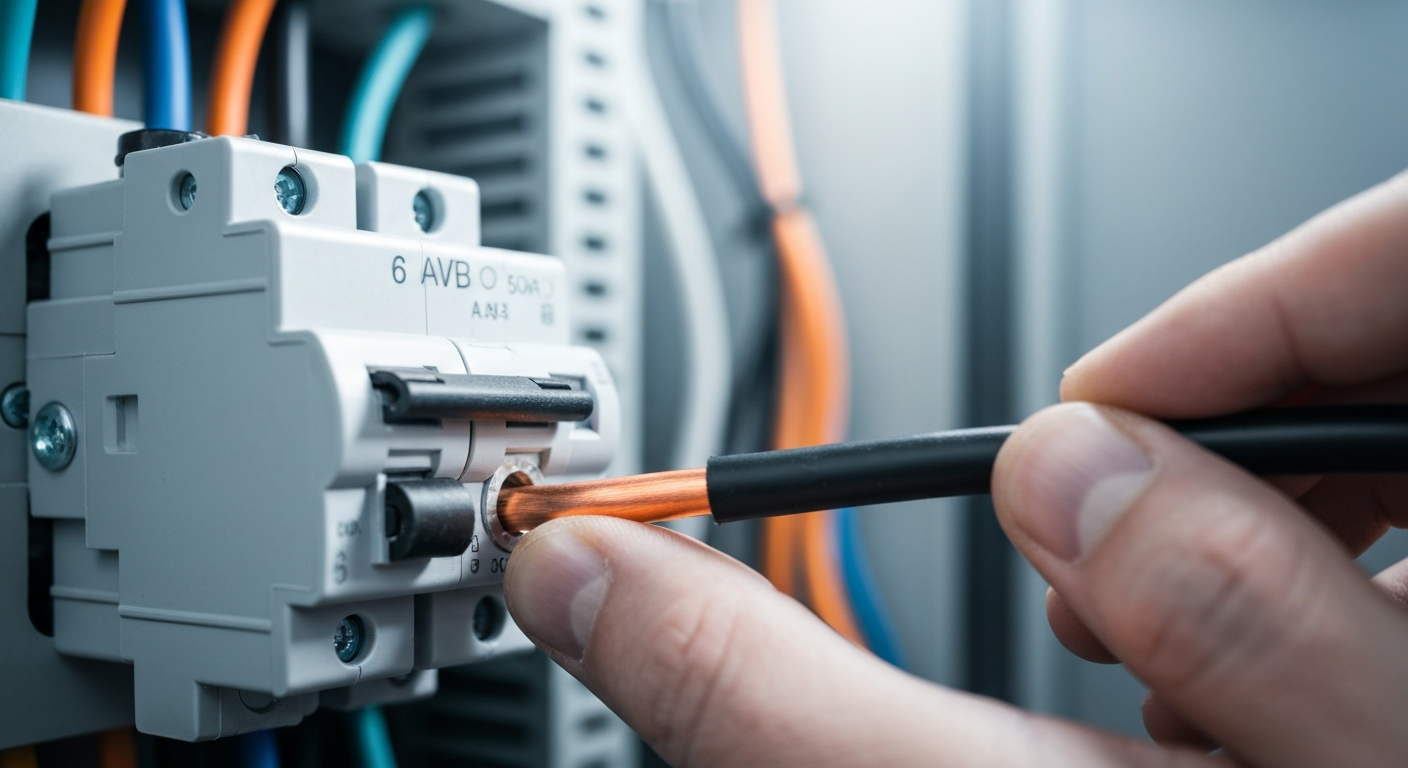
How to Calculate Wire Gauge for a 50 Amp Circuit
How to Calculate Wire Gauge for a 50 Amp Circuit
For a 50 amp circuit, the standard required 50 amp wire size is typically 6 AWG copper wire or 4 AWG aluminum wire. This baseline recommendation is derived from the National Electrical Code (NEC) and is based on the conductor’s ampacity at a specific temperature rating. However, simply choosing this size without further consideration is a critical mistake. Factors such as the conductor material, the load type (continuous or non-continuous), ambient temperature, and the total length of the circuit run can all require you to use a larger wire. For instance, a long circuit may demand a larger wire to mitigate voltage drop, a key factor addressed by a voltage drop calculation. The selection is governed by NEC Table 310.16, the definitive wire ampacity chart for electricians. This ensures the wire can handle the load from a 50 amp breaker safely without overheating, adhering to strict safety and performance standards outlined in the nec code book.
Understanding the Fundamentals of 50 Amp Wire Size
Properly sizing a conductor for a 50 amp circuit is one of the most fundamental safety tasks for an electrician. Choosing a wire that is too small for the amperage is a serious fire hazard. The wire can overheat, melting its insulation and potentially igniting surrounding materials. This is why the National Electrical Code (NEC), published by the National Fire Protection Association (NFPA), provides rigorous guidelines for branch circuit sizing. The entire system is designed around the concept of overcurrent protection. A 50 amp breaker is designed to trip and shut off the circuit if the current exceeds 50 amps. Its primary job is to protect the wire connected to it. Therefore, the wire itself must have an ampacity—or current-carrying capacity—of at least 50 amps after all real-world conditions are accounted for.
The Starting Point: NEC Table 310.16 and Conductor Ampacity
The journey to determining the correct wire size begins with NEC Table 310.16. This table is the authoritative source for finding the allowable ampacity for insulated conductors. When you consult this wire ampacity chart, you’ll see columns for different conductor materials (copper, aluminum) and different temperature ratings (60°C, 75°C, and 90°C).
- For Copper Conductors: A 6 AWG copper wire in the 75°C column has an ampacity of 65A.
- For Aluminum Conductors: A 4 AWG aluminum wire in the 75°C column has an ampacity of 65A.
Since both values are above 50A, they are the typical starting points. But why use the 75°C column? According to NEC 110.14(C)(1), the circuit’s maximum ampacity is limited by the lowest temperature rating of any connected termination, device, or conductor. Most circuit breakers and panelboard terminals are rated for 75°C, making this the most common column to use for these circuits. To dive deeper into using this critical code section, you can review how to properly use NEC Table 310.16 for ampacity.
Step-by-Step: How to Calculate the Correct 50 Amp Wire Size
Selecting the right wire is more than just looking at a chart. Professional electricians must perform a series of calculations to ensure compliance and safety. Here is a step-by-step process for accurate 240V circuit wiring.
- Determine Load Type (Continuous vs. Non-continuous)
The NEC defines a continuous load as one that runs at maximum current for three hours or more. Per NEC 210.19(A)(1), branch circuit conductors must be sized to carry 125% of the continuous load. This is often called the 80% rule in reverse: a breaker can only be loaded to 80% of its rating for a continuous load. For a 50 amp circuit, the maximum continuous load is 40A (50A x 80%). If your load is a 45A non-continuous load, a 50A circuit is fine. But if you have a 45A continuous load, you need to size the wire and breaker for 56.25A (45A x 1.25), which would push you into the next standard breaker size (60A). - Select Conductor Material and Find Base Ampacity
Choose between copper and aluminum. Copper is a better conductor and more durable, but more expensive. Aluminum is lighter and more affordable but requires larger sizing and specific installation techniques. Using NEC Table 310.16 at 75°C, identify the base ampacity: 6 AWG copper (65A) or 4 AWG aluminum (65A). - Apply Correction and Adjustment Factors
The ampacity found in the table is for ideal conditions: an ambient temperature of 86°F (30°C) and no more than three current-carrying conductors in a raceway. When conditions are not ideal, you must derate the wire’s ampacity.
Temperature Correction Factors
If the wire will be run through a hot environment, such as an attic in a warm climate, you must apply a temperature correction factor from NEC Table 310.15(B)(1). For example, if 6 AWG THHN copper wire (which has a 90°C insulation rating, giving it a starting ampacity of 75A) is run in an ambient temperature of 115°F (46°C), you must multiply its ampacity by 0.82. The adjusted ampacity becomes 61.5A (75A x 0.82), which is still safely above 50A.
Conduit Fill Adjustments
If you run more than three current-carrying conductors in the same conduit or cable, you must also apply an adjustment factor per NEC Table 310.15(C)(1). For example, bundling 4-6 current-carrying conductors requires you to reduce the ampacity to 80% of its original value. This factor is applied in addition to any temperature corrections.
- Calculate Voltage Drop for Long Circuits
For long circuit runs, voltage drop becomes a significant concern. The NEC [210.19(A)(1) Informational Note No. 4] recommends limiting voltage drop to 3% for branch circuits to ensure equipment efficiency and performance. You can use a voltage drop calculator or the formula: VD = (2 x K x I x D) / CM.- VD = Voltage Drop
- K = Resistivity of the conductor (approx. 12.9 for copper, 21.2 for aluminum)
- I = Current (Amps)
- D = One-way distance in feet
- CM = Circular Mils of the conductor (from NEC Chapter 9, Table 8)
For a 50A load on a 240V circuit, a 3% drop is 7.2V. If your calculation shows a drop greater than this, you must increase your wire size (e.g., from 6 AWG to 4 AWG copper) until the drop is within the acceptable range. A detailed guide is essential for getting this right, so be sure to understand how to calculate voltage drop using NEC principles.
Power up your knowledge on high-amperage circuits. View our course catalog.
Common Applications and Cable Types for 50 Amp Circuits
50 amp circuits are common for high-power residential and light commercial equipment. Typical applications include:
- Electric Ranges and Cooktops
- Electric Vehicle (EV) Chargers connected to a NEMA 14-50 outlet
- Large Electric Water Heaters
- Welders or other large shop tools
- Feeders to a subpanel feeder
The type of cable used is also critical. A common choice is a 6/3 wire, which contains three insulated conductors (two hots, one neutral) and a bare ground conductor. When using non-metallic sheathed cable (NM-B, or Romex), NEC 334.80 requires that the ampacity be based on the 60°C column of Table 310.16. For 6 AWG copper, the 60°C ampacity is 55A, which is still sufficient for protection by a 50A breaker. For installations in conduit, individual conductors like THHN/THWN-2 are common, offering higher temperature ratings that provide a buffer when derating is necessary. For subpanels, Service Entrance Cable (SER) is another popular option. For those installing EV chargers, it’s vital to know how to properly install a NEMA 14-50 receptacle for safety and code compliance.
Sizing the Breaker and Overcurrent Protection
The final piece of the puzzle is the breaker itself. The rules for overcurrent protection are found in NEC Article 240. The breaker’s rating must protect the conductor according to its final, derated ampacity. You cannot simply use a larger wire and keep the same breaker without ensuring the entire circuit is rated for it. The relationship between the breaker and the wire is non-negotiable. If you follow the steps above and determine your conductor ampacity is at least 50A after all adjustments, a 50 amp breaker is the correct choice. Mastering this relationship is key, and further study on how to size a circuit breaker per the NEC will solidify your understanding.
Primary Sources
- NFPA 70, National Electrical Code (NEC), 2023 Edition
Frequently Asked Questions (FAQ)
What size wire for a 50 amp breaker?
The typical wire size for a 50 amp breaker is 6 AWG copper or 4 AWG aluminum. This is the starting point based on NEC Table 310.16. However, you must verify this size by performing adjustments for ambient temperature, conduit fill, and a voltage drop calculation for long distances.
Can I use 8 AWG wire for a 50 amp circuit?
No, you cannot use 8 AWG copper wire for a 50 amp circuit. While NEC Table 310.16 lists an ampacity of 50A for 8 AWG copper at 75°C, this is not the final determining factor. Per NEC 240.4(D), the maximum overcurrent protection for 8 AWG copper conductors is 40A. The “next size up” rule in NEC 240.4(B) cannot be used to justify a 50A breaker on this wire due to the specific small conductor limitations in 240.4(D). Using 8 AWG on a 50A breaker is a code violation and a significant safety hazard.
How far can you run 6 AWG wire for a 50 amp circuit?
For a 240V, 50A circuit, you can run 6 AWG copper wire approximately 147 feet before exceeding the NEC’s recommended 3% voltage drop, assuming a resistive load. This is based on standard NEC calculations using values from Chapter 9, Table 8. If your run is longer, you will need to increase the wire size to 4 AWG copper to stay within the voltage drop limit and ensure equipment operates correctly. Always use a size electrical wire calculator for your specific load and distance.
What is a 6/3 wire used for?
A 6/3 wire is a cable assembly typically used for 50 amp, 240V circuits that require two hot conductors, a neutral, and a ground. Its most common applications are for electric ranges, EV chargers terminating in a NEMA 14-50 outlet, and as a subpanel feeder. The “6” refers to the 6 AWG conductor size, and the “3” indicates it contains three insulated conductors.
Continuing Education by State
Select your state to view board-approved continuing education courses and requirements:

Disclaimer: The information provided in this educational content has been prepared with care to reflect current regulatory requirements for continuing education. However, licensing rules and regulations can vary by state and are subject to change. While we strive for accuracy, ExpertCE cannot guarantee that all details are complete or up to date at the time of reading. For the most current and authoritative information, always refer directly to your state’s official licensing board or regulatory agency.
NEC®, NFPA 70E®, NFPA 70®, and National Electrical Code® are registered trademarks of the National Fire Protection Association® (NFPA®)
You may also like

Colorado Electrical Licensing Requirements and Reciprocity Guide

Standby Generators in DE: Navigating Coastal Storm Regulations

 Login with Google