
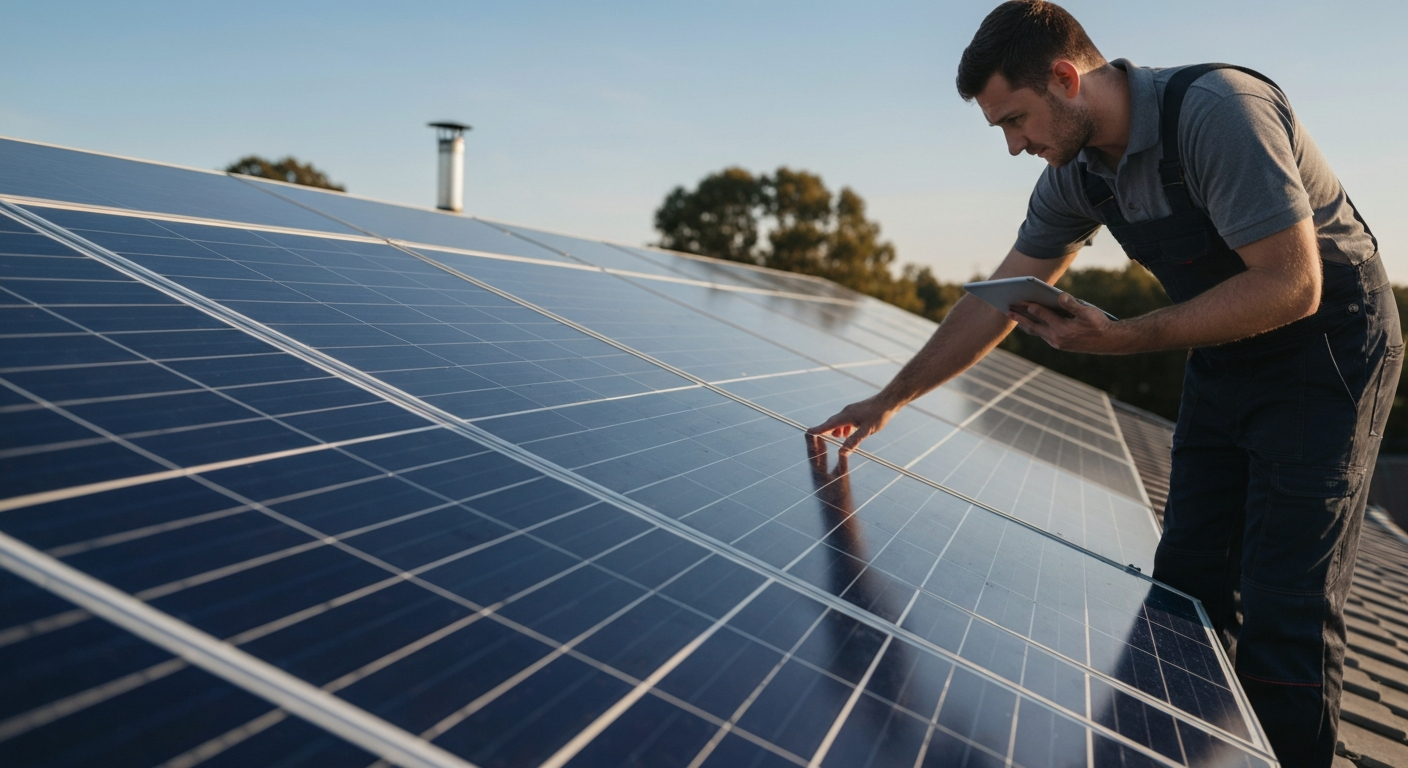
Calculating Optimal PV Azimuth and Tilt Angles for Max Output
Why Azimuth and Tilt Angles are Critical for PV System Performance
For any journeyman electrician or master electrician working with photovoltaics, understanding the physics of solar energy collection is as crucial as understanding wiring. The financial viability and energy output of a PV system — from a small residential array to a backup solar-powered generator for home use — hinges on its orientation to the sun. The goal is to achieve the most direct exposure for the longest period, a concept known as maximizing the optimal angle of incidence. An incorrectly oriented array can noticeably reduce annual energy output; the magnitude of losses depends on azimuth/tilt deviation, local irradiance, and shading. Quantifying the loss requires site-specific modeling. Therefore, precise solar array orientation is not a trivial detail; it is a foundational element of effective PV system design and a key component of professional electrician training in renewables.
Understanding the Fundamentals: Azimuth vs. Tilt
Before diving into calculations, it’s essential to clearly define the two primary angles that govern a solar array’s position.
Defining Azimuth: Your Compass Direction
Azimuth is the horizontal, compass direction that your solar panels face, measured in degrees clockwise from true north (for example, 0° = north, 90° = east, 180° = south, 270° = west). For many Northern Hemisphere projects, aiming panels near true south (180°) is a common baseline for optimization. Because a magnetic compass points to magnetic north, installers should adjust compass readings by the local magnetic declination to find true north/south — NOAA provides a calculator for local declination.
Defining Tilt: The Angle to the Sun
Tilt is the vertical angle of your solar panels relative to the horizontal ground. A panel lying flat has a 0° tilt, while a panel mounted vertically has a 90° tilt. The purpose of tilting the array is to adjust for the sun’s height in the sky, which varies by latitude and season. A widely used rule of thumb for fixed-tilt systems is to start with a tilt near the site’s latitude (e.g., a site near 40° latitude would typically begin around 40° tilt), but final tilt should be confirmed with a production model.
Step-by-Step Guide to Determining Optimal PV Azimuth and Tilt
While software tools provide the most precise figures, understanding the manual process is essential for exam preparation and on-site verification. Here’s a step-by-step approach:
- Determine Site Latitude: Find the precise latitude of the installation site. This is easily done using any online mapping service or GPS tool. This value is the foundation for your tilt angle baseline.
- Calculate True South (Azimuth): Use a compass and the local magnetic declination (from a source such as NOAA) to convert magnetic bearings to true bearings; apply the local declination adjustment to compass readings to locate true south. This ensures your solar array orientation is aligned with true geographic directions rather than magnetic bearings.
- Establish a Baseline Fixed Tilt: For year-round performance, a common starting point is a tilt near the site’s latitude. For a grid-tied system where summer production may be more valuable, evaluate slight reductions in tilt to favor summer performance — the exact choice should be modeled.
- Consider Seasonal Tilt Adjustment: To maximize seasonal yield, adjusting the tilt for winter (steeper) and summer (shallower) can help — evaluate these adjustments with a model rather than applying a fixed numerical offset without analysis.
- Refine with PV Design Software: Use a tool like the NREL PVWatts calculator to perform detailed PV system performance modeling. PVWatts incorporates historical solar resource and irradiance data for your location, allowing you to model how different azimuth and tilt combinations will perform on a monthly and annual basis. This step moves from rule-of-thumb to data-driven optimization.
Key Factors That Influence Your Final Design
Calculating angles is only part of the story. A professional electrician must consider several real-world factors that can override the “ideal” numbers.
- Shading Analysis: A detailed shading analysis is non-negotiable. Even a small amount of shading from a tree, chimney, or neighboring building can have a disproportionately negative impact on a string of panels. It is often better to have a shade-free, sub-optimal orientation than an “ideal” orientation that is shaded for part of the day.
- Site and Structural Constraints: The available roof plane dictates the possible azimuth. Furthermore, array structural loading is a critical safety consideration. The roof must be able to handle the weight of the array and the additional wind and snow loads, which can limit the feasible tilt angle.
- Local Weather Patterns and Irradiance: In areas with frequent morning fog or afternoon clouds, nudging the azimuth slightly east or west, respectively, may yield better results. PV design software that uses local weather files can model these nuanced effects.
- Utility Rate Structures: For grid-tied systems in areas with Time-of-Use (TOU) billing, orienting the array slightly west of south can shift peak production to the late afternoon, when electricity prices are often highest, maximizing financial returns even if total kWh production is slightly lower.
- Interconnection Requirements: Always consult local utility and building codes regarding interconnection requirements. While these rarely dictate orientation, they govern how the system connects to the grid, which is a key part of the overall design process.
Integrating PV Systems with Electrical Codes and Best Practices
A safe and effective solar installation requires more than just optimal angles; it demands rigorous adherence to electrical standards. All PV system installations must comply with NEC 690, the section of the NFPA 70 (NEC) dedicated to solar energy, which sets mandatory electrical safety requirements for PV systems. NEC Article 690 outlines critical requirements for conductor sizing, overcurrent protection, grounding, and rapid shutdown — these code requirements apply regardless of panel orientation. For example, understanding how to apply ambient temperature correction and conductor adjustment factors is vital for determining conductor ampacity and proper wire sizing; see NEC Article 310 for ampacity tables and correction factors. Design choices, such as using a series vs parallel circuit configuration for strings, will directly impact system voltage and current, which in turn affects wire sizing and voltage‑drop considerations. This is especially true for longer wire runs in larger or ground-mounted systems. For more on this, you can review how to calculate voltage drop according to the NEC. Mastery of these details is what separates an amateur from a professional and is essential for anyone pursuing NABCEP certification.
As solar energy continues its rapid expansion, electricians who master these design principles are in high demand. For those in burgeoning markets, such as electricians exploring solar career opportunities in Colorado, this expertise is a significant competitive advantage. Optimize your solar designs. Enroll in our advanced PV online electrical courses and comprehensive electrician training.
Advanced Concepts in PV System Performance Modeling
For electricians moving into advanced PV design and analysis, simple angle calculations are just the beginning. Professional PV system performance modeling incorporates a range of loss factors to create a highly accurate production estimate. A key variable is the DC-to-AC derate factor, which accounts for expected system losses: inverter inefficiency, soiling, wiring losses, and other factors. PVWatts and similar tools include default loss parameters but allow project-specific inputs; a detailed analysis calculates each specific loss to build a more accurate model, ensuring the final system performs as promised to the client.
Frequently Asked Questions (FAQ)
- What is the best pv azimuth and tilt angle if I can’t use the ideal orientation?
- If the ideal south-facing orientation is not possible, an east- or west-facing roof is still very viable. A west-facing array can be beneficial for residential customers on TOU rates, as it produces more power in the late afternoon. While production will be less than a perfectly oriented array, the magnitude of the reduction varies by site (commonly on the order of single-digit to low‑double‑digit percent in many cases) and should be modeled using a tool like PVWatts to set realistic expectations.
- How does seasonal tilt adjustment affect energy from a solar panel generator?
- For an off-grid solar panel generator, seasonal adjustment can be valuable. In winter, when the sun is lower, increasing tilt to catch the low sun can improve daily energy capture; in summer, decreasing tilt can favor the high sun. The amount of benefit depends on latitude and site conditions and is best quantified with a production model.
- Do I really need PV design software, or can I just use my latitude for the tilt?
- Using latitude for your tilt angle is a useful rule of thumb and will get you close to the optimal fixed angle for year-round production. However, using PV design software like the PVWatts Calculator is recommended for professional proposals because it incorporates local weather and irradiance data, shading, and system loss inputs to provide a more accurate estimate of monthly and annual energy production and financial savings.
- Where in the nec code book can I find rules for solar array orientation?
- The NEC (NFPA 70) — specifically Article 690 — does not prescribe solar array orientation (azimuth and tilt). Article 690 and related NEC articles govern the electrical safety requirements (conductor sizing, overcurrent protection, grounding, rapid shutdown) that apply regardless of how the panels are oriented.
Primary Sources
- National Renewable Energy Laboratory (NREL) – PVWatts Calculator
- National Oceanic and Atmospheric Administration (NOAA) – Magnetic Declination
- National Fire Protection Association (NFPA) – NEC Article 690
Continuing Education by State
Select your state to view board-approved continuing education courses and requirements:

Disclaimer: The information provided in this educational content has been prepared with care to reflect current regulatory requirements for continuing education. However, licensing rules and regulations can vary by state and are subject to change. While we strive for accuracy, ExpertCE cannot guarantee that all details are complete or up to date at the time of reading. For the most current and authoritative information, always refer directly to your state’s official licensing board or regulatory agency.
NEC®, NFPA 70E®, NFPA 70®, and National Electrical Code® are registered trademarks of the National Fire Protection Association® (NFPA®)
You may also like

Colorado Electrical Licensing Requirements and Reciprocity Guide
Standby Generators in DE: Navigating Coastal Storm Regulations

 Login with Google