
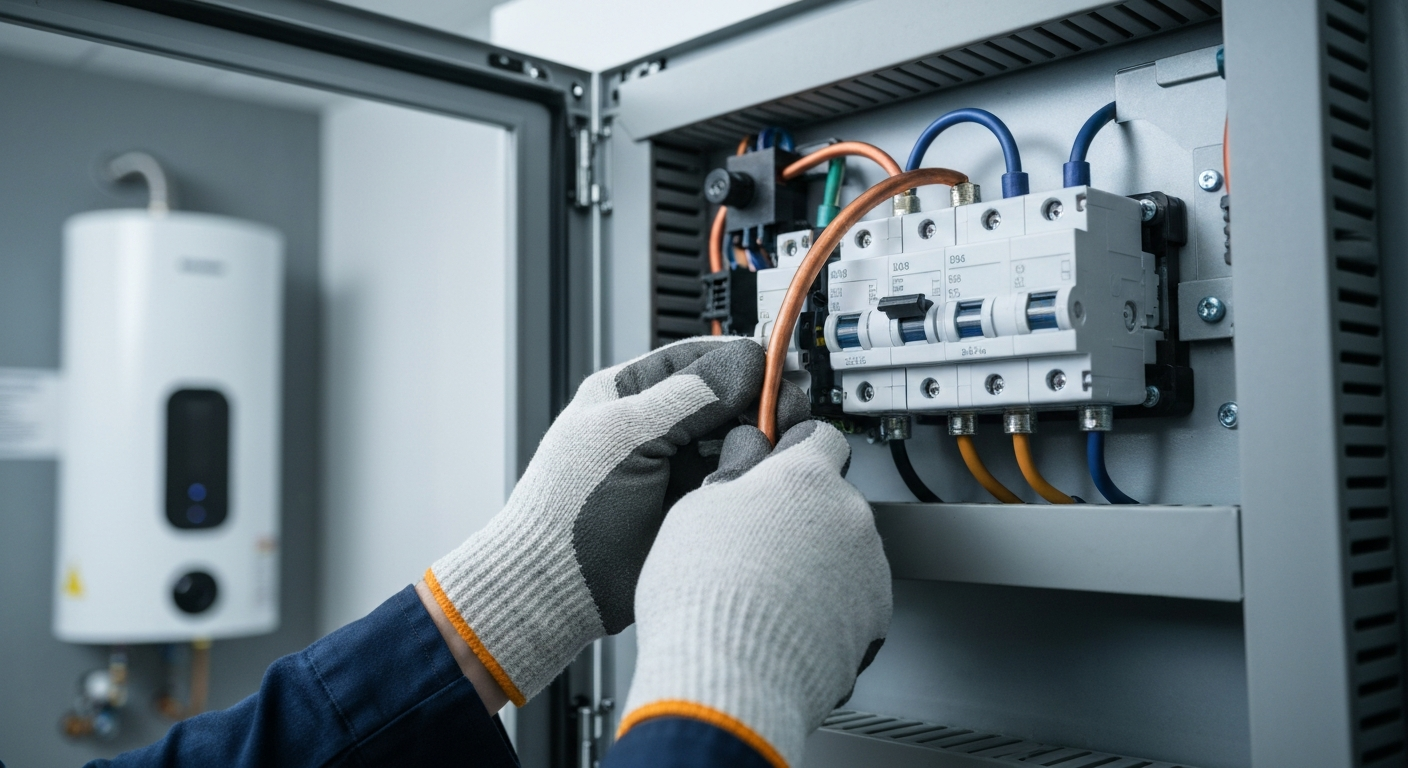
Calculating Branch Circuit Size for Electric Tankless Water Heaters
Calculating Branch Circuit Size for Electric Tankless Water Heaters
Calculating the correct circuit size for a tankless water heater is a critical task for any licensed electrician. A proper continuous load calculation based on the NEC continuous-load requirements is required to determine the minimum ampacity, which then dictates the appropriate overcurrent protection device (OCPD) and conductor size. Whole-house electric tankless water heater models are high-power appliances and commonly draw very large currents — many models draw 100 A or more, and some high-demand units can require on the order of 150–200 A or use multiple dedicated circuits — making a dedicated circuit mandatory. After determining the heater’s maximum amperage draw from its nameplate (or computing it from the rated watts), you must apply the NEC continuous-load multiplier (125%) to the continuous portion of the load. This result is used to determine the minimum conductor ampacity and is a key value when selecting the OCPD from the standard sizes. Finally, a total dwelling load calculation (NEC Article 220) is essential to ensure the existing electrical service can handle the added demand, as a service panel upgrade is frequently necessary for safe and compliant installations.
Why Proper Circuit Sizing is Non-Negotiable
The increasing adoption of electric tankless water heaters is driven by consumer demand for energy efficiency and on-demand hot water. However, these units have a significantly higher power demand than their tank-style counterparts. While a typical storage-tank water heater often uses a 30‑amp circuit, whole-house electric tankless water heaters commonly require much larger capacity — many demand 100 amps or more, and some installations can require on the order of 200 amps or more depending on model and configuration. This substantial electrical load makes precise circuit sizing not just a recommendation, but a matter of safety and performance. Undersizing the circuit conductors or the overcurrent protection device can lead to overheating, creating a severe fire hazard and causing premature failure of the appliance.
Understanding Key Electrical Concepts for Installation
To perform a compliant installation, a journeyman electrician must be proficient in several core concepts outlined in the NEC code book. These principles form the foundation of safe and reliable circuit design for high-power appliances.
- Continuous Load and the NEC 125% Rule: The NEC defines a continuous load as one expected to run for 3 hours or more. A tankless water heater’s duty can be intermittent or continuous depending on application and usage patterns; when the load is continuous, the NEC requires that conductor ampacity and continuous-load calculations include the 125% multiplier (see NEC Article 210.19(A)(1) for conductor ampacity and 210.20(A) for overcurrent device considerations). Appliance branch-circuit guidance and marking requirements are covered in Article 422.
- Ampacity and Wire Gauge (AWG): Ampacity is the maximum current a conductor can carry continuously without exceeding its temperature rating, determined by conductor material (copper or aluminum), size (AWG), insulation, and installation conditions. Reference the ampacity tables in Article 310 (e.g., Table 310.16) and apply any ambient‑temperature and conductor‑count adjustment factors before finalizing the conductor size.
- Voltage Drop: Over long conductor runs, voltage drop can reduce appliance performance. The NEC recommends planning for reasonable voltage drop (commonly ~3% for branch circuits) — for high‑draw appliances like tankless heaters, you may need a larger conductor than the minimum ampacity to limit voltage drop and preserve performance.
Step-by-Step: Calculating the Circuit Size for a Tankless Water Heater
Follow these steps to determine the correct branch circuit size for a tankless water heater on a 240-volt circuit.
- Determine the Maximum Amperage Draw (nameplate or watts): Locate the heater’s nameplate for total wattage or Full Load Amperage (FLA). If only wattage is provided, use Amps = Watts / Volts. For example, a 30,000 W heater on 240 V would be 30,000 / 240 = 125 A.
- Apply the NEC continuous-load multiplier: If the load is continuous as defined by the NEC, multiply the continuous portion of the nameplate amperage by 1.25. Using the example: 125 A × 1.25 = 156.25 A. This is the minimum ampacity value that must be used for conductor sizing and as the continuous value when determining overcurrent protection.
- Select the Overcurrent Protection Device (OCPD): The chosen OCPD must comply with NEC limitations (240.4, 210.20, and the standard ratings in Table 240.6(A)). Since 156.25 A is not a standard breaker size, you would select the next appropriate standard rating (for example, 175 A), provided the appliance nameplate and equipment ratings permit that breaker and the conductors and terminations are rated accordingly. For more detail on breaker selection and the NEC, see how to size a circuit breaker based on the NEC.
- Size the Conductor (Wire): Use the required ampacity (the 125%-adjusted continuous value) and then apply any ambient temperature and conductor-count adjustment factors to select a conductor size per Article 310 tables (e.g., Table 310.16). For THHN copper on 75°C terminations, 2/0 AWG is typically rated about 175 A and would cover the 156.25 A requirement in the example, but always confirm termination temperature ratings and apply ambient/adjustment factors before final selection.
- Perform a Total Dwelling Load Calculation: Perform the NEC Article 220 load calculation for the dwelling to ensure the existing service can safely supply the new load. Many older 100 A or 150 A services will lack adequate capacity, and a service panel upgrade (commonly to 200 A or larger) is often required when adding a whole‑house tankless heater.
Confidently install high-power appliances. Enroll in our load calculation courses.
Installation Considerations and Best Practices
Beyond the calculations, executing a professional installation involves several key practices. Adhering to these guidelines ensures the safety, reliability, and longevity of the system.
- Dedicated Circuit: An electric tankless water heater must be installed on its own dedicated circuit. It cannot share a circuit with unrelated outlets or appliances. Some larger models require multiple dedicated circuits as specified by the manufacturer.
- Service Panel Capacity: Before starting work, verify the main service panel has both physical space for the new breaker(s) and sufficient electrical capacity to support the new load. Effective electrical load management starts with this assessment; if the total calculated load exceeds the service rating, a service upgrade is necessary per NEC Article 220.
- Disconnecting Means: Permanently connected appliances require a disconnecting means that meets NEC Article 422. The branch‑circuit breaker can serve as the disconnect if it is within sight of the appliance; otherwise provide a local disconnect at the unit or a listed arrangement permitted by the code. Learn more about applicable disconnect requirements in our install a water heater disconnect switch guide.
- Manufacturer’s Instructions: Always consult the manufacturer’s installation manual. The NEC provides minimum safety standards, but manufacturers frequently specify wiring, connection, and installation details that must be followed.
For a comprehensive overview of the entire process, see our guide on how to install an electric tankless water heater. If you encounter issues with an existing unit, our article on troubleshooting an electric water heater can provide valuable insights.
Primary Sources
- National Fire Protection Association (NFPA) for the National Electrical Code (NEC)
Frequently Asked Questions (FAQ)
- How many dedicated circuits does an electric tankless water heater need?
- Many residential models use one or more dedicated 240‑V circuits; some whole‑house high‑demand models require multiple circuits or very large single circuits and can place significant demands on the service (sometimes requiring 150–200 A or more). Always follow the manufacturer’s specifications for the exact number and amperage of circuits.
- Can I use the old circuit from my tank-style water heater?
- In almost all cases, no. A standard tank water heater commonly uses a 30‑amp circuit with 10 AWG copper. A whole‑house electric tankless water heater has a much higher maximum amperage draw and will typically require much larger conductors and breakers (for example, 2/0 AWG or larger and 150 A–200 A OCPD, or multiple circuits) depending on the unit. Always confirm with the appliance nameplate and NEC requirements.
- What is the risk of using the wrong wire gauge (AWG)?
- Using an undersized wire gauge (AWG) for the circuit’s ampacity is dangerous: the wire can overheat, damaging insulation and creating a fire hazard. It also increases voltage drop, which reduces appliance performance and can shorten equipment life.
- Is a service panel upgrade always required for a tankless water heater?
- A service panel upgrade is not automatically required but is common. Installers must perform a total dwelling load calculation per NEC Article 220. If the new total load exceeds the existing service capacity, an upgrade is necessary for a safe and code-compliant installation.
Continuing Education by State
Select your state to view board-approved continuing education courses and requirements:

Disclaimer: The information provided in this educational content has been prepared with care to reflect current regulatory requirements for continuing education. However, licensing rules and regulations can vary by state and are subject to change. While we strive for accuracy, ExpertCE cannot guarantee that all details are complete or up to date at the time of reading. For the most current and authoritative information, always refer directly to your state’s official licensing board or regulatory agency.
NEC®, NFPA 70E®, NFPA 70®, and National Electrical Code® are registered trademarks of the National Fire Protection Association® (NFPA®)
You may also like

Colorado Electrical Licensing Requirements and Reciprocity Guide
Standby Generators in DE: Navigating Coastal Storm Regulations

 Login with Google