
Understanding Air Brake System Components for the CDL Exam
An Electrician’s Guide to Commercial Air Brake System Components
For any electrical professional, understanding a system’s load and control scheme is fundamental. In modern commercial vehicles, few systems are as critical as the air brakes. While seemingly mechanical, today’s air brake systems are complex electro-pneumatic networks managed by sophisticated electronics. For a journeyman electrician or master electrician looking to apply their skills in the vehicle service industry, a grasp of these components is essential. The system blends mechanical parts like compressors and brake chambers with a suite of electronic controls, including the brake system ECU, wheel speed sensors, and solenoid valves. These components communicate over a CAN bus network, creating a system where electrical diagnostic skills are paramount. A deep dive into this technology, from the logic of an air brake ABS wiring diagram to wheel speed sensor diagnostics, reveals a new and complex field for electrical expertise.
The Foundation: Core Mechanical Components as a Controlled System
Before diagnosing the electronics, it is crucial for an electrical professional to understand the fundamental mechanical parts that the control system manages. These components work together to convert stored potential energy (compressed air) into the mechanical force needed to stop a heavy vehicle. From an electrician’s viewpoint, this is the “load” side of the circuit.
- Air Compressor: The heart of the system, the air compressor is an engine-driven pump that pressurizes air and sends it to the storage tanks.
- Governor: This device controls the air compressor, functioning like a pressure switch. It tells the compressor when to pump air (the “cut-in” pressure) and when to stop (the “cut-out” pressure). While FMVSS 121 does not mandate specific governor cut-in/cut-out pressures, many manufacturers commonly set cut-in at approximately 100 psi and cut-out near 120–130 psi; exact values vary by vehicle and governor model.
- Air Storage Tanks (Reservoirs): These tanks store the compressed air, holding enough to allow for several brake applications. FMVSS 121 establishes braking performance requirements and test criteria; reservoir capacity is chosen by manufacturers so that the vehicle meets those performance requirements rather than FMVSS specifying a fixed reservoir size.
- Air Dryer: Located between the compressor and reservoirs, the air dryer removes moisture and oil from the compressed air to prevent freeze-ups and protect electro-pneumatic valve seals from contamination.
- Foot Valve (Treadle Valve): This is the driver’s primary input device. When pressed, it functions as a variable pneumatic controller, metering air from the reservoirs and sending it to the brake chambers to apply the brakes.
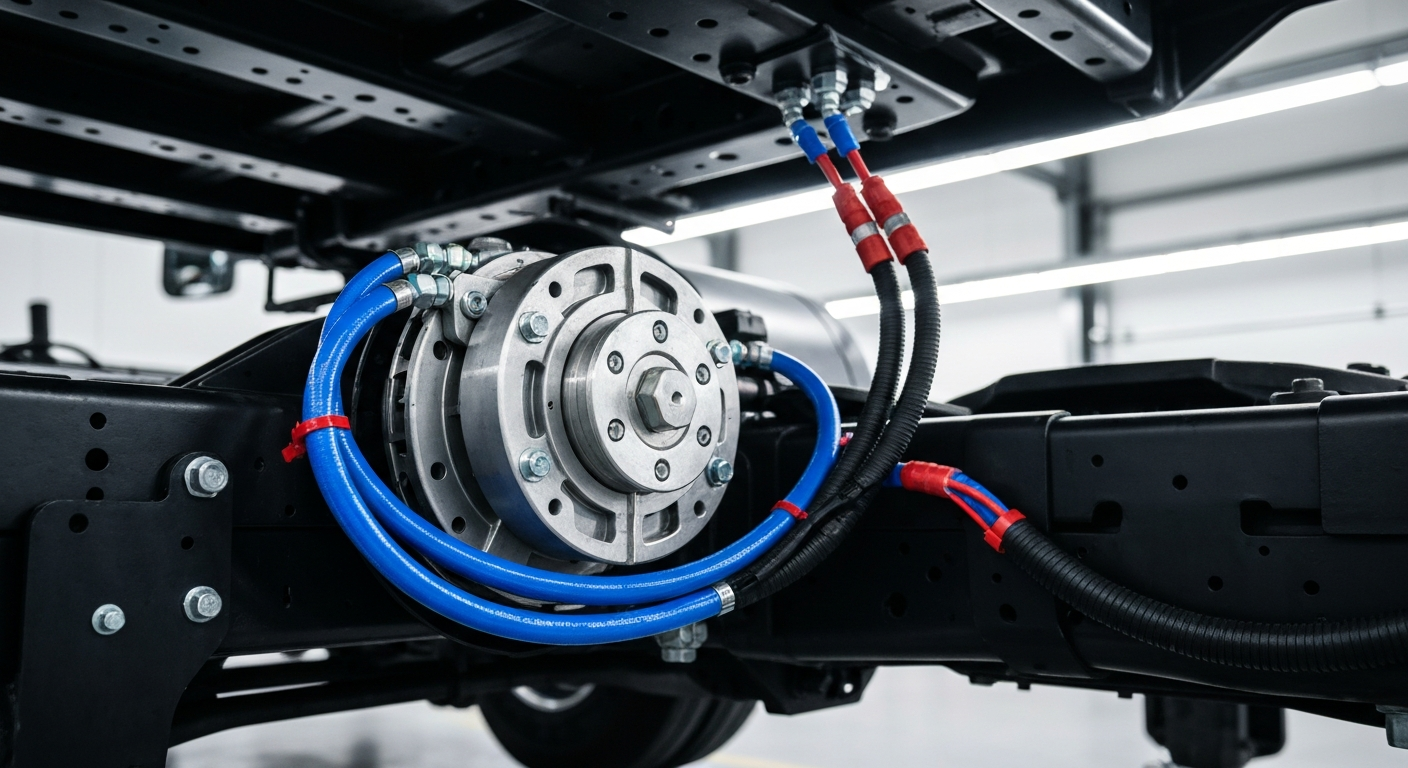
- Brake Chambers: These actuators, located at each wheel, convert the energy of compressed air into mechanical force by pushing on a diaphragm connected to a pushrod.
- Slack Adjusters and S-Cams: The pushrod connects to a slack adjuster, a lever that rotates an S-shaped cam. The S-cam forces the brake shoes against the brake drum, creating friction.
- Foundation Brakes: This refers to the mechanical friction parts at the wheel, typically S-cam drum brakes or air disc brakes.
The Brains of the Operation: Electronically Controlled Braking System (EBS) Maintenance
While mechanical parts provide the force, modern trucks rely on a sophisticated electronic network for precise control and safety. The Electronically Controlled Braking System (EBS) is an electronically controlled pneumatic system that enhances driver input for faster, more balanced braking while still using pneumatic actuation. It serves as the central nervous system for features like the Anti-lock Braking System (ABS) and stability control, making its maintenance and diagnostics a critical task for technicians.
The Brake System ECU: The Central Command
The Electronic Control Unit (ECU) is the brain of the modern braking system. It receives input from the driver’s brake pedal sensor and various other sensors around the vehicle, such as wheel speed and vehicle load. Using this data, the ECU’s embedded software calculates the precise braking pressure needed for each wheel to ensure stability and the shortest possible stopping distance. This intelligent control enables advanced safety functions and efficient brake management; FMVSS 121 addresses braking performance and ABS requirements that these electronic systems help the vehicle meet.
Critical Sensors and Diagnostics
The ECU relies on a constant stream of accurate data. Wheel speed sensor diagnostics are paramount, as faulty sensors can disable the ABS. These sensors, often Hall effect or variable reluctance types, monitor each wheel’s rotational speed and report it to the ECU. If a wheel is about to lock up, the ECU detects the rapid deceleration and modulates the brake pressure to that specific wheel. Likewise, understanding brake pressure sensor wiring and function is key, as these sensors inform the ECU of the driver’s braking request.
Actuators and Valves
The ECU’s commands are carried out by electro-pneumatic valves. Air brake solenoid valve testing is a crucial diagnostic step. When the ECU determines braking is needed, it sends a duty-cycle/digital command to the appropriate solenoid valve, which then opens to allow a controlled amount of air pressure to flow to the brake chamber. This process happens much faster than a purely mechanical system could achieve, improving safety and performance.
Troubleshooting and Communication in Modern Brake Systems
The complexity of modern air brakes means that troubleshooting requires a blend of mechanical inspection and advanced electronic diagnostics. For an electrician, traditional diagnostic skills remain invaluable, but technicians working on vehicle systems should also follow industry-specific procedures and training.
Data, Codes, and Communication
Effective air brake system electrical troubleshooting often begins at the diagnostic port. The entire system communicates via a network called the Controller Area Network (CAN bus), which allows various ECUs (engine, brake, transmission) to share data. This is analogous to an industrial control network linking multiple PLCs. In commercial vehicles, this communication typically follows the SAE J1939 protocol. A technician commonly connects a scan tool to the vehicle’s 9-pin Deutsch connector (the heavy-vehicle diagnostic port) to perform brake system fault code analysis. These codes can pinpoint issues with specific components, like a faulty wheel speed sensor or an open circuit in a solenoid valve.
The tractor-trailer 7-way connector is another critical electrical link. It provides power and signal circuits for the trailer (lights, turn/brake signals, and sometimes auxiliary power) and many trailer ABS units draw power through this connector. Some manufacturers also use power-line carrier (PLC) techniques or dedicated wiring schemes for additional tractor–trailer communication, though implementations vary by manufacturer and are governed by SAE and industry practices. Federal regulations (see FMVSS and 49 CFR Part 393) require proper braking performance and ABS malfunction indication; a damaged trailer cable or connector can indeed cause ABS faults on the trailer.
The Evolving Landscape: New Technologies and Careers
The world of commercial vehicles is rapidly changing, driven by electrification and automation. This evolution directly impacts braking systems and creates new opportunities for skilled electrical professionals.
Advanced Braking: Electric and Regenerative Systems
The rise of the electric truck regenerative braking system is a game-changer. These systems use the electric motor as a generator to slow the vehicle, converting kinetic energy back into electricity to recharge the battery. This process is blended with the traditional air brake system by the vehicle control architecture. When the driver brakes, the ECU or vehicle control unit prioritizes regenerative braking and supplements it with the air brakes as needed. This requires seamless foundation brake electrical integration, where the ECU decides how to blend the two systems for maximum efficiency and safety. This technology not only increases vehicle range but also significantly reduces wear on mechanical brake components.
A New Frontier for Electrical Professionals
The increasing complexity of commercial vehicle electrical systems has opened a new career path for individuals with a strong electrical background. The skills of a journeyman electrician or master electrician—such as understanding wiring diagrams, diagnosing shorts with a multimeter, and working with control systems—are highly transferable. It is critical to understand, however, that while these skills are applicable, work on heavy-vehicle brake systems is governed by industry standards and commercial-vehicle certifications rather than the NEC or most state electrical board rules. Instead, it typically requires certifications specific to the heavy-vehicle industry, such as those from the National Institute for Automotive Service Excellence (ASE), and knowledge of federal standards like the Federal Motor Vehicle Safety Standards (e.g., FMVSS 121 for air brakes) and FMCSA regulations found in 49 CFR Part 393.
Key Takeaways for Electrical Professionals
- Commercial vehicle brake systems are complex electro-pneumatic networks controlled by a dedicated brake system ECU.
- Electrical diagnostic skills are essential for troubleshooting components like wheel speed sensors, pressure sensors, and solenoid valves.
- System-wide communication occurs on a CAN bus network, typically using the SAE J1939 protocol.
- An air brake ABS wiring diagram is the primary tool for tracing circuits and understanding component integration.
- While skills are transferable, vehicle systems are governed by FMVSS and FMCSA regulations (e.g., 49 CFR Part 393), not the NEC.
- The growth of electric trucks and regenerative braking creates new opportunities that require blending high-voltage power knowledge with traditional vehicle control system diagnostics.
Frequently Asked Questions
- What are the main components of a commercial air brake system?
- The main components include the air compressor, governor, air dryer, storage tanks (reservoirs), foot valve, brake chambers, slack adjusters, and the foundation brakes. These are all controlled and monitored by an electronic system.
- How does an air brake ABS wiring diagram work?
- An ABS wiring diagram illustrates the electrical connections between the brake system ECU, the wheel speed sensors at each wheel, and the modulator (solenoid) valves. When a sensor detects a wheel locking up, it signals the ECU, which then pulses the corresponding modulator valve to rapidly release and reapply brake pressure, preventing a skid.
- What is the role of the brake system ECU in commercial vehicle electrical systems?
- The brake system ECU is the central computer for the braking system. It processes signals from the driver and an array of sensors to control the brakes electronically, manage ABS and stability control functions, and optimize braking force at each wheel for safety and performance.
- Why is wheel speed sensor diagnostics important for air brake systems?
- Wheel speed sensor diagnostics are critical because the ABS and stability control systems depend entirely on accurate data from these sensors. A faulty sensor provides incorrect information to the ECU, which will disable the ABS or limit its functionality and compromise safety during emergency braking maneuvers.
- Can a journeyman electrician work on air brake electrical troubleshooting?
- Yes, the diagnostic skills of a journeyman electrician are highly applicable. With specific training on commercial vehicle systems governed by industry standards and federal regulations, familiarity with communication protocols like CAN bus (SAE J1939), and the use of vehicle diagnostic tools, an electrician can effectively perform air brake system electrical troubleshooting and repairs. However, heavy-vehicle work typically requires manufacturer procedures and industry certifications (such as ASE) in addition to general electrical licensing.
Continuing Education by State
Select your state to view board-approved continuing education courses and requirements:

Disclaimer: The information provided in this educational content has been prepared with care to reflect current regulatory requirements for continuing education. However, licensing rules and regulations can vary by state and are subject to change. While we strive for accuracy, ExpertCE cannot guarantee that all details are complete or up to date at the time of reading. For the most current and authoritative information, always refer directly to your state’s official licensing board or regulatory agency.
NEC®, NFPA 70E®, NFPA 70®, and National Electrical Code® are registered trademarks of the National Fire Protection Association® (NFPA®)
You may also like
Colorado Electrical Licensing Requirements and Reciprocity Guide
Standby Generators in DE: Navigating Coastal Storm Regulations

 Login with Google