
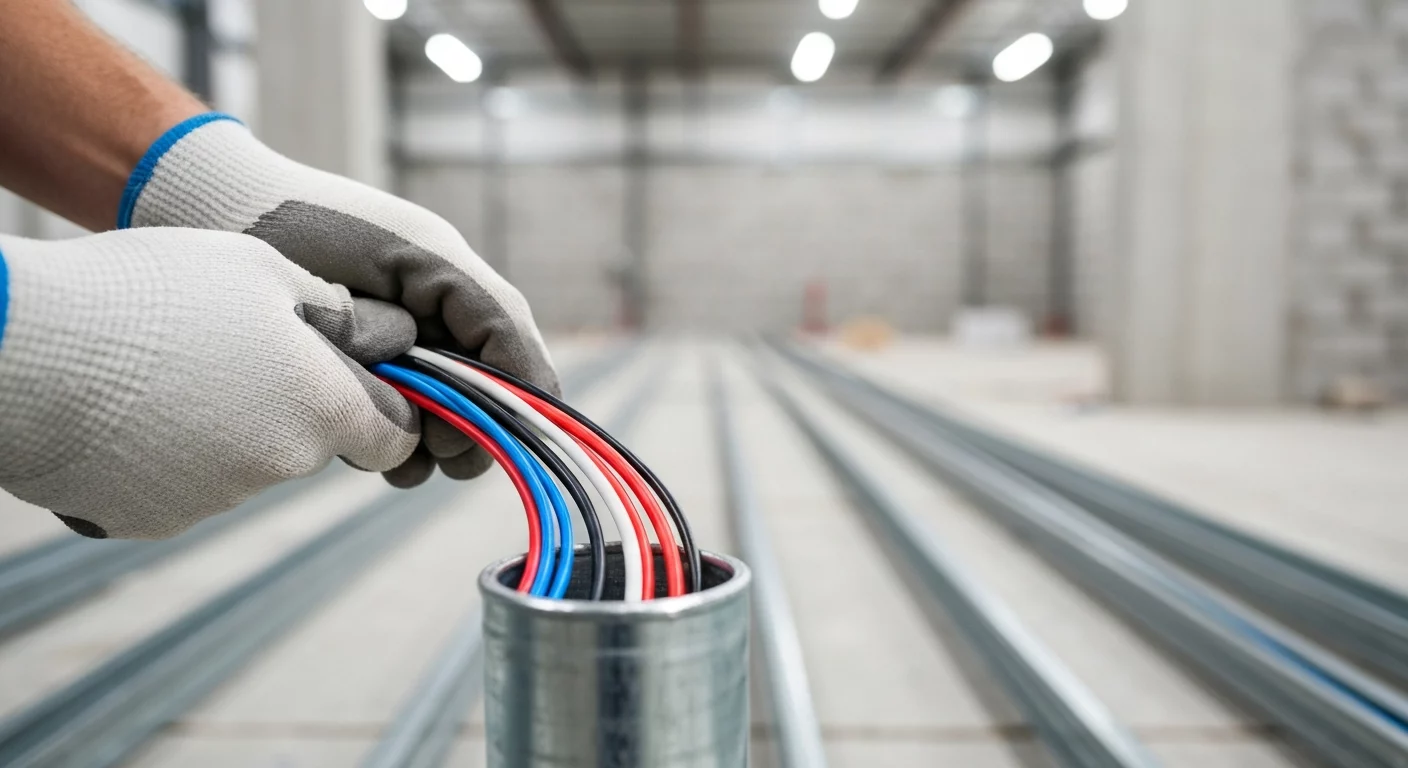
Using THHN Wire in Conduit: NEC Article 310 Code Rules
What is THHN Wire? Understanding the Basics
THHN wire is one of the most common single-conductor building wires used in commercial and residential construction. The acronym THHN stands for Thermoplastic High Heat-resistant Nylon-coated. This designation tells you about the wire’s construction and capabilities. It features a PVC (polyvinyl chloride) thermoplastic insulation, which provides primary dielectric strength, and is covered by a tough nylon jacket that protects the conductor from abrasion, chemicals, and oils during installation in raceways. For a deeper dive into how conductors and insulators function, see our guide on conductors versus insulators.
Most THHN wire sold today carries a dual rating: THHN/THWN-2. The “W” signifies that it is also rated for wet locations, and the “-2” indicates it can operate at up to 90°C in both dry and wet conditions. This versatility makes it a go-to choice for a wide range of applications, from dry indoor raceways to outdoor conduit runs. While THHN is a workhorse, other types like XHHW-2, which uses a thermoset insulation, offer different performance characteristics, such as greater flexibility and durability. Understanding the nuances between these options is key to selecting the right material for the job. You can explore more in our comprehensive electrical cable types guide.
Core NEC Rules for THHN Wire in Conduit
When installing THHN wire in any raceway, NEC Article 310, “Conductors for General Wiring,” is the primary section of the code book that governs the installation. This article provides the foundational rules for conductor ampacity, temperature limitations, and adjustments needed for specific conditions. It is crucial for every journeyman electrician to work from the current edition of the `nec code book` adopted by their jurisdiction, as tables and section numbers can change. For example, Article 310 was significantly reorganized in the 2020 NEC. Note that this article uses section numbers from the 2023 NEC for reference; always verify with the code edition adopted by your local jurisdiction.
Determining Ampacity with NEC Table 310.16
The starting point for determining a wire’s current-carrying capacity is `NEC Table 310.16`, “Allowable Ampacities of Insulated Conductors.” This `wire ampacity chart` provides values based on conductor size (AWG or kcmil), material (copper or aluminum), and insulation temperature rating (60°C, 75°C, and 90°C). Since THHN is a `90°C conductor rating` wire, you will use the 90°C column for your initial ampacity value when performing certain calculations.
However, a critical rule found in NEC 110.14(C) is the limitation imposed by the `terminal temperature rating`. Most circuit breakers, lugs, and other termination devices are rated for either 60°C or 75°C. This means that even though the THHN conductor itself can handle 90°C, its `allowable ampacity` must not exceed the value listed in the 60°C or 75°C column of Table 310.16, corresponding to the lowest-rated terminal in the circuit. The primary benefit of the 90°C rating is that it provides a higher starting ampacity for derating calculations. To learn more about applying this table correctly, review our detailed guide on how to use NEC Table 310.16.
Crucial Adjustments: Ampacity Derating and Conduit Fill
Simply selecting a wire from Table 310.16 is not enough. An installation is only code-compliant after all necessary adjustments for site-specific conditions are made. This involves two separate but equally important calculations: ampacity derating and conduit fill.
Ampacity Derating for Multiple Conductors and Ambient Temperature
Heat is the enemy of electrical conductors, and `Ampacity derating` is the process of reducing a wire’s allowable current to compensate for conditions that prevent it from dissipating heat effectively.
The two primary reasons for derating are:
- More than three current-carrying conductors: When you have four or more current-carrying conductors in a single raceway or cable, their proximity to each other generates excess heat. `NEC 310.15(C)(1)` (formerly 310.15(B)(3)(a) in the 2017 NEC) provides `adjustment factors` to account for this `conductor bundling`. For example, a conduit with 4-6 current-carrying conductors requires you to reduce the ampacity to 80% of its original value.
- Ambient temperature correction factors: The ampacities in Table 310.16 are based on a standard ambient temperature of 30°C (86°F). If your installation is in a hotter environment, such as an attic or on a rooftop, you must apply correction factors. The specific table number varies by NEC edition (e.g., Table 310.15(B)(1) in the 2023 NEC or Table 310.15(B)(2)(a) in the 2020 NEC), so always verify with your adopted code book.
These adjustments are applied to the conductor’s ampacity from the 90°C column (for THHN), and the final result cannot exceed the ampacity listed in the column corresponding to the terminal rating (e.g., 75°C). For a full breakdown of these adjustments, consult our guide on how to calculate wire ampacity derating.
A Step-by-Step Guide to Raceway Fill Calculations
Beyond ampacity, the physical volume conductors occupy inside a conduit is also strictly regulated. A `conduit fill calculator` or manual calculation is necessary to ensure you don’t exceed the permitted `Conduit fill percentage`. These `raceway fill calculations` prevent physical damage to wire insulation during pulling and ensure adequate space for heat dissipation.
- Identify the Rule from NEC Chapter 9, Table 1: This table specifies the maximum fill percentage. For three or more conductors, the conduit cannot be filled to more than 40% of its total cross-sectional area.
- Find the Conduit’s Total Area: Using NEC Chapter 9, Table 4, find the total internal area for your specific raceway type and size (e.g., 1/2″ `EMT conduit`). Note that different conduit types (`EMT conduit`, `PVC conduit`, RMC) of the same trade size have different internal areas.
- Find the Conductor’s Area: Using NEC Chapter 9, Table 5, find the cross-sectional area of a single conductor of your type and size (e.g., 12 AWG THHN).
- Calculate the Total Conductor Area: Multiply the area of one conductor by the total number of conductors you plan to install.
- Verify Compliance: Divide the total conductor area by the total conduit area (from step 2) and multiply by 100 to get your fill percentage. This value must be 40% or less.
For more examples and a deeper look at this process, refer to our comprehensive NEC derating and conduit fill guide.
Practical Application and Common Pitfalls
Properly installing THHN wire in conduit requires careful attention to detail to avoid common code violations and safety hazards. Mastering these concepts is essential for any professional electrician.
- Overlooking Overcurrent Protection Limitations: The final derated ampacity of a conductor must be protected by a standard-sized fuse or circuit breaker. If the calculated ampacity does not match a standard size, NEC 240.4(B) generally permits using the next higher standard size for `overcurrent protection limitations`, provided the circuit meets certain conditions (e.g., it is not a multi-outlet branch circuit supplying receptacles).
- Confusing 90°C Rating with Final Ampacity: A common error is assuming the 90°C column in Table 310.16 gives the final allowable ampacity. Remember, this value is primarily for derating calculations; the `terminal temperature rating` dictates the final limit.
- Ignoring Conductor Bundling Rules: The derating requirements of NEC 310.15(C)(1) apply not just to conductors inside a single conduit but also to cables bundled together for 24 inches or more without maintaining spacing.
- Choosing the Wrong Conductor for the Environment: While dual-rated THHN/`THWN-2` is suitable for most wet locations, extremely harsh chemical or abrasive environments might call for a more robust conductor like `XHHW-2`, which has a cross-linked polyethylene (XLPE) insulation that is more durable than THHN’s PVC/nylon construction.
To master these complex calculations and avoid common errors, it’s crucial to stay updated with ongoing training. Deepen your understanding of conductor types and applications. View our courses.
Primary Sources for Code Compliance
All rules and tables referenced in this article are based on the National Fire Protection Association’s NFPA 70, National Electrical Code. Electricians should always consult the official `nec code book` and any local amendments for final authority on installations. Information can be found directly at the source: NFPA.org.
Frequently Asked Questions about THHN Wire in Conduit
What is the maximum number of THHN wires in a 1/2″ EMT conduit?
The number depends on the wire gauge. For example, you can fit nine 12 AWG THHN conductors in a 1/2″ EMT conduit before exceeding the 40% `conduit fill percentage`. For 14 AWG THHN, the number is twelve. For 10 AWG THHN, it is five. Always use a `conduit fill chart` or perform a full calculation based on NEC Chapter 9 tables.
When do you have to derate the ampacity of THHN wire?
`Ampacity derating` is required under two main conditions: when there are `more than three current-carrying conductors` in a raceway or bundled together, and when the ambient temperature is above 86°F (30°C). Both conditions require applying adjustment factors from NEC 310.15.
Can I use the 90°C ampacity for my THHN wire?
Generally, no. The `allowable ampacity` of the circuit is limited by the lowest temperature rating of any component, which is typically the 60°C or 75°C `terminal temperature rating` of the breaker or device. The `90°C conductor rating` should only be used as the starting point for `ampacity derating` calculations.
What’s the difference between THHN and THWN-2?
Both are `conductor insulation types`. THHN is rated for dry and damp locations at 90°C. THWN-2 has the same 90°C rating but is also approved for wet locations. Today, most THHN wire is dual-rated as THHN/THWN-2, making it suitable for nearly all raceway applications.
Continuing Education by State
Select your state to view board-approved continuing education courses and requirements:

Disclaimer: The information provided in this educational content has been prepared with care to reflect current regulatory requirements for continuing education. However, licensing rules and regulations can vary by state and are subject to change. While we strive for accuracy, ExpertCE cannot guarantee that all details are complete or up to date at the time of reading. For the most current and authoritative information, always refer directly to your state’s official licensing board or regulatory agency.
NEC®, NFPA 70E®, NFPA 70®, and National Electrical Code® are registered trademarks of the National Fire Protection Association® (NFPA®)
You may also like

Colorado Electrical Licensing Requirements and Reciprocity Guide
Standby Generators in DE: Navigating Coastal Storm Regulations

 Login with Google