
Skin Effect in AC Conductors: What Electricians Should Know
Skin Effect in AC Conductors: What Electricians Should Know
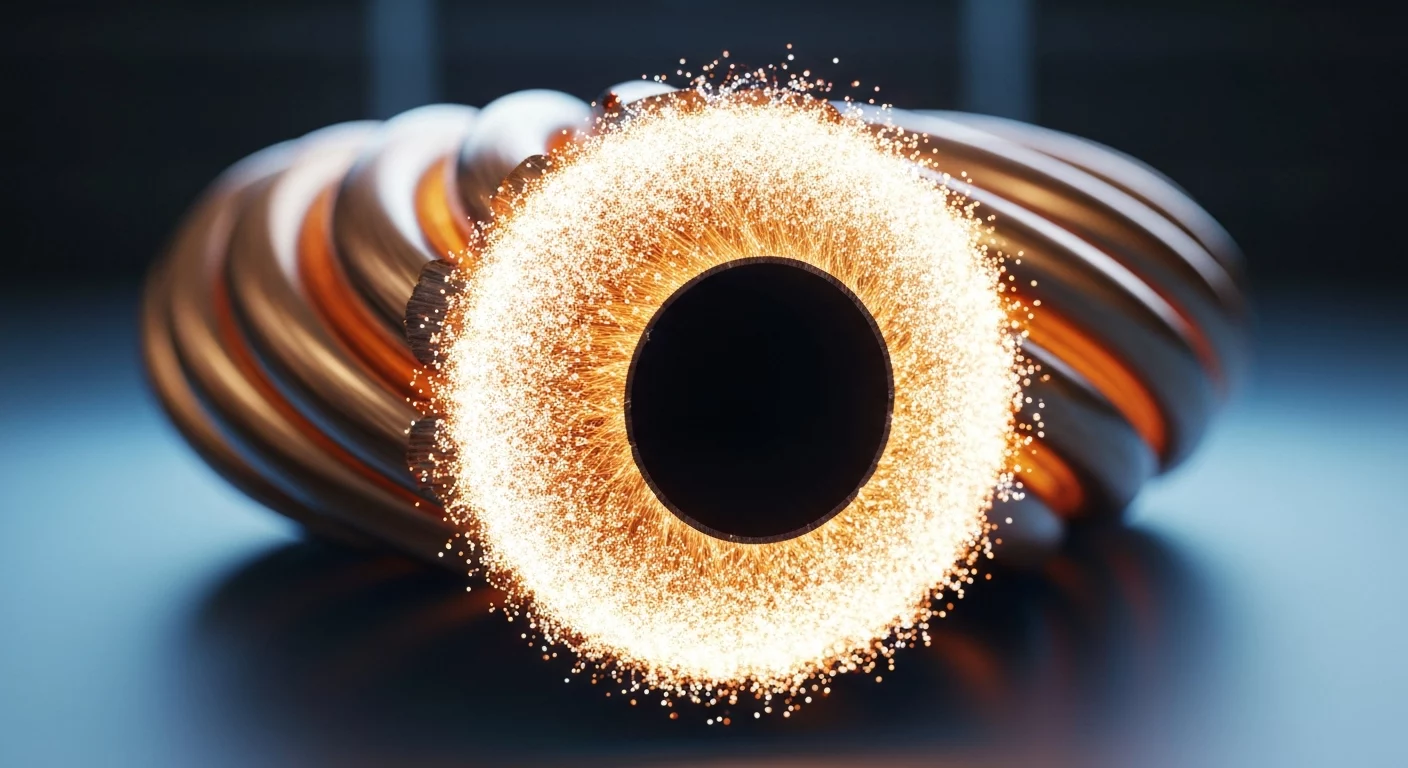
For electricians, understanding how current travels through a wire is foundational. While direct current (DC) flows uniformly through a conductor’s entire cross-section, alternating current (AC) behaves differently. The skin effect in AC conductors is a phenomenon where AC current density is highest near the surface (or “skin”) of the conductor, with lower current density at the core. This effectively reduces the usable cross-sectional area of the wire, leading to an increase in its AC resistance compared to its DC resistance. This matters for any journeyman electrician or master electrician because it causes increased power loss, generates more heat, and impacts voltage drop calculations, especially in circuits with high frequencies or large gauge conductors. Properly accounting for this effect is crucial for accurate wire size computation and ensuring the safety and efficiency of an electrical system.
What Is a Conductor and Why Does Skin Effect Happen in AC?
At its core, an electrical conductor is a material that allows electricity to flow through it easily. In DC systems, electrons flow in a steady, one-way path, utilizing the entire volume of the wire. However, the very nature of alternating current, which continuously reverses direction, creates a changing magnetic field around and within the conductor. This is the origin of the skin effect.
Eddy Currents: The Root Cause
According to Faraday’s law of induction, a changing magnetic field induces small, circulating currents within a conductor. These are known as eddy currents. Inside an AC conductor, these eddy currents flow in opposition to the main current flow at the center of the wire and in the same direction as the main current at the surface. The result is a cancellation effect at the core and a reinforcement effect at the skin, forcing the majority of the current to travel in the outer portion of the conductor. This reduces the effective cross-sectional area available for current flow.
Defining Skin Depth
The term skin depth refers to the distance from the conductor’s surface to the point where the current density drops to approximately 37% of its value at the surface (the 1/e point). A smaller skin depth means the current is confined to an even thinner layer, making the skin effect more pronounced. In copper, the skin depth at 60 Hz is approximately 8.4–8.5 mm. For many common conductor sizes the skin depth is larger than the conductor radius (so the skin effect is small at 60 Hz), but the effect becomes important for very large conductors and at higher frequencies.
Key Factors That Influence the Skin Effect
The intensity of the skin effect is not constant; it is influenced by several variables. A professional electrician must consider these factors, especially when working outside of standard residential or commercial systems.
- Frequency Dependence: This is the most significant factor. As the frequency of the alternating current increases, so does the magnitude of the skin effect. This is why it’s a major concern in radio frequency (RF) circuits, data centers, and systems with Variable Frequency Drives (VFDs), which introduce high-frequency harmonics.
- Conductor Diameter: The skin effect is more prominent in large gauge conductors. A larger diameter means there is more central core area that goes unused by the current, leading to a more significant increase in AC resistance.
- Conductor Material: The specific permeability and resistivity of the conductor material (e.g., copper vs. aluminum) influence the changing magnetic fields and resulting eddy currents, thereby affecting the skin depth.
Practical Consequences for the Working Electrician
While a fascinating physics problem, the skin effect has real-world consequences that impact safety, efficiency, and code compliance. Ignoring it can lead to under-specified systems and potential failures.
Increased AC Resistance and Power Loss
The most direct consequence is an increase in the conductor’s effective resistance. Because the current is squeezed into a smaller area, it encounters more opposition. This elevated AC resistance leads to greater power loss in the form of heat (I²R loss). In major industrial applications, these added losses can be substantial and should be evaluated when engineering large power distribution systems. For long-term projects it is prudent to consider life-cycle cost impacts from increased losses in the design phase.
Impact on Ampacity and Conductor Derating
A conductor’s ampacity is its maximum current-carrying capacity without exceeding its temperature rating. Since skin effect increases resistance and heat, it can effectively lower a conductor’s practical ampacity in certain high-frequency or very large-conductor situations. This is a crucial consideration in derating calculations, especially for conductor bundling or in high-temperature environments. While standard wire ampacity chart values are based on 60 Hz, engineers and electricians must be mindful of skin and proximity effects in high-frequency applications, as the chart may not be sufficient to ensure safety in those cases.
Voltage Drop and Wire Size Computation
Accurate wire size computation is essential for maintaining proper voltage at the load. The classic voltage drop formula relies on the resistance of the conductor. When skin effect is significant, using the DC resistance value from a standard table will lead to an inaccurate, underestimated voltage drop. The true voltage drop will be higher, which can cause equipment malfunctions. To perform an accurate calculation, one must use the AC resistance, which accounts for both skin effect and, in many cases, the proximity effect.
Understanding these advanced electrical concepts is what separates a proficient technician from a true expert. Deepen your expertise and ensure your projects are safe and efficient. See our course list for advanced training and online electrical courses.
How to Mitigate the Skin Effect
Engineers have developed several strategies to combat the negative impacts of skin effect, particularly in applications where it is most severe.
- Use Stranded Conductor: A stranded conductor is composed of many smaller strands of wire twisted together. While the overall bundle acts as a single conductor, this construction offers slightly more surface area than a solid conductor of the same gauge. It offers a minor improvement for 60 Hz power but is not a complete solution.
- Employ Litz Wire: For high-frequency applications, Litz wire is the definitive solution. The name comes from the German Litzendraht, meaning woven wire. It consists of many thin, individually insulated wire strands that are woven together in a specific pattern. This design forces the current to be shared equally among all strands, effectively neutralizing the skin effect and keeping the AC-to-DC resistance ratio close to 1. The market for Litz wire is growing, driven by its use in EVs, induction heating, and high-frequency power supplies.
- Use Hollow or Shaped Conductors: In large-scale, high-voltage power transmission and heavy-duty buswork it is common to use hollow conductors or flat busbars. Since current at power frequencies concentrates toward the outside, shaping or hollowing the conductor can save material and weight without sacrificing performance.
Skin Effect vs. Proximity Effect: A Crucial Distinction
The skin effect is often discussed alongside the proximity effect, but they are different phenomena.
- Skin Effect is self-generated. It is the tendency of AC current to flow on the outer layer of a single, isolated conductor due to its own changing magnetic field.
- Proximity Effect occurs in parallel AC conductors. The magnetic field of one conductor induces eddy currents in its neighbor, forcing the current in both wires to flow on the portions of the conductors furthest from each other. This also reduces the effective cross-sectional area and increases resistance.
When multiple conductors are run in the same conduit, both skin effect and proximity effect contribute to the overall increase in AC impedance.
What the National Electrical Code (NEC) Says
The National Electrical Code (NEC) provides the authoritative guidance for safe electrical installations. The writers of the nec code book are aware of AC behavior differences from DC. A crucial resource is NEC Chapter 9, Table 8 Conductor Properties. This table provides values for conductor resistance for AC at 60 Hz (in addition to useful DC references) and thus helps designers account for AC resistance when required. For installations where conductors run in close proximity (bundled or in parallel), the table values for isolated conductors do not include proximity-effect increases in resistance, so additional derating or analysis is necessary for an accurate impedance calculation.
Frequently Asked Questions
What is the primary cause of skin effect in AC conductors?
The primary cause is the nature of alternating current itself. The constantly changing current creates a changing magnetic field, which in turn induces eddy currents within the conductor. These eddy currents oppose the main current flow at the conductor’s center and assist it at the surface, forcing the net current to concentrate near the skin.
How does wire size computation account for AC resistance?
For critical applications, wire size computation must go beyond simple DC resistance. The nec code book, specifically in NEC Chapter 9, Table 8, provides AC resistance values for isolated conductors at 60 Hz, which designers can use in the voltage drop formula and ampacity considerations. These values address skin effect at 60 Hz for isolated conductors. However, when conductors are run in parallel or bundled in the same raceway, the proximity effect also increases AC impedance and must be considered by applying derating factors or a more detailed electromagnetic analysis.
Is skin effect a concern for a typical journeyman electrician?
For a journeyman electrician working on standard residential or light commercial projects with 60 Hz power and smaller conductors (for example, conductors smaller than very large sizes such as 2/0 AWG and above), the skin effect is generally small and is already encompassed by standard tables and practices. However, it becomes a critical concern when working with large gauge conductors, medium- or high-voltage systems, or specialized equipment like VFDs that introduce higher-frequency components.
What is the difference between a stranded conductor and Litz wire?
A stranded conductor is made of multiple bare wires twisted together, but they are all in electrical contact, so the bundle largely acts as a single, larger wire. It offers minimal benefit against skin effect at power frequencies. Litz wire is fundamentally different: each individual strand is coated with an enamel insulator and the strands are transposed; this forces the current to be distributed evenly among all strands, directly counteracting the skin effect, making it ideal for high-frequency applications.
Continuing Education by State
Select your state to view board-approved continuing education courses and requirements:

Disclaimer: The information provided in this educational content has been prepared with care to reflect current regulatory requirements for continuing education. However, licensing rules and regulations can vary by state and are subject to change. While we strive for accuracy, ExpertCE cannot guarantee that all details are complete or up to date at the time of reading. For the most current and authoritative information, always refer directly to your state’s official licensing board or regulatory agency.
NEC®, NFPA 70E®, NFPA 70®, and National Electrical Code® are registered trademarks of the National Fire Protection Association® (NFPA®)
You may also like

Colorado Electrical Licensing Requirements and Reciprocity Guide

Standby Generators in DE: Navigating Coastal Storm Regulations

 Login with Google