
Sizing GEC with NEC Table 250.66: A Step-by-Step Guide
Sizing GEC with NEC Table 250.66: A Step-by-Step Guide
Answer-First Summary
Properly sizing the Grounding Electrode Conductor (GEC) is a critical safety and code-compliance task for any licensed electrician. The fundamental rule, found in NEC Article 250, is to use NEC Table 250.66. This table dictates the minimum GEC size based on the size of the largest ungrounded service conductors. For instance, a service using 500 kcmil copper ungrounded conductors requires a minimum 1/0 AWG copper GEC. When dealing with parallel conductor sizing, the circular mil area of the conductors per phase must be summed to find an equivalent total before consulting the table.
However, crucial exceptions apply: NEC 250.66(A) rod, pipe, plate electrodes only require a GEC no larger than 6 AWG copper (or 4 AWG aluminum where applicable). For a concrete-encased electrode under NEC 250.66(B), the GEC need not be larger than 4 AWG copper; the NEC text for this exception is specifically stated for copper. Understanding the main table and these specific electrode exceptions is essential for correctly installing a grounding electrode system.
Continuing Education by State
Select your state to view board-approved continuing education courses and requirements:
As a certified CE instructor and electrical professional, I’ve seen firsthand how misinterpretations of grounding and bonding rules can lead to failed inspections and unsafe installations. The Grounding Electrode Conductor (GEC) is a cornerstone of a safe electrical system, providing a path for lightning, line surges, or unintentional contact with higher-voltage lines to reach the earth. Its size is not arbitrary; it’s meticulously detailed in the National Electrical Code (NEC) to ensure it can handle these events.
This guide will provide you with a step-by-step process for accurately sizing GECs for alternating-current systems using NEC Table 250.66, demystify the exceptions, and clarify its role within the larger grounding electrode system.
Distinguishing the GEC from the EGC
Before we size the GEC, it’s vital to differentiate it from an Equipment Grounding Conductor (EGC).
- Grounding Electrode Conductor (GEC): This conductor connects the system’s grounded conductor (usually the neutral) at the service equipment to the grounding electrode (like a ground rod or water pipe) or to the grounding electrode system. Its primary job is to connect the electrical system to the earth. We size the GEC using NEC Table 250.66.
- Equipment Grounding Conductor (EGC): This conductor provides a ground-fault current path from the metal parts of equipment back to the overcurrent protective device (breaker or fuse). Its goal is to clear a fault. The EGC is sized based on the overcurrent device rating, using NEC Table 250.122.
Confusing these two can lead to significant safety hazards. The GEC is for system grounding, while the EGC is for equipment safety. For a deeper dive into how these connections are handled, you might find value in our lesson on how Grounding Electrode Conductor connections are handled in the 2023 NEC.
Sizing the GEC: The Primary Rule with NEC Table 250.66
For most alternating-current systems, the journey to finding the correct GEC size begins and ends with NEC Table 250.66. The process is straightforward, hinging on one key piece of information: the size of the largest ungrounded service conductors.
Here is a step-by-step guide to using the table:
- Identify the Largest Ungrounded Conductor: Determine the size and material (copper or aluminum) of your largest ungrounded service conductor. If you have parallel runs, proceed to the next section on parallel conductor sizing.
- Locate the Conductor Size in Table 250.66: Find the appropriate row in the first two columns of the table that corresponds to your conductor size and material.
- Find the Corresponding GEC Size: Move across that row to the last two columns to find the minimum required size for your GEC, ensuring you select the correct material (copper or aluminum).
Example:
Your service uses 500 kcmil copper ungrounded service conductors.
- In NEC Table 250.66, you find the row covering the 500 kcmil range for copper.
- Following this row to the copper GEC column, you’ll find the required size is 1/0 AWG copper.
Handling Parallel Conductor Sizing
When ungrounded service conductors are installed in parallel, you cannot use the size of a single conductor. Instead, you must calculate the total equivalent circular mil (cmil) area.
- Find the cmil Area: Use NEC Chapter 9, Table 8 to find the circular mil area for one of your parallel conductors.
- Calculate Total Area: Multiply this area by the number of conductors per phase.
- Use Total Area in Table 250.66: Use this total equivalent area to find the correct row in NEC Table 250.66 to size your GEC.
Example:
A service is supplied by two parallel sets of 350 kcmil copper conductors per phase.
- From NEC Chapter 9, Table 8, a 350 kcmil conductor has its circular-mil area listed; multiply by two for the two conductors.
- Total area puts you in the next range up by equivalent size, and NEC Table 250.66 is used with that equivalent area to determine the GEC; for example, two 350 kcmil conductors (700 kcmil equivalent) are sized using the table range that covers “over 600 through 1100” and the required GEC is the value listed for that range (copper 2/0 AWG in the standard table ranges).
Critical Exceptions: When Not to Use Table 250.66 Directly
While Table 250.66 is the primary tool, NEC Article 250 provides specific exceptions for certain types of electrodes. These exceptions can save cost and labor but must be applied correctly. It’s important to note these exceptions only apply if the GEC connects solely to that specific electrode type and doesn’t continue on to another electrode that requires a larger conductor.
NEC 250.66(A) Rod, Pipe, and Plate Electrodes
If the GEC connects only to one or more ground rods, pipes, or plate electrodes as defined in NEC 250.52, the GEC is not required to be larger than 6 AWG copper or 4 AWG aluminum. This is a common scenario in residential and small commercial services. Even if Table 250.66 calls for a larger conductor based on your service size, this exception limits the required GEC size.
NEC 250.66(B) Concrete-Encased Electrode
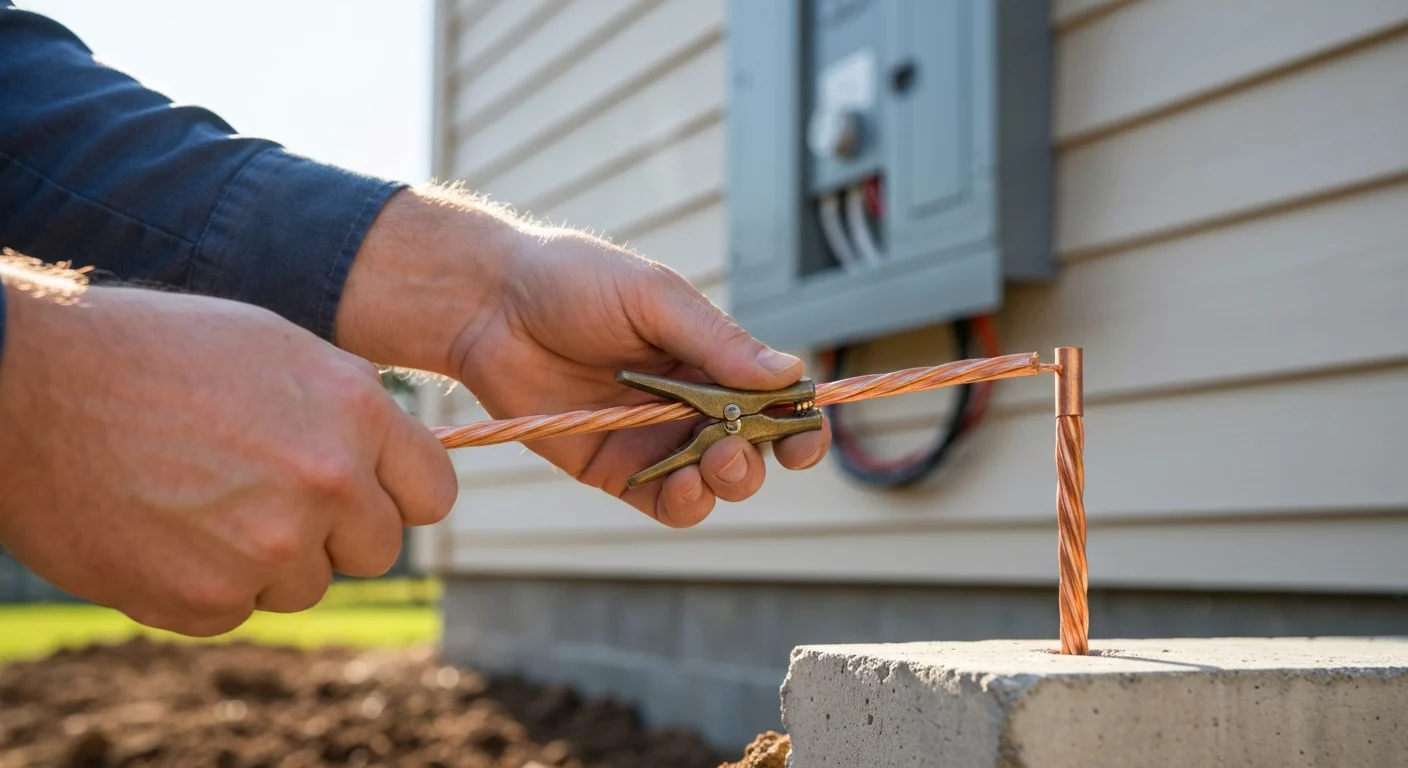
For a concrete-encased electrode (often called a “Ufer ground” and described in NEC 250.52(A)(3)), the GEC is not required to be larger than 4 AWG copper. The NEC text for this exception is specified for copper conductors; check the Code text to determine whether aluminum is acceptable for your specific installation or jurisdiction. Learn more about how 2023 NEC grounding electrode conductor rules are affecting transformer installations.
NEC 250.66(C) Ground Ring
When connecting to a ground ring electrode (which the Code requires to be effectively sized), the GEC is not required to be larger than the ground ring conductor itself. So, for a standard ground ring conductor (often 2 AWG copper), the GEC would not need to be larger than that conductor.
Important Considerations for GEC Installations
- Physical Protection: A GEC needs protection from physical damage when exposed. If you enclose the GEC in metallic conduit, tubing, or similar protection, follow Article 250’s bonding and continuity rules so the metallic enclosure is properly connected into the grounding/bonding system.
- Bonding Jumpers: The main bonding jumper and system bonding jumper are critical components, but they are not sized with Table 250.66. They are sized using NEC 250.102 and the related tables based on the largest ungrounded conductors at the service or derived-source end.
- Separately Derived Systems: For separately derived systems like transformers, a GEC is required to connect the derived winding to an electrode. Its size is determined by Table 250.66 based on the size of the derived ungrounded conductors (see the separately derived system grounding requirements in Article 250).
- GFCI Requirements: While not directly related to GEC sizing, remember that sections like NEC 210.8 outline mandatory GFCI protection in many locations, which is another crucial aspect of electrical safety.
The NEC is constantly evolving. Stay ahead of the curve by exploring the latest GEC sizing rule changes in the 2023 NEC.
Master grounding and bonding with our in-depth NEC courses.
Primary Sources
For official and complete code language, always refer to the source:
- National Fire Protection Association (NFPA): NFPA 70®, National Electrical Code®
Frequently Asked Questions (FAQ)
1. How do I use NEC Table 250.66 for parallel conductors?
When sizing a GEC for parallel conductor sizing, you must first find the total cross-sectional area. Add the circular mil area of each parallel ungrounded conductor per phase to get an equivalent larger conductor size, then use that total area to find the required GEC size in NEC Table 250.66.
2. What is the difference between a Grounding Electrode Conductor (GEC) and an Equipment Grounding Conductor (EGC)?
A Grounding Electrode Conductor (GEC) connects the electrical service to the earth via the grounding electrode system and is sized by NEC Table 250.66. An Equipment Grounding Conductor (EGC) bonds non-current-carrying metal parts of equipment to provide a path for fault current and is sized by NEC Table 250.122 based on the overcurrent protection.
3. Are there exceptions to sizing the GEC with NEC Table 250.66?
Yes. NEC 250.66(A) limits the GEC to 6 AWG copper for rod/pipe/plate electrodes (4 AWG aluminum where the Code allows). NEC 250.66(B) limits the concrete-encased electrode exception in terms of a 4 AWG copper conductor. And NEC 250.66(C) limits the GEC to the size of the ring conductor for ground rings, typically 2 AWG copper. These exceptions apply only when the GEC connects exclusively to that type of electrode and the connection does not continue to other electrodes that would require a larger conductor.

Disclaimer: The information provided in this educational content has been prepared with care to reflect current regulatory requirements for continuing education. However, licensing rules and regulations can vary by state and are subject to change. While we strive for accuracy, ExpertCE cannot guarantee that all details are complete or up to date at the time of reading. For the most current and authoritative information, always refer directly to your state’s official licensing board or regulatory agency.
NEC®, NFPA 70E®, NFPA 70®, and National Electrical Code® are registered trademarks of the National Fire Protection Association® (NFPA®)
You may also like

Colorado Electrical Licensing Requirements and Reciprocity Guide
Standby Generators in DE: Navigating Coastal Storm Regulations

 Login with Google