
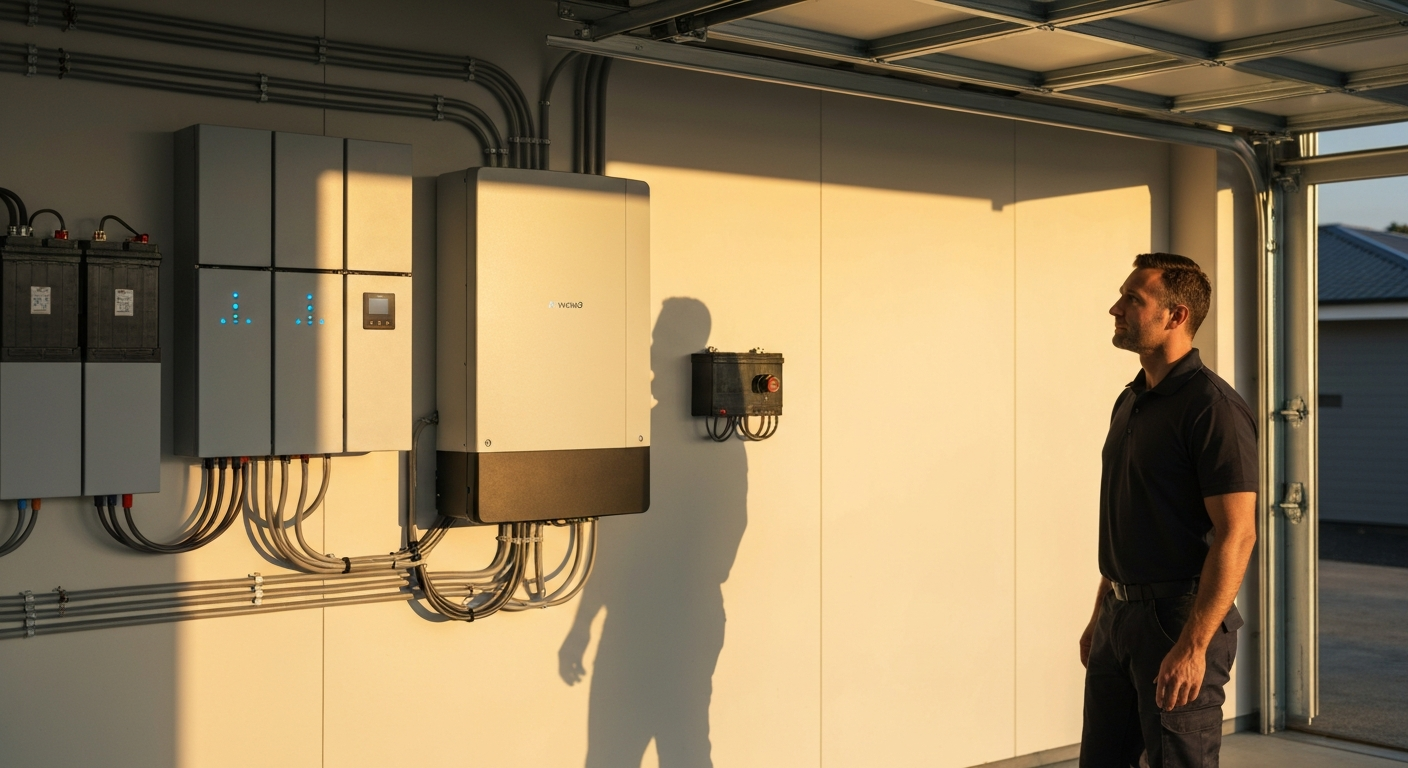
Sizing DC-Coupled vs. AC-Coupled Battery Storage Systems
Sizing DC-Coupled vs. AC-Coupled Battery Storage Systems: A Guide for Electricians
When sizing a solar-plus-storage system, the choice between a DC-coupled vs AC-coupled architecture is one of the most important decisions an electrician will make. For new installations, DC-coupled systems are generally preferred for higher practical round-trip efficiency because the PV energy can be managed directly with fewer conversions when charging the battery and supplying loads. This design, often utilizing a single hybrid inverter (or an integrated MPPT + battery inverter arrangement), is more streamlined. For a system retrofit, AC-coupling is the go-to solution, allowing a battery and a dedicated inverter to be added to a home’s AC panel without replacing the existing solar inverter. Sizing in AC-coupled systems is often constrained by the existing solar equipment and the existing panel/breaker layout, while DC-coupled sizing focuses on balancing the solar array, battery capacity, and the hybrid inverter’s capabilities. Understanding the nuances of each is essential for any master electrician designing a system that is both compliant and efficient.
Foundational Concepts: AC vs. DC Coupling Explained
For any professional journeyman electrician or master electrician, understanding the fundamental flow of power is key. In solar energy, power is generated as Direct Current (DC) by the panels and must be converted to Alternating Current (AC) for use in a home. The point at which the battery is integrated into this process defines the system’s architecture. For a deeper dive into the basics, our guides on AC vs. DC current explained and the more in-depth AC vs. DC current guide are excellent resources.
DC-Coupled Systems
In a DC-coupled architecture, PV DC is managed by MPPT/charge-control electronics (often integrated in the hybrid inverter or provided as a dedicated DC-DC stage) and used to charge the battery bank. The battery supplies DC to the hybrid inverter (which typically contains the battery inverter and MPPT functions) to produce AC for the home’s loads. Because solar energy is stored in the battery prior to AC conversion, DC-coupled systems typically require only one DC-to-AC conversion point when supplying household loads, which reduces conversion losses and improves overall efficiency.
- Best For: New solar-plus-storage installations.
- Key Component: A hybrid inverter or multi-mode inverter that can manage inputs from solar, battery, and the grid (in many products the MPPT and battery inverter are integrated).
- Efficiency: Higher round-trip efficiency compared with many AC-coupled designs — typically in the low- to mid-90% range for modern lithium-based systems (exact values depend on inverter/BMS performance and system configuration).
AC-Coupled Systems
In an AC-coupled system, the solar panels are connected to their own dedicated solar inverter, which immediately converts DC power to AC. This AC power is used by the home or sent to the grid. To add storage, a separate battery system with its own inverter (sometimes called a battery inverter or multi-mode inverter) is connected to the home’s AC electrical panel. To charge the battery, this second inverter converts the AC power from the solar array back to DC; when the battery discharges, the inverter converts DC back to AC. This AC↔DC↔AC process typically results in lower round-trip efficiency than a comparable DC-coupled design, but it offers tremendous flexibility for retrofits and allows adding storage without replacing existing PV inverters.
- Best For: A system retrofit to add batteries to an existing solar installation.
- Key Components: A standard solar inverter and a separate battery inverter.
- Efficiency: Lower round-trip efficiency than DC-coupled systems; AC-coupled systems often have round-trip efficiencies in the high-80s to low-90s (for many residential products this is commonly in the ~85–92% range) because of the additional AC↔DC conversions.
Sizing Step 1: Load Calculation and Days of Autonomy
Before comparing architectures, the first step is always a thorough load calculation to determine the client’s energy needs. This process determines the total capacity the battery must hold to power critical loads during an outage, much like sizing a traditional standby generator. The goal is to calculate the total watt-hours (Wh) required per day.
- Identify Critical Loads: Work with the homeowner to list all essential appliances and systems they want to run during an outage (e.g., refrigerator, well pump, lights, internet router, medical devices).
- Determine Power and Runtime: For each load, find its power consumption in watts (W) and estimate its daily runtime in hours (h). For example, a refrigerator might run intermittently, which you can estimate as a daily equivalent runtime for sizing purposes.
- Calculate Daily Energy Needs: Multiply each device’s wattage by its daily runtime to get its daily energy consumption in watt-hours (Wh). Sum the Wh for all critical loads to get the total daily energy requirement.
- Factor in Days of Autonomy: Decide how many days the system should be able to operate without any solar production (days of autonomy). Multiply the daily energy requirement by the desired days of autonomy (e.g., 2 days) to get the total required energy storage.
- Adjust for Battery Characteristics: The final battery capacity must account for the battery’s Depth of Discharge (DoD). If a 15 kWh battery has a 90% DoD, only 13.5 kWh is usable. The battery management system (BMS) enforces this limit to protect the battery’s health. The total calculated energy need must be less than or equal to the battery’s usable capacity.
Sizing a DC-Coupled System: Efficiency and Inverter Oversizing
Sizing a DC-coupled system revolves around the hybrid inverter. This component must be powerful enough to handle the home’s peak loads and have a solar input capacity that matches the PV array. A major advantage here is the ability to capture energy that would otherwise be “clipped” or lost when the PV array produces more DC power than the inverter can convert to AC at any instant.
This is achieved through inverter oversizing, also known as a high Inverter Loading Ratio (ILR). It’s common practice to have a solar array with a DC power rating higher than the inverter’s AC power rating (for example, 8 kW of panels on a 6 kW inverter). In a standard grid-tied system any power generated above the inverter rating is clipped. In a DC-coupled system with appropriate control, some of that excess DC energy can be directed to charge the battery instead of being wasted. This makes the overall system more productive and is one reason for increased deployments and solar career opportunities for electricians.
Sizing an AC-Coupled System: Retrofitting and Interconnection Rules
AC-coupling is the practical solution for adding a battery to an existing PV system, effectively turning it into a solar-powered generator for the home. The sizing process is primarily constrained by the existing infrastructure. The new battery inverter must be compatible with the existing solar inverter and correctly integrated into the home’s AC panel.
A key consideration is compliance with NEC Article 705, which governs power production source interconnections. The so-called “120% rule” limits the sum of the overcurrent protection devices (OCPDs) feeding a busbar to 120% of the busbar’s rating; in a retrofit, adding a battery inverter’s breaker could cause the sum of breakers to exceed that limit, potentially requiring a panel upgrade or alternative load-side connection approaches. The battery inverter often provides an automatic islanding/transfer function similar in outcome to a transfer switch for a generator, isolating from the grid during an outage and supplying selected loads or a sub-panel of critical circuits.
Code Compliance: NEC, UL 9540, and Safety Requirements
Regardless of the chosen architecture, strict adherence to the NEC is mandatory. As energy storage technology evolves, so do the codes governing its safe installation. For any licensed electrician, staying current is non-negotiable.
- NEC Article 706: The primary article for Energy Storage Systems (ESS), covering installation requirements, disconnecting means, naming/marking, and other ESS-specific provisions.
- NEC Article 705: Covers interconnection of production sources (including ESS interacting with PV and the grid).
- UL 9540: The safety standard for Energy Storage Systems and Equipment; listed systems simplify inspection because components are evaluated for charge/discharge and fire performance.
- Rapid Shutdown Requirements: Per NEC 690.12, PV systems must include means to rapidly reduce array conductors to safer voltages for first responders; in many DC-coupled architectures the inverter or listed PV Hazard Control equipment provides required functionality. Both architectures must satisfy PV rapid-shutdown rules where applicable.
- Overcurrent Protection and Circuit Sizing: Proper circuit sizing, conductor ampacity, and OCPD selection are fundamental to prevent thermal hazards on conductors between the inverter, batteries, and service panels. Follow NEC guidance for conductor ampacity, overcurrent protection, and listed equipment.
Battery safety is a paramount concern, and standards continue to evolve. To ensure you are up to date on workplace electrical safety and battery-related changes, it’s important to review the latest guidance, such as materials covering NFPA 70e and battery safety requirements.
The complexity of these systems highlights the need for specialized knowledge. ExpertCE offers a range of online electrical courses to help you master these advanced topics. Design efficient and reliable battery backup systems. Explore our ESS courses.
Frequently Asked Questions (FAQ)
What is the main difference in sizing a DC-coupled vs AC-coupled system?
The main difference lies in the central component. In DC-coupled systems, sizing revolves around the capabilities of the single hybrid inverter, balancing its PV input, battery charging/discharging rates, and AC output. In AC-coupled systems, sizing is more about integrating a separate battery inverter with the existing solar inverter and AC service panel, often constrained by NEC interconnection rules and the output of the existing PV system.
Which system has better round-trip efficiency?
DC-coupled systems generally deliver better round-trip efficiency because solar DC can be stored with fewer conversions before being inverted once for home use. AC-coupled designs tend to incur more conversion steps (DC→AC→DC→AC for a full charge/discharge cycle) and therefore usually measure a few percentage points lower in round-trip efficiency for comparable equipment.
Can I add a battery to my existing solar panels?
Yes — this is an ideal scenario for an AC-coupled system. This type of system retrofit allows you to add a battery and a dedicated battery inverter to your existing installation without needing to replace your current solar inverter, making it a cost-effective path to energy resilience in many cases.
What is a hybrid inverter and is it required?
A hybrid inverter, also known as a multi-mode inverter, is an all-in-one device that can intelligently manage power flow between solar panels, a battery bank, the grid, and a home’s loads. It is the core component of many modern DC-coupled systems (where it handles MPPT, battery charging, and DC-to-AC conversion), but AC-coupled systems typically use separate inverters for the solar array and the battery.
Primary Sources
- National Fire Protection Association (NFPA) — National Electrical Code (NEC), especially Articles 250, 690, 705, and 706 for grounding, PV, interconnection, and ESS.
- Underwriters Laboratories (UL) — UL 9540 Standard for Energy Storage Systems and Equipment.
Continuing Education by State
Select your state to view board-approved continuing education courses and requirements:

Disclaimer: The information provided in this educational content has been prepared with care to reflect current regulatory requirements for continuing education. However, licensing rules and regulations can vary by state and are subject to change. While we strive for accuracy, ExpertCE cannot guarantee that all details are complete or up to date at the time of reading. For the most current and authoritative information, always refer directly to your state’s official licensing board or regulatory agency.
NEC®, NFPA 70E®, NFPA 70®, and National Electrical Code® are registered trademarks of the National Fire Protection Association® (NFPA®)
You may also like
Colorado Electrical Licensing Requirements and Reciprocity Guide
Standby Generators in DE: Navigating Coastal Storm Regulations

 Login with Google