
Safe Rigging Practices for Lifting and Setting Utility Poles
The Foundation of Safety: Job Safety Analysis (JSA) and Site Assessment
Before any lift begins, a comprehensive Job Safety Analysis (JSA) is mandatory. This pre-emptive assessment is the first and most critical step in mitigating risk. The JSA process involves identifying potential hazards associated with the lift and establishing clear procedures to eliminate or control them. Key elements include assessing the ground conditions for stability, identifying any underground utilities, and, most importantly, locating all overhead power lines. A critical component of the JSA is establishing the Minimum Approach Distance (MAD), the OSHA-mandated safe distance that unqualified personnel and equipment must maintain from energized conductors. This planning phase is a crucial element of electrical hazard protection and ensures every team member understands the operational plan and safety constraints.
Pre-Lift Inspection: Your First Line of Defense
A successful lift depends on the integrity of both the utility pole and the equipment used to move it. A dual-focused inspection process is a non-negotiable part of safe rigging practices. Failure to identify defects can lead to catastrophic equipment failure or pole breakage during the lift.
Critical Wood Pole Inspection Checklist
OSHA 1910.269 requires qualified employees to perform the necessary inspections and to follow employer procedures to determine structural integrity before climbing or working from a pole. A pole that is buckled, cracked, or shows signs of rot may not be safe to work with and must be properly secured before proceeding. Key inspection points include:
- General Condition: Look for unusual buckling at the ground line or if the pole is leaning at an odd angle, which could indicate a break or rot below the surface.
- Cracks and Holes: Assess both vertical and horizontal cracks. While vertical cracks are common, horizontal cracks can severely weaken a pole’s structural integrity. Hollow spots from decay or woodpecker holes also reduce strength.
- Shell Rot and Decay: Prod the pole near the ground line with a tool like a screwdriver. If the tool penetrates easily, it indicates substantial decay, rendering the pole unsafe. A “hammer test,” where you strike the pole and listen for a dull sound, can indicate internal decay pockets; these techniques are referenced in OSHA guidance and industry practice rather than a mandatory appendix citation.
- Knots: A large knot or a cluster of smaller knots at the same height can create a significant weak point.
Rigging Inspection and Component Integrity
Simultaneously, all rigging equipment must undergo a detailed visual inspection before each use. This rigging inspection ensures that every component can handle the anticipated stress of the lift. Check the following:
- Slings: Examine synthetic, wire rope, and chain slings for cuts, abrasions, broken wires, chemical damage, or stretching.
- Hardware: Inspect hooks, shackles, and eyebolts for cracks, deformation, or excessive wear. Ensure safety latches on hooks are present and functional.
- Pole Tongs and Slings: Verify that pole tongs grip securely and that the mechanisms are free of damage. Ensure lifting slings are rated for the load and show no signs of degradation.
Understanding Load Dynamics: Key Calculations for a Safe Lift
Guesswork has no place in professional rigging. Accurate calculations are essential for ensuring the stability and control of the lift from start to finish. This involves understanding the pole’s weight, its balance point, and how rigging configurations affect the forces applied to the equipment.
Load Capacity Calculation and Center of Gravity
The first step in any load capacity calculation is to determine the total weight of the utility pole. This weight must then be compared against the rated capacity of the digger derrick, crane, and all rigging components. Crucially, you must also perform a center of gravity determination. The center of gravity (CG) is the balance point of the pole. Lifting a load at its CG ensures a level, stable lift. For a uniform pole, the CG is at its geometric center. However, for tapered poles or those with attachments, the CG will shift towards the heavier end. A quick test lift—raising the pole just inches off the ground—can confirm if the rigging is attached at the correct CG.
The Critical Role of Sling Angles
When using a multi-leg sling bridle, the leg angle dramatically impacts the tension in each sling. Measured consistently (and noting whether you are using the angle from the horizontal or from the vertical), the flatter the leg (closer to horizontal), the greater the tension on each leg. As a rule of thumb used in industry, avoid very shallow sling-leg angles (commonly those under about 30° from the horizontal) because the induced tension multiplies rapidly. Field practice often uses sling angles around 45°–60° for a good balance of stability and reduced leg tension. OSHA 1910.184 addresses sling inspection and selection; sling-angle calculations are an industry rigging principle.
Step-by-Step Guide to Digger Derrick Operations for Pole Setting
Properly executing the lift with a digger derrick requires a systematic approach. Each step must be performed deliberately and with clear communication among the crew. These steps are fundamental to any quality electrician training program focused on line work.
- Prepare the Site and Position the Digger Derrick: Ensure the ground is firm and level. Fully deploy outriggers on stable ground or pads to create a solid foundation for the lift.
- Conduct Pre-Operational Checks: Before starting, perform a full inspection of the digger derrick, including hydraulic fluids, controls, and safety devices.
- Attach the Rigging Securely: Attach the pole tongs or slings to the pole at or slightly above the determined center of gravity. Ensure all hardware is properly seated and secured.
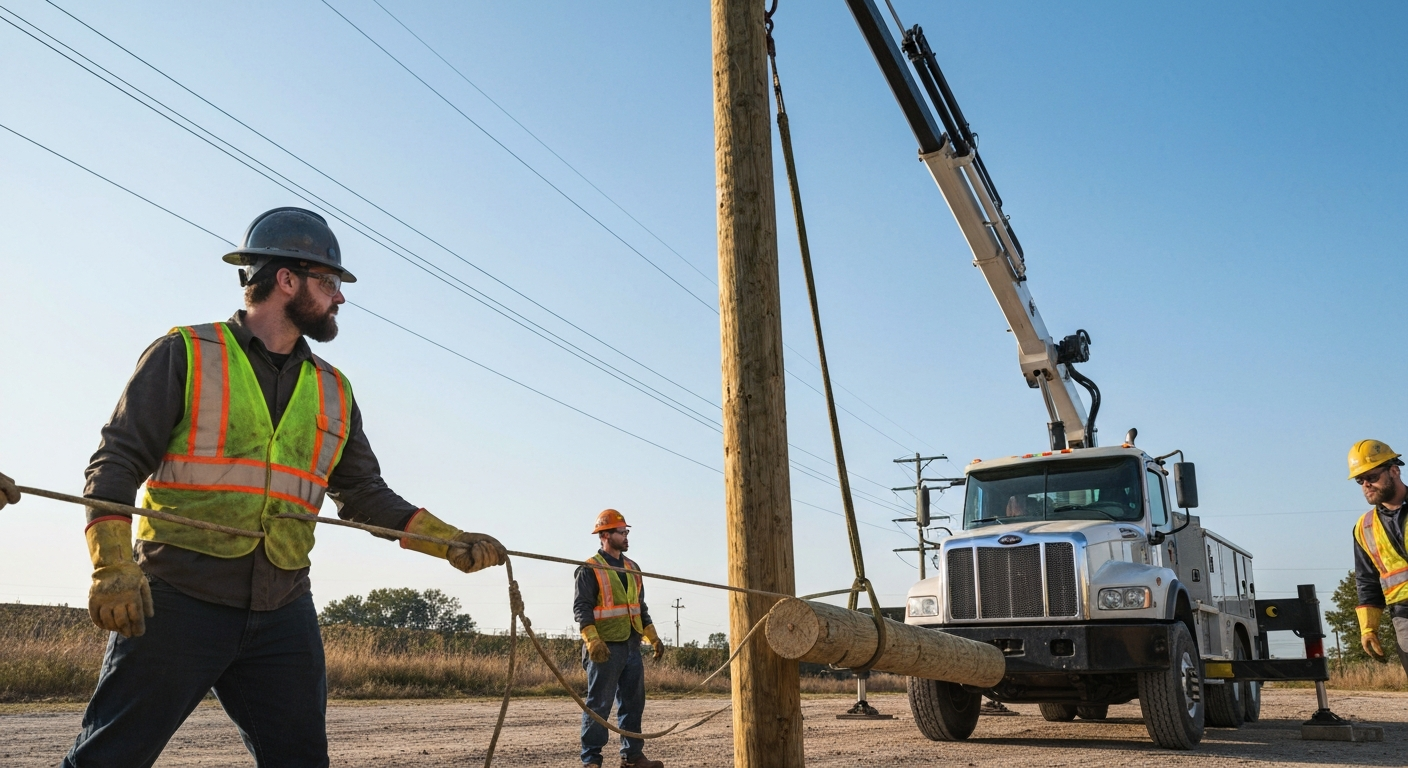
- Control the Load with Tag Lines: Attach at least one, and preferably two, tag lines to the ends of the pole. Proper tag line usage is essential for controlling the load, preventing rotation, and guiding it away from hazards, especially during windy conditions.
- Perform a Test Lift: Slowly lift the pole just a few inches from the ground to verify the balance and the rigging’s stability. Adjust as necessary before proceeding with the full lift.
- Lift and Guide the Pole: Lift the pole smoothly, avoiding sudden movements. The ground crew will use the tag lines to guide the base of the pole toward the pre-dug hole.
- Set and Secure the Pole: Carefully lower the pole into the hole. Once it is plumb and at the correct depth, secure it with temporary supports before backfilling and tamping the soil to ensure it is stable.
Electrical Hazard Protection and OSHA Standards
For any journeyman electrician or master electrician working with utility poles, energized conductor safety is the highest priority. The risk of electrocution from high-voltage sources is ever-present and requires strict adherence to established safety protocols.
Adhering to OSHA 1910.269 and Minimum Approach Distance (MAD)
The OSHA 1910.269 standard for “Electric Power Generation, Transmission, and Distribution” is the definitive regulation for this type of work. It mandates comprehensive training, job planning, and specific safety measures. A key element of this standard is the enforcement of Minimum Approach Distance (MAD). MAD is the closest distance an employee may approach an energized conductor; these distances differ for qualified versus unqualified employees and vary based on the line’s voltage. All mechanical equipment must be positioned and operated to maintain these distances from exposed energized lines, and employers must ensure employees are trained to recognize and maintain the required clearances.
Essential Lineman PPE and Fall Protection Protocols
Proper personal protective equipment (PPE) is the last line of defense against injury. All personnel involved in the lift must be equipped with appropriate gear. Important items include:
- Lineman PPE for Rigging: This includes a hard hat, safety glasses, high-visibility clothing, and steel-toed boots. For those working near energized parts, voltage-rated gloves and sleeves are mandatory.
- Fall Protection Protocols: Any work performed at height requires adherence to strict fall protection protocols. This includes using appropriate harnesses, lanyards, and anchor points. Work-positioning equipment must be inspected daily before use.
Communication: The Linchpin of Safe Rigging Practices
Effective communication is critical to coordinating a safe lift. The operator of the digger derrick often has a limited or obstructed view of the load and the surrounding area, making the role of a qualified signal person essential. Clear and standardized signal person communication ensures that every movement is intentional and understood by the entire team. Standard hand signals, as defined by OSHA and ASME, should be used and posted on the job site. If radios are used, they must be on a dedicated, clear channel. Before the lift, the operator, signal person, and crew leader must hold a pre-lift briefing to confirm the signals and the plan. Anyone on the job site has the authority to signal an emergency stop, and the operator must always obey that signal immediately.
Elevating Your Expertise: Training and Certification
Continuing education and certification are vital for anyone involved in high-risk operations. Programs like those offered by the National Center for Construction Education and Research (NCCER) provide rigorous, industry-recognized training in safe rigging and signaling. These certifications validate the skills of a journeyman electrician and are often a prerequisite for advancement to a master electrician role overseeing complex projects. Investing in online electrical courses that cover advanced topics, such as a three-phase electrical calculations guide, builds the comprehensive knowledge needed to understand the full scope of electrical systems. A bad lift can be catastrophic. Master safe rigging practices.
Frequently Asked Questions (FAQ)
- What is the most critical first step in safe rigging practices for utility poles?
- The most critical first step is conducting a thorough Job Safety Analysis (JSA). This pre-lift planning identifies all potential hazards, such as overhead power lines and unstable ground, and establishes clear procedures for risk mitigation, including defining the Minimum Approach Distance.
- How does OSHA 1910.269 impact digger derrick operations?
- OSHA 1910.269 is the primary safety standard for electric power work. It governs nearly every aspect of digger derrick operations, including mandatory training for employees, required inspection of equipment, electrical hazard protection, and establishing safe minimum approach distances from energized conductors.
- Why is load capacity calculation essential before any lift?
- A load capacity calculation is essential to prevent equipment failure. It ensures that the weight of the utility pole does not exceed the rated capacity of the digger derrick, slings, shackles, and other rigging hardware. Overloading is a leading cause of catastrophic rigging accidents.
- What are the key elements of a pre-lift rigging inspection?
- A pre-lift rigging inspection involves a visual check of all lifting components. For slings (wire rope, chain, synthetic), look for cuts, frays, or stretching. For hardware like hooks and shackles, check for cracks, bending, or deformation. Also, ensure hook safety latches are functional.
- What is the purpose of tag line usage during a pole lift?
- Tag line usage is critical for controlling the load. Tag lines are ropes attached to the pole that allow ground personnel to guide the pole, prevent it from spinning or swinging uncontrollably, and keep it clear of obstacles and personnel during the lift.
Primary Sources
- OSHA 29 CFR 1910.269 – Electric Power Generation, Transmission, and Distribution
- OSHA 29 CFR 1910.184 – Slings
- NCCER Rigger and Signal Person Certification Standards
Continuing Education by State
Select your state to view board-approved continuing education courses and requirements:

Disclaimer: The information provided in this educational content has been prepared with care to reflect current regulatory requirements for continuing education. However, licensing rules and regulations can vary by state and are subject to change. While we strive for accuracy, ExpertCE cannot guarantee that all details are complete or up to date at the time of reading. For the most current and authoritative information, always refer directly to your state’s official licensing board or regulatory agency.
NEC®, NFPA 70E®, NFPA 70®, and National Electrical Code® are registered trademarks of the National Fire Protection Association® (NFPA®)
You may also like
Colorado Electrical Licensing Requirements and Reciprocity Guide
Standby Generators in DE: Navigating Coastal Storm Regulations
 Login with Google