
Romex Cable Ampacity Derating for Bundling (NEC 334.80)
Romex Ampacity Derating: A Guide to NEC 334.80 for Electricians
Understanding Romex ampacity derating is essential for any professional electrician performing residential wiring. Governed by NEC 334.80, this rule addresses the heat buildup that occurs when multiple nonmetallic (NM) cables are bundled together. When more than two NM cables (each with two or more current-carrying conductors) are either bundled through a sealed opening in wood framing or installed in contact with thermal insulation without spacing, their safe current-carrying capacity must be reduced, or “derated.” The key to correct derating calculations is starting with the conductor’s 90°C ampacity rating for the calculation, even though its final protection is based on the 60°C rating. This process, using ampacity adjustment factors from NEC Table 310.15(C)(1), ensures the installation is safe, compliant, and avoids potential fire hazards, which is a critical aspect of passing an electrical inspection. Proper application of this nec code book rule is a hallmark of a qualified journeyman electrician or master electrician.
What is Romex Ampacity Derating Under NEC 334.80?
In the world of electrical work, “ampacity” refers to the maximum current, in amperes, that a conductor can carry continuously under the conditions of use without exceeding its temperature rating. For nonmetallic-sheathed cable, commonly known by the brand name Romex®, this is a critical safety parameter. Romex ampacity derating is the mandatory reduction of this capacity to account for heat accumulation. The primary rule governing this is found in the National Electrical Code (NEC) in Article 334.80. This section addresses the specific scenario of bundling NM cables, a common practice in residential construction. Heat is the enemy of wiring; when cables are bundled tightly, they cannot dissipate heat effectively, which can lead to insulation breakdown and create a significant fire risk. NEC 334.80 provides the specific rules for when and how to apply these safety-critical adjustments. For a broader look at this type of cable, review this guide to NM cable types.
The Critical “60°C vs. 90°C” Rule Explained
One of the most misunderstood aspects of NEC 334.80 involves conductor temperature ratings. Modern NM-B cable contains individual conductors with insulation rated for 90°C. However, NEC 334.80 explicitly states that the overall ampacity of the cable shall not exceed that of a 60°C conductor temperature rating. For example, a 12 AWG copper conductor has a 60°C ampacity of 20 amps, which is why it’s protected by a 20-amp breaker.
Here’s the crucial exception for derating: the code permits you to use the higher 90°C ampacity rating as the starting point for your derating calculations. For that same 12 AWG conductor, the 90°C ampacity is 30 amps (per NEC Table 310.16). You apply the required ampacity adjustment factors to this higher value. The final, derated ampacity must not exceed the conductor’s 60°C rating. This provision is a practical allowance that often prevents the need to upsize conductors in common bundling scenarios, a vital piece of knowledge for any journeyman electrician or master electrician.
When is Derating for Bundling Required?
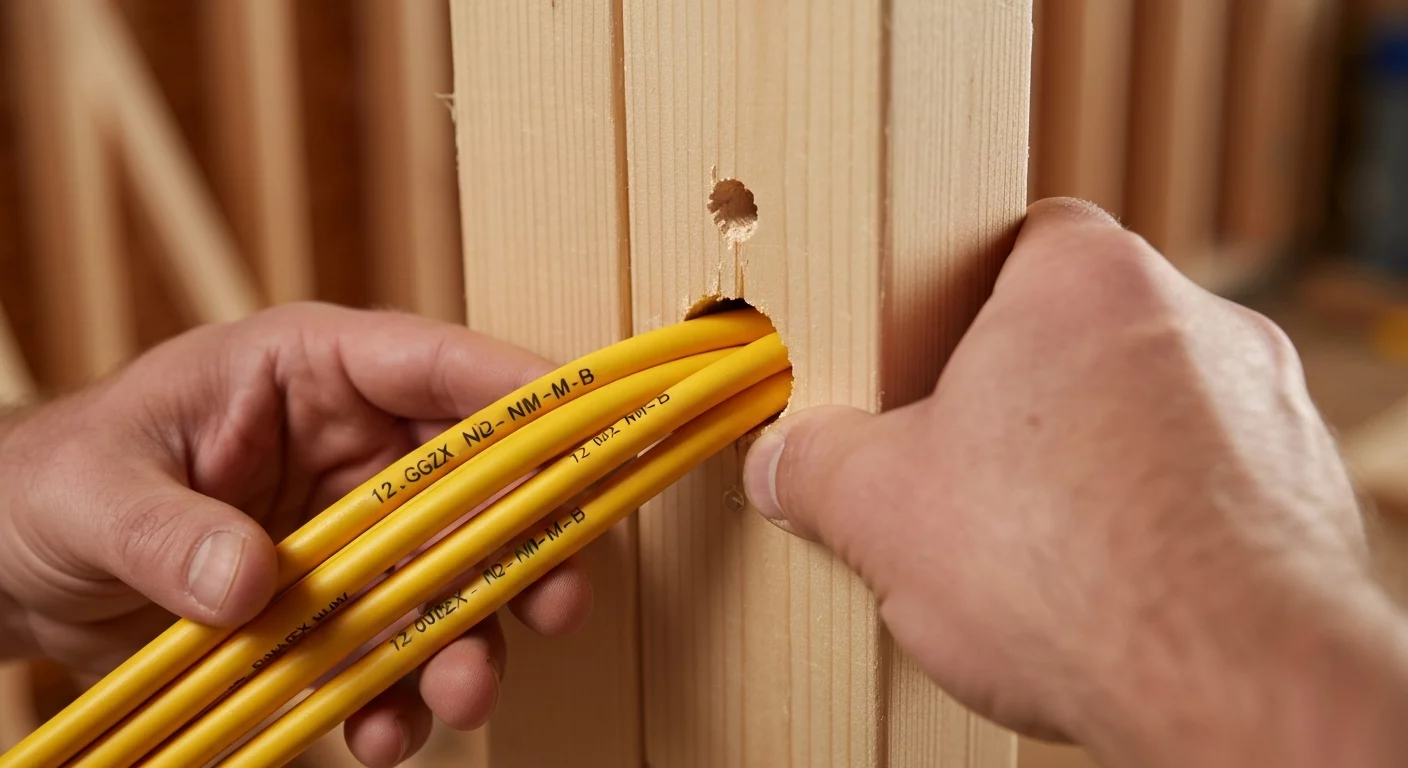
Derating isn’t required every time cables are near each other. The rules in NEC 334.80 are specific. An adjustment is mandatory when more than two NM cables, each containing at least two current-carrying conductors, are installed in one of the following ways that trap heat:
- Bundled Through a Sealed Wood Frame Opening: The bundle passes through the same bored hole or opening in wood framing, and that opening is sealed with thermal insulation, caulk, foam, or another material for the purpose of firestopping or draft stopping.
- Installed in Contact with Thermal Insulation: The cables are installed in direct contact with thermal insulation without maintaining spacing between each cable.
If any of these conditions are not met—for instance, if only two cables pass through a hole, or if the hole is unsealed and not in contact with insulation—then derating for bundling is not required by this section. Understanding these nuances is key to passing an electrical inspection and adhering to the residential wiring code.
How to Calculate Romex Ampacity Derating: A Step-by-Step Guide
Performing derating calculations is a fundamental skill. It ensures you select the right wire size and overcurrent protection. For a more in-depth guide on the topic, see how to calculate wire ampacity derating. Let’s walk through an example of bundling four 12/2 NM-B cables.
- Count the Current-Carrying Conductors: Four 12/2 cables each have two current-carrying conductors (the hot and the neutral). The ground wire is not counted. The total is 4 cables x 2 conductors/cable = 8 current-carrying conductors.
- Find the Adjustment Factor: Go to NEC Table 310.15(C)(1) (in the 2020 and 2023 NEC). For 7-9 conductors, the required adjustment factor is 70%.
- Start with the 90°C Ampacity: Look up the ampacity for a 12 AWG copper conductor in the 90°C column of the wire ampacity chart (NEC Table 310.16). The value is 30 amps.
- Apply the Adjustment Factor: Multiply the 90°C ampacity by the adjustment factor: 30 amps × 0.70 (70%) = 21 amps.
- Verify Against the 60°C Limit: The calculated ampacity is 21 amps. However, NEC 334.80 requires that the final ampacity of the cable not exceed that of a 60°C rated conductor. From NEC Table 310.16, the 60°C ampacity for a 12 AWG copper conductor is 20 amps. We must use the lesser of our calculated value (21 amps) and the 60°C rating (20 amps). Therefore, the final allowable ampacity is 20 amps. This value aligns with the standard overcurrent protection size of 20 amps for 12 AWG wire permitted by NEC 240.4(D), confirming that a 20-amp breaker is compliant for this bundled installation.
This process is foundational for electrician training and everyday application. Mastering these calculations is essential to avoid common code violations. Sign up for our NEC wiring methods course to ensure your projects are always up to code.
Avoiding Derating: Best Practices for Installation
While derating is a necessary calculation, the best-case scenario is often to avoid triggering the requirement in the first place. Proper planning during the rough-in phase can save time and prevent complex calculations. This topic is closely related to other code requirements, like those for conduit fill which you can explore in this NEC derating conduit fill guide.
- Maintain Spacing Between Cables: Whenever possible, drill separate holes for each NM cable through studs and joists. If running cables through the same large opening, avoid bundling them tightly together where possible to improve heat dissipation.
- Limit the Number of Cables per Hole: If you must run cables through a single hole, limit it to two cables whenever practical. The bundling rule in 334.80 starts with more than two cables.
- Be Mindful of Thermal Insulation Contact: Heat is the underlying concern. Avoid installing large bundles in areas that will be heavily packed with insulation, as this exacerbates heat retention.
- Understand When Bundling is Unavoidable: In some situations, like feeding a multi-gang switch box or panel, bundling is necessary. In these cases, you must perform the derating calculation correctly. Knowing precisely when cable bundling violates NEC rules is critical.
Primary Sources
- NFPA 70®, National Electrical Code®, 2023 Edition
Frequently Asked Questions (FAQ)
- How many Romex cables can be bundled before derating?
- According to NEC 334.80, ampacity derating is required when more than two NM cables (e.g., three or more), each containing at least two current-carrying conductors, are either bundled through a sealed/fire-stopped hole in wood framing or installed in contact with thermal insulation without spacing. Therefore, you can bundle up to two such cables in these conditions without triggering this specific derating rule.
- Does the ground wire count as one of the current-carrying conductors for derating?
- No. The equipment grounding conductor (the bare copper wire in Romex) is not considered a current-carrying conductor for the purposes of ampacity adjustment calculations under normal conditions. You only count the insulated “hot” and neutral conductors.
- What happens if I ignore Romex ampacity derating rules?
- Failing to apply required ampacity adjustments is a serious code violation. It can lead to a failed electrical inspection, requiring costly rework. More importantly, it creates a dangerous situation where bundled cables can overheat, leading to the degradation of insulation and posing a significant fire hazard. It is a critical part of the residential wiring code that every residential electrician must follow.
- Does derating apply if cables are stapled close together on a running board?
- No, not typically. The rule in NEC 334.80 specifically applies to cables bundled together where they pass through a sealed or fire-stopped opening in wood framing or are in contact with thermal insulation. If cables are simply run parallel to each other and secured to a surface with spacing (even if minimal), they have a greater ability to dissipate heat, and this particular bundling rule does not apply.
- Can I use the 90°C ampacity rating for my breaker size after derating?
- No. This is a common point of confusion. You can only use the 90°C ampacity rating as the starting point for your calculation. The final allowable ampacity for overcurrent protection is still capped by the conductor’s 60°C rating as stated in NEC 334.80 and general overcurrent protection rules in Article 240.
Related Resources
Continuing Education by State
Select your state to view board-approved continuing education courses and requirements:

Disclaimer: The information provided in this educational content has been prepared with care to reflect current regulatory requirements for continuing education. However, licensing rules and regulations can vary by state and are subject to change. While we strive for accuracy, ExpertCE cannot guarantee that all details are complete or up to date at the time of reading. For the most current and authoritative information, always refer directly to your state’s official licensing board or regulatory agency.
NEC®, NFPA 70E®, NFPA 70®, and National Electrical Code® are registered trademarks of the National Fire Protection Association® (NFPA®)
You may also like
Colorado Electrical Licensing Requirements and Reciprocity Guide
Standby Generators in DE: Navigating Coastal Storm Regulations

 Login with Google