
Protecting Conductors from Physical Damage: NEC 300.4 Explained
Protecting Conductors from Physical Damage: NEC 300.4 Explained
NEC 300.4 of the National Electrical Code is a foundational section that provides explicit rules for the protection of electrical conductors from physical damage. For any master electrician or journeyman electrician, a deep understanding of this section is not just about compliance; it’s about ensuring the safety and longevity of an electrical installation. This article provides a comprehensive overview of NEC 300.4, detailing requirements for bored holes in wood members, the critical 1-1/4 inch setback rule, and when to use nail plate protection. It also covers the specific provisions for metal framing, large conductors, and the crucial role of wiring methods and materials like electrical conduit and MC cable in safeguarding every conductor from predictable physical threats.
The Core Principle of NEC 300.4: Protection From Physical Damage
At its heart, NEC 300.4 is built on a simple but critical premise: where conductors are subject to physical damage, they must be protected. This overarching rule, stated in the opening of the section, sets the stage for the specific scenarios that follow. The “why” is clear: damaged conductor insulation is a leading cause of electrical faults, arc flashes, and fires. According to the National Fire Protection Association (NFPA), an estimated annual average of 46,700 U.S. home fires from 2015-2019 involved electrical failure or malfunction. Understanding what is a conductor—the wire or cable carrying the electrical current—and how vulnerable its insulation is to nicks, cuts, and abrasion is the first step to appreciating this code section. The final say on whether a conductor is adequately protected often comes down to Authority Having Jurisdiction (AHJ) interpretation, making it vital to know these rules inside and out.
For professional electricians, these aren’t just abstract rules from an nec code book; they are practical applications that prevent costly callbacks and life-threatening hazards.
Navigating NEC 300.4(A): Cables and Raceways Through Wood Members
One of the most common situations an electrician encounters is running cables through wooden studs, joists, and rafters. NEC 300.4(A) provides two primary methods for protection in this scenario.
The 1-1/4 Inch Setback Rule
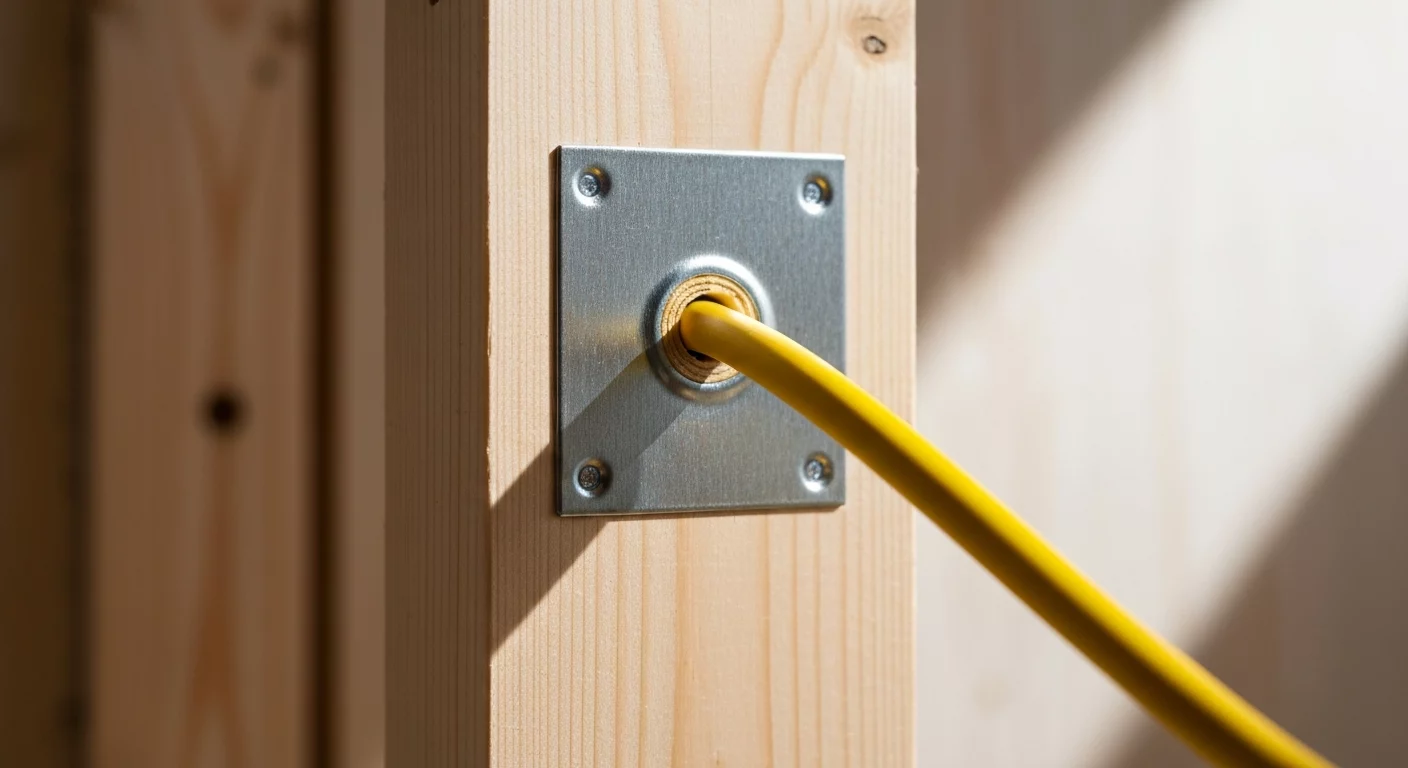
The primary rule of thumb is the 1-1/4 inch setback rule. It states that when you drill bored holes in wood members, the edge of the hole must be at least 1-1/4 inches from the nearest edge of the wood member. This distance is designed to keep the cable out of the path of common fasteners like drywall screws or nails used to hang pictures or shelving, which could otherwise penetrate the cable and cause a fault.
When Setback Isn’t Possible: The Role of Nail Plate Protection
In the real world, maintaining a 1-1/4 inch setback is not always feasible, especially in tight spaces or with large holes. When this distance cannot be maintained, the code mandates an alternative form of protection. The cable or raceway must be protected by a steel plate or bushing at least 1/16-inch (1.6 mm) thick. This nail plate protection must be of appropriate length and width to cover the area of wiring. The same rule applies to notches in wood; if a cable is laid in a notch, it must be protected by 1/16-inch thick steel plates for notches. There are, however, EMT and RMC protection exceptions; these and other specified conduits are not required to be protected by steel plates as they are considered to provide sufficient protection on their own.
Protecting Conductors in Metal Framing: Understanding NEC 300.4(B)
Running cables through metal studs and framing members presents a different hazard: the sharp edges of the factory- or field-punched holes. NEC 300.4(B) addresses this with a straightforward requirement for metal framing member protection. When nonmetallic-sheathed cables (like Type NM or “Romex”) or electrical nonmetallic tubing (ENT) pass through these openings, they must be protected by listed bushings and grommets. These plastic or rubber inserts must be securely fastened in the opening before the cable is installed to prevent the sharp metal edges from slicing into the cable’s jacket and insulation. A deeper dive into cable specifics can be found in this guide to NM cable types.
Special Considerations for Large Conductors: NEC 300.4(G)
Larger conductors have their own unique protection requirements due to their weight, stiffness, and the difficulty of pulling them. NEC 300.4(G) focuses specifically on insulated conductors 4 AWG or larger. Where insulated conductors 4 AWG or larger enter a raceway in a cabinet, junction box, pull box, or auxiliary gutter, they must be protected from abrasion by a fitting with a smoothly rounded insulating surface. This is typically accomplished with insulated raceway termination fittings.
A key update in the 2023 NEC clarifies that this protection must be installed before the conductors are pulled. This prevents damage to the conductor insulation during the pull and avoids the difficult task of trying to install a bushing after the fact.
How to Properly Terminate a 4 AWG Conductor in a Raceway
- Prepare the Raceway: Ensure the end of the electrical conduit is reamed and free of burrs.
- Install the Protective Fitting: Securely install an identified fitting with a smoothly rounded insulating surface, such as a plastic bushing, onto the end of the raceway or connector.
- Pull the Conductors: Carefully pull the 4 AWG or larger conductors through the protected opening. The bushing protects the insulation from abrasion against the raceway edge.
- Inspect the Installation: Verify that the bushing is still securely in place and that the conductor insulation is not damaged.
- Terminate Conductors: Complete the termination of the conductors to the lugs or terminals inside the enclosure.
Other Key Provisions and 2023 NEC Updates
The NEC is a living document, and understanding recent changes is part of the ongoing electrician training for every master electrician and journeyman electrician. Several other parts of Section 300.4 address specific installation scenarios.
Cables and Raceways Parallel to Framing (NEC 300.4(D))
This section addresses running cables parallel to framing members like studs or joists. Similar to the bored hole rule, if a cable or raceway is installed on the side of a framing member, it must be set back at least 1-1/4 inches or be protected. This rule is crucial for securing and supporting conductors in wall cavities.
Cables Under Metal-Corrugated Roof Decking (NEC 300.4(E))
Installations under metal-corrugated roof decking require a space of at least 1-1/2 inches between the top of the cable or raceway and the lowest surface of the roof decking. This is to prevent damage from long screws used by roofers. The 2023 NEC added an important exception: this spacing is not required if the decking is covered by at least 2 inches of concrete, as the concrete provides adequate protection.
Staying current with the latest code is essential. The 2023 NEC brought several changes impacting conductor protection, including how 2023 NEC updates protect NM and NMC cable, new considerations for open conductor installations, and even changes to armored cable guard strip requirements.
Mastering the nuances of NEC 300.4 and other critical wiring methods and materials sections is non-negotiable for professional electricians. Build a strong foundation in safe wiring practices. Enroll in our online electrical courses.
Key Takeaways for NEC 300.4 Compliance
- Always maintain the 1-1/4 inch setback rule when drilling through wood members unless you plan on adding protection.
- Use 1/16-inch thick nail plate protection when the setback cannot be maintained or when notching studs.
- Listed bushings and grommets are mandatory to protect cables from the sharp edges of metal framing members.
- Insulated fittings must be used for conductors 4 AWG or larger where they enter raceways, and they must be installed before pulling the wire.
- Always check the latest edition of the nec code book for updates and consult with the Authority Having Jurisdiction (AHJ) if you have questions about interpretation.
Primary Sources
- NFPA 70, National Electrical Code (NEC), 2023 Edition
- Ahrens, Marty. “Home Electrical Fires.” National Fire Protection Association, Quincy, MA, October 2021.
Frequently Asked Questions (FAQ)
What is the main purpose of NEC 300.4?
The main purpose of NEC 300.4 is to provide rules for the protection from physical damage for electrical conductors, cables, and raceways. It outlines specific requirements for installations in wood and metal framing, under roof decking, and for large-sized conductors to prevent damage that could lead to electrical hazards.
Does the 1-1/4 inch setback rule have any exceptions?
Yes. The rule’s primary “exception” is the alternative of providing protection with a 1/16″ steel plate. Furthermore, NEC 300.4(A)(1), Exception No. 1, lists specific raceways that do not require steel plate protection even if the setback isn’t met. These include Rigid Metal Conduit (RMC), Intermediate Metal Conduit (IMC), PVC conduit, reinforced thermosetting resin conduit (RTRC), and Electrical Metallic Tubing (EMT), because these raceways are considered tough enough to resist nail or screw penetration on their own.
Are bushings always required for conductors 4 AWG or larger?
Generally, yes. When conductors 4 AWG or larger enter a raceway in a cabinet, junction box, pull box, or auxiliary gutter, they must be protected by a fitting with a smoothly rounded insulating surface, like a bushing. An exception exists for threaded hubs or bosses that are integral to the enclosure and already provide a smooth, flared entry. The key is that the conductors must be protected from abrasion.
Where can I find quality electrician training for the latest NEC code book?
Staying up-to-date with the National Electrical Code is critical for any licensed electrician. High-quality online electrical courses provide a convenient and effective way to learn about significant changes to sections like NEC 300.4, new wiring methods and materials, and other updates that impact your work. Look for providers that offer courses specifically designed for license renewal and exam prep.
Continuing Education by State
Select your state to view board-approved continuing education courses and requirements:

Disclaimer: The information provided in this educational content has been prepared with care to reflect current regulatory requirements for continuing education. However, licensing rules and regulations can vary by state and are subject to change. While we strive for accuracy, ExpertCE cannot guarantee that all details are complete or up to date at the time of reading. For the most current and authoritative information, always refer directly to your state’s official licensing board or regulatory agency.
NEC®, NFPA 70E®, NFPA 70®, and National Electrical Code® are registered trademarks of the National Fire Protection Association® (NFPA®)
You may also like

Colorado Electrical Licensing Requirements and Reciprocity Guide
Standby Generators in DE: Navigating Coastal Storm Regulations

 Login with Google