
NEC Rules for Underground Feeder (UF) Cable Installation
A Professional Electrician’s Guide to NEC Rules for UF Cable Installation
Proper UF cable installation is critical for any safe and durable outdoor or underground electrical circuit. Governed primarily by NEC Article 340 (Type UF) and the minimum-cover guidance in NEC Table 300.5, these rules ensure that underground feeder (UF-B) cable is protected from physical damage and moisture. For a standard direct-burial installation the typical minimum cover requirement is 24 inches. NEC Table 300.5 does include a reduced-depth allowance of 12 inches for certain residential branch circuits (120 V or less) when the entire underground circuit is protected by GFCI protection (which can be provided by a GFCI breaker or other listed GFCI device). Compliance with these NEC standards — including using proper bedding and backfill material, protecting the cable where it emerges from the ground, and making connections in a listed outdoor box — is non-negotiable for a professional journeyman electrician. Understanding these requirements is essential for safety and for passing inspections.
Understanding UF-B Cable: The Go-To for Underground Circuits
Underground Feeder (UF-B) cable is a type of nonmetallic-sheathed cable specifically designed for the harsher conditions of underground and outdoor wiring. Unlike standard NM-B (Nonmetallic-Sheathed) cable, which is restricted to dry, indoor locations, UF-B cable has a robust outer jacket that provides protection against moisture and wet locations, and it is listed for direct burial when installed per the NEC. That construction gives it a wet-location capability that makes it a common choice for direct-burial feeder and branch circuits when the cable type is listed for that application. Many UF products are also marked for sunlight resistance for exposed outdoor runs, but always verify the product listing and marking for the specific use. For a broader look at different wiring types, see this electrical cable types guide.
Core NEC Rules for UF Cable Installation: Article 340
The National Electrical Code (NEC) provides the definitive rules for any UF cable installation in NEC Article 340. Every journeyman electrician should be familiar with the permitted uses, required protections, and the installation-specific limits that Article 340 establishes for UF cable.
Uses Permitted by NEC 340.10
NEC Article 340 allows Type UF cable for use underground, including direct burial in the earth. UF is commonly used for branch circuits and feeders where the cable is listed for those purposes. When UF is run indoors or in other locations, the installation must meet Article 340’s requirements and other applicable NEC provisions for raceways, supports, wet locations, boxes, and terminations — it is not simply treated identically to NM-B in every respect. For more details on NM cable’s specific applications, refer to this guide to NM cable types.
Uses Not Permitted by NEC 340.12
NEC Article 340 also lists prohibited uses for UF cable. Typical restrictions you must be aware of include (but are not limited to):
- Use as service-entrance cable (UF is not a service-entrance type).
- Use in locations specified elsewhere in the NEC where UF is not allowed, such as certain hazardous (classified) locations unless the cable and application are specifically listed and permitted.
- Situations where the cable would be subject to physical damage unless suitable protection is provided.
- Where materials or installation practices would embed cable in poured concrete in a way not allowed by code or the cable listing; the NEC has limited exceptions for certain listed cable portions (for example, non-heating leads) — always verify the listing and the applicable code language.
Digging Deeper: NEC Table 300.5 Minimum Cover Requirements
One of the most important aspects of a UF cable installation is achieving the proper burial depth. “Cover” is defined as the vertical distance from the top surface of the direct-buried conductor or cable to the finished grade. The specific minimum depths are specified in NEC Table 300.5 and vary based on the wiring method and location. For a typical direct burial of UF-B cable the usual minimum cover is 24 inches (600 mm). For some residential branch circuits (120 V or less) that are protected by listed GFCI protection for the entire circuit, NEC Table 300.5 provides a reduced burial-depth allowance of 12 inches (300 mm). Always check the exact column in Table 300.5 that corresponds to the wiring method and the specific circuit type in your project.
The GFCI Protection Exception for Reduced Burial Depth
NEC Table 300.5 includes a residential allowance that reduces the required cover to 12 inches for qualifying branch circuits (120-volt, 20-amp or smaller) when GFCI protection is provided for the entire circuit. Remember that the GFCI protection can be implemented at the panel with a GFCI breaker or with other listed GFCI devices that protect the whole run — the key is that the entire underground branch circuit is GFCI protected as required by the code language tied to that table column.
Step-by-Step UF Cable Installation for Direct Burial
A compliant UF cable installation requires careful planning and execution. Follow these steps to help ensure a safe and code-compliant project.
- Plan the Route & Trenching Safety: Before digging, call 811 to have underground utilities located and marked. Plan a route that avoids obstructions and minimizes length to help control voltage drop. Follow all trenching and excavation safety rules to protect workers and comply with local safety regulations.
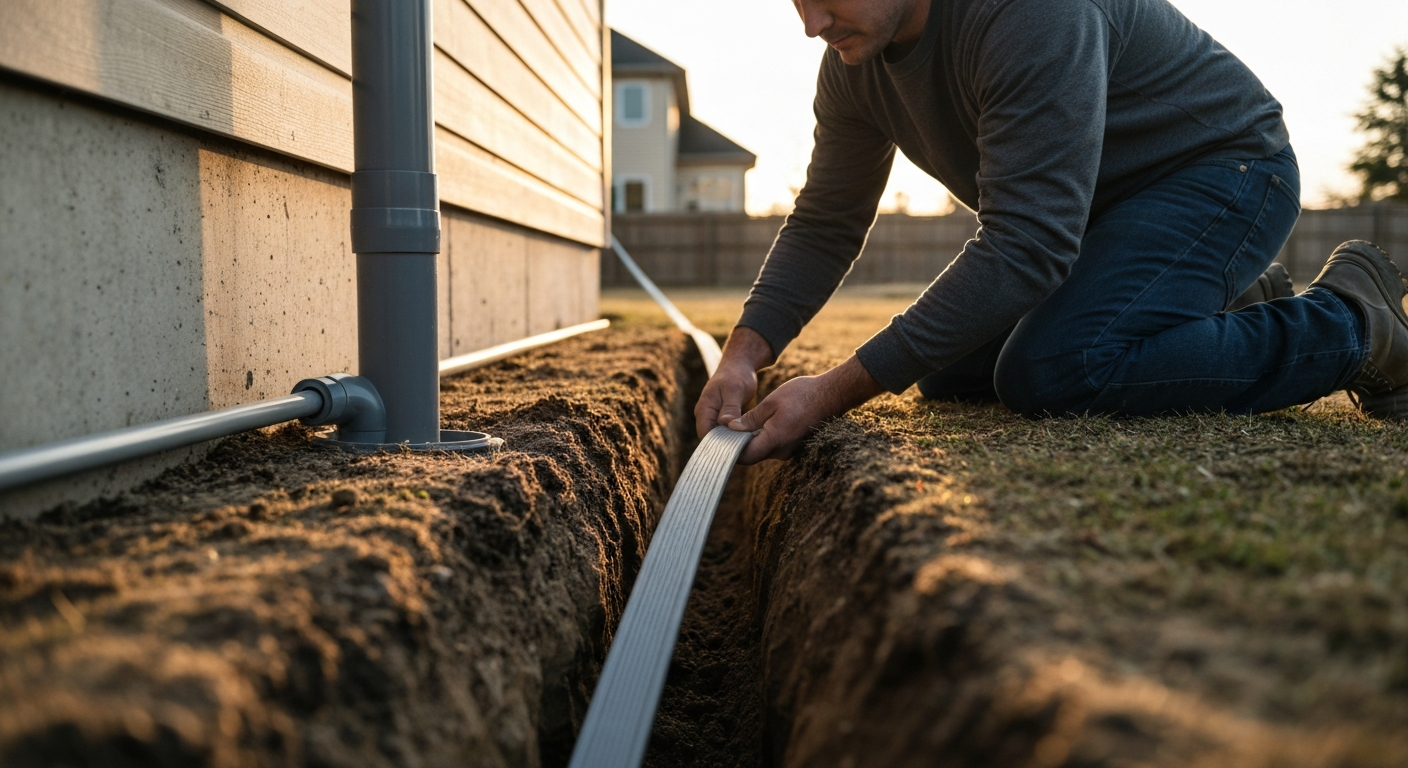
- Dig the Trench to Meet the Required Cover: Excavate the trench so the installed cable will have the minimum cover required by NEC Table 300.5 for the specific circuit and location. “Cover” is measured from the top of the cable to the final grade, so the excavation depth needs to account for bedding material and final grade adjustments.
- Prepare the Trench with Appropriate Bedding: Use suitable backfill material free of large rocks, debris, or sharp objects that can damage the cable. A few inches of sand or fine soil beneath the cable is common best practice and helps protect the cable from sharp objects.
- Lay the UF-B Cable Carefully: Place the cable in the trench without sharp bends or kinks, and do not pull it taut. Leave some slack for settlement and thermal movement. Verify the cable is listed for direct burial and that the product marking matches the intended use and conductor sizes.
- Protect the Cable at Emergence Points: Where the cable emerges from the ground to an outdoor box or building entry, protect the cable from physical damage. NEC requires protection extending from the minimum cover below grade (per Table 300.5) up to at least 2.5 m (8 ft) above finished grade; NEC also notes the below-grade protection need not exceed 450 mm (18 in.) below finished grade. In practice, this commonly results in installing a rigid conduit sleeve (for example, Schedule 80 PVC) that provides exposure protection above grade and a protective length below, followed by proper bedding and backfill. Place warning tape or a detectable marker above the buried cable (and for certain service installations the NEC requires a warning ribbon at least 300 mm (12 in.) above the conductors).
- Make Proper Connections in Listed Boxes: All splices and terminations must be made in a listed, weather-rated enclosure when outdoors; for direct-burial splices in some conditions the NEC permits listed direct-burial splice kits or splices made in accordance with 110.14(B). Use connectors and devices listed for the environment and the cable type.
Getting these outdoor installations right requires a good working knowledge of the NEC. For electricians who want to sharpen field skills and code knowledge for the latest cycle, mastering these details is key. For additional training, Enroll today.
Critical Considerations for a Compliant Installation
Beyond the basic steps, a professional journeyman electrician must account for several other factors for a robust and compliant UF cable installation.
- Physical Damage Protection: Any portion of the UF cable emerging from the ground or otherwise exposed is considered subject to physical damage and must be protected. A rigid conduit or sleeve is the common method. You can read more about how open conductor installations are protected and how expansion fittings protect PVC.
- Ampacity Derating and Voltage Drop: UF conductor ampacity must be determined by the cable’s listed temperature rating and in accordance with Article 310 ampacity rules, while also observing Article 340 limitations for UF. If multiple current-carrying conductors are grouped in a raceway, conduit, or cable, the ampacity derating rules in Article 310 apply and must be used. For long runs, check voltage drop so that the load receives acceptable voltage (commonly targeted at 3–5%).
- Underground Splices: Direct-buried splices and taps are permitted only when the splice/tap method and materials are listed for direct-burial use or otherwise meet NEC 110.14(B). Use direct-burial-rated kits or other approved methods intended for buried cable to maintain moisture resistance and mechanical durability.
- Grounding: If you feed a separate structure with a feeder, NEC Article 250 (see 250.32) generally requires a grounding electrode system at the separate building or structure. Follow Article 250 for grounding electrode installation and conductor sizing requirements, and confirm the required bonding/conductor terminations in the field. The equipment grounding conductor included with the cable (bare or insulated) serves to bond exposed metal parts per Article 250 — verify the product marking and size per 250.122.
Primary Sources
- NFPA 70, National Electrical Code (NEC), especially Article 340 (Type UF), Table 300.5 (minimum cover), and the grounding and equipment grounding requirements in Article 250.
Frequently Asked Questions about UF Cable Installation
What is the main difference between UF-B cable and NM-B cable (Romex)?
The primary difference is approved usage. UF-B cable has a heavier, moisture-resistant jacket and is listed for direct burial and wet locations; NM-B cable is for dry, interior applications only. Always verify the cable marking and listing for the intended use.
Can you run UF cable inside PVC conduit for the entire underground run?
Yes — running UF inside conduit is allowed and sometimes done for additional mechanical protection. If you place UF in conduit, follow the burial depth requirements for the conduit type in NEC Table 300.5, and be mindful of ampacity derating rules if multiple current-carrying conductors are grouped in the conduit.
Do all outdoor circuits using UF cable require GFCI protection for underground circuits?
Not all such circuits require GFCI protection solely because they are underground, but GFCI protection is required by NEC 210.8 for many outdoor receptacles (125 V–250 V) and, when applied to an eligible residential branch circuit, allows reduced burial depth per Table 300.5. Always check the applicable receptacle and branch-circuit GFCI requirements in Article 210 and the local authority having jurisdiction for enforcement details.
Continuing Education by State
Select your state to view board-approved continuing education courses and requirements:

Disclaimer: The information provided in this educational content has been prepared with care to reflect current regulatory requirements for continuing education. However, licensing rules and regulations can vary by state and are subject to change. While we strive for accuracy, ExpertCE cannot guarantee that all details are complete or up to date at the time of reading. For the most current and authoritative information, always refer directly to your state’s official licensing board or regulatory agency.
NEC®, NFPA 70E®, NFPA 70®, and National Electrical Code® are registered trademarks of the National Fire Protection Association® (NFPA®)
You may also like
Colorado Electrical Licensing Requirements and Reciprocity Guide
Standby Generators in DE: Navigating Coastal Storm Regulations

 Login with Google