
Navigating NEC Article 334: Nonmetallic-Sheathed Cable (Romex)
Navigating NEC Article 334: A Guide to Nonmetallic-Sheathed Cable (Romex)
For any residential electrician, mastering the rules for Nonmetallic-Sheathed (NM) cable is fundamental. Governed by NEC Article 334 of the National Electrical Code, the installation of what is commonly known as Romex® wire is subject to strict guidelines that ensure safety and compliance. This article covers the essential requirements every master and journeyman electrician must know, including the critical uses permitted and not permitted for NM cable, proper techniques for securing and supporting NM cable as defined in NEC 334.30, and the often-misunderstood rules for ampacity derating 334.80. Understanding these regulations is crucial for passing inspections and delivering safe, professional work. Key takeaways include support intervals, protection from physical damage, and the vital distinction between the cable’s NM-B 90°C rating and its allowable ampacity, which is limited by conductor temperature limitations at terminals.
What is NEC Article 334?
NEC Article 334 is the section of the nec code book that provides the definitive rules for the use, installation, and construction specifications for nonmetallic-sheathed cable (Types NM and NMC). Often referred to by the popular brand name Romex®, this wiring method is the backbone of residential and light commercial construction in the United States. For any residential electrician, a deep understanding of this article is not just best practice—it is a requirement for safe, code-compliant installations. The article dictates everything from where you can run the cable to how it must be protected and supported, ensuring the final installation is free from electrical and mechanical hazards. As the NEC is updated, such as with the 2023 NEC changes to NM and NMC cable installation rules, it is vital for professionals to stay current.
Uses Permitted and Not Permitted Under NEC 334.10 & 334.12
One of the most critical aspects of NEC Article 334 is defining the appropriate environments for NM cable. The “uses permitted and not permitted” sections are essential knowledge for any journeyman electrician or master electrician to avoid failed inspections and unsafe conditions.
Where You CAN Use NM Cable
According to NEC 334.10, Type NM cable is primarily permitted for both exposed and concealed work installation in normally dry locations. This includes:
- One- and two-family dwellings and their attached or detached garages and storage buildings.
- Multi-family dwellings of specific construction types (typically Types III, IV, and V), provided the cable is concealed within walls, floors, or ceilings with a 15-minute finish rating.
- In some cases, other structures of Types III, IV, and V construction, again with the requirement of concealment behind a fire-rated barrier.
- Fished into air voids of masonry block or tile walls where not subject to excessive moisture.
Critical Restrictions: Where You CANNOT Use NM Cable
NEC 334.12 outlines a clear list of prohibited uses for NM and NMC cables. Understanding these restrictions is paramount. NM cable shall not be used in:
- Any dwelling or structure not specifically permitted in 334.10.
- Exposed in dropped or suspended ceilings in non-residential buildings.
- As service-entrance cable.
- In commercial garages, theaters, motion picture studios, or other hazardous (classified) locations.
- Embedded in poured cement, concrete, or aggregate.
- In wet or damp locations; for these, an electrician might choose Type NMC or UF cable, or a different wiring method like MC cable entirely. A complete guide to electrical cable types can help in selecting the appropriate alternative.
Securing and Supporting NM Cable: NEC 334.30 Requirements
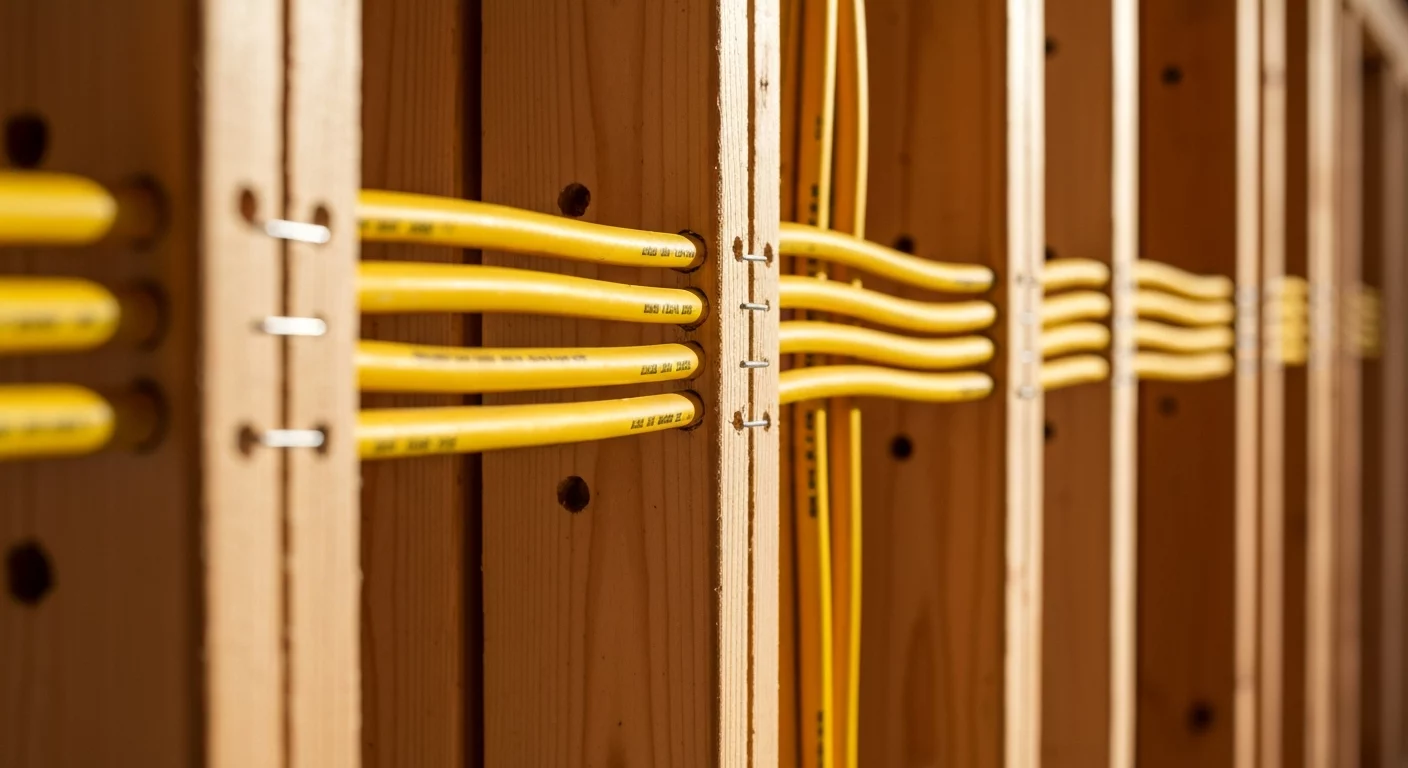
Properly securing and supporting NM cable is crucial for preventing strain on connections and protecting the cable from damage. NEC 334.30 provides explicit instructions that every electrician must follow. The general rule requires that NM cable be secured at intervals not exceeding 4.5 feet and within 12 inches of every box, cabinet, or fitting. When running cables through bored holes in framing members that are spaced no more than 4.5 feet apart, the cables are considered supported. However, they must still be secured within 12 inches of termination points. For flat cables, such as a typical 12/2 wire, staples must not be applied on edge, as this can compress the conductors and damage the insulation. Only listed fittings, such as staples, straps, or cable ties identified for support, should be used to avoid damaging the cable’s sheath.
Key Installation Practices for Journeyman and Master Electricians
Beyond the basic rules, achieving a professional and safe installation requires attention to several other key sections within NEC Article 334. This level of detail is a core part of comprehensive electrician training.
Protection from Physical Damage (NEC 334.15 and 334.17)
In both exposed and concealed locations, NM cable must be protected from physical damage. Per NEC 334.15, exposed cables must closely follow the building surface or run on running boards. In unfinished basements or crawl spaces, cables running through bored holes in joists are considered protected, as are cables running parallel to framing members when set back at least 1.25 inches. When running cable through bored holes in studs, joists, or rafters (governed by 334.17), NEC 300.4 requires the hole to be at least 1.25 inches from the nearest edge of the framing member. If this distance cannot be maintained, a steel plate at least 1/16-inch thick must be installed to protect the cable from nails and screws. Understanding how 2023 NEC updates protect NM cable from physical damage is vital for compliance.
Bend Radius Requirements (334.24)
To prevent damage to conductors and insulation, bend radius requirements 334.24 state that NM cable must not be bent tighter than a radius of five times the cable’s major diameter. For flat NM cable, the “diameter” refers to the wider dimension of the cable. A sharp bend can compromise the integrity of the sheath and the conductor insulation, creating a potential failure point. Using a can or a pipe as a template can help visually ensure compliance during installation.
The Most Misunderstood Rule: Ampacity Derating and the NM-B 90°C Rating (NEC 334.80)
Perhaps the most confusing rule in Article 334 is ampacity derating 334.80. Modern Type NM-B 90°C rating cable has conductors with insulation rated for 90°C. However, Section 334.80 explicitly states that the allowable ampacity of NM cable shall not exceed that of a 60°C rated conductor. This is due to conductor temperature limitations at terminals on devices like breakers and receptacles, which are typically rated for 60°C or 75°C.
The 90°C rating can, however, be used for ampacity adjustment and correction calculations (derating). For example, when bundling multiple cables together or running them in a high-temperature environment, you start the derating calculation from the higher 90°C ampacity value. The final calculated ampacity, however, must not exceed the value listed in the 60°C column of Table 310.16.
Step-by-Step Ampacity Derating Guide
When bundling more than two NM cables with two or more current-carrying conductors through the same bored hole in wood framing for a continuous length longer than 24 inches, you must derate. Here is how to apply it:
- Count Conductors: Determine the total number of current-carrying conductors. For example, three 12/2 cables have six current-carrying conductors.
- Find Starting Ampacity: Look up the ampacity of the conductor in the 90°C column of NEC Table 310.16. For 12 AWG copper, this is 30A.
- Apply Adjustment Factor: Use NEC Table 310.15(C)(1) to find the adjustment factor. For 4-6 conductors, the factor is 80%.
- Calculate Adjusted Ampacity: Multiply the 90°C ampacity by the adjustment factor. For our six conductors (three 12/2 cables): 30A x 80% = 24A.
- Final Check: Compare the result to the 60°C ampacity. The 60°C ampacity for 12 AWG is 20A. Since our calculated 24A exceeds this value, the final allowable ampacity must be limited to 20A per NEC 334.80.
These complex calculations underscore the importance of continuous learning. Master residential wiring methods with our in-depth NEC courses.
Type NM vs Type NMC: What’s the Difference?
While standard Type NM cable is for dry indoor locations, the NEC also defines Type NMC. The key difference is in the jacket. Type NM vs Type NMC shows that NMC cable has a sheath that is not only flame-retardant and moisture-resistant but also fungus- and corrosion-resistant. This makes it suitable for damp or corrosive environments like agricultural buildings where standard NM cable is prohibited. Learn more about the nuances in our guide to NM cable types. The 2023 NEC has also introduced updates relevant to protecting wiring in agricultural buildings from factors like rodent damage, often influencing cable selection.
The Role of the Authority Having Jurisdiction (AHJ)
Finally, always remember the Authority Having Jurisdiction (AHJ)—the local electrical inspector—has the final say on code interpretation. While the nec code book provides a national standard, local jurisdictions may have amendments or specific interpretations. For instance, some jurisdictions prohibit the use of NM cable in all commercial applications, regardless of construction type. Always verify local requirements before starting a project.
Primary Sources
- National Fire Protection Association (NFPA) 70, National Electrical Code (NEC), 2023 Edition
Frequently Asked Questions about NEC Article 334
- What is the main purpose of NEC Article 334?
- NEC Article 334 provides the mandatory rules for the safe installation of nonmetallic-sheathed cable (like romex wire). It covers everything from where it can be used, how to support it (securing and supporting nm cable), and how to protect it from damage.
- Can I use the 90°C ampacity for 12/2 NM-B wire?
- No. While the wire has an NM-B 90°C rating, NEC 334.80 limits its ampacity to the 60°C column of Table 310.16 (20A for 12 AWG copper) due to terminal ratings. The 90°C value is only used for starting derating calculations, and overcurrent protection is further limited by NEC 240.4(D) to 20A for a 12 AWG branch circuit.
- How often do I need to staple Romex wire?
- According to NEC 334.30, you must support and secure the cable at intervals not exceeding 4.5 feet and within 12 inches of every electrical box or cabinet.
- Is NM cable allowed in a commercial building?
- It depends. NEC Article 334 permits NM cable in certain commercial structures (Types III, IV, and V construction) if it’s concealed behind a 15-minute finish rating. However, it’s prohibited in many commercial scenarios and may be further restricted by the local Authority Having Jurisdiction (AHJ).
- What is the difference between NM and MC cable?
- The primary difference is the outer jacket. NM cable has a flexible plastic sheath, while MC cable (Metal-Clad) has a metallic armor. This makes MC cable more durable and permissible in more locations where NM cable is prohibited due to risk of physical damage.
Continuing Education by State
Select your state to view board-approved continuing education courses and requirements:

Disclaimer: The information provided in this educational content has been prepared with care to reflect current regulatory requirements for continuing education. However, licensing rules and regulations can vary by state and are subject to change. While we strive for accuracy, ExpertCE cannot guarantee that all details are complete or up to date at the time of reading. For the most current and authoritative information, always refer directly to your state’s official licensing board or regulatory agency.
NEC®, NFPA 70E®, NFPA 70®, and National Electrical Code® are registered trademarks of the National Fire Protection Association® (NFPA®)
You may also like
Colorado Electrical Licensing Requirements and Reciprocity Guide
Standby Generators in DE: Navigating Coastal Storm Regulations

 Login with Google