
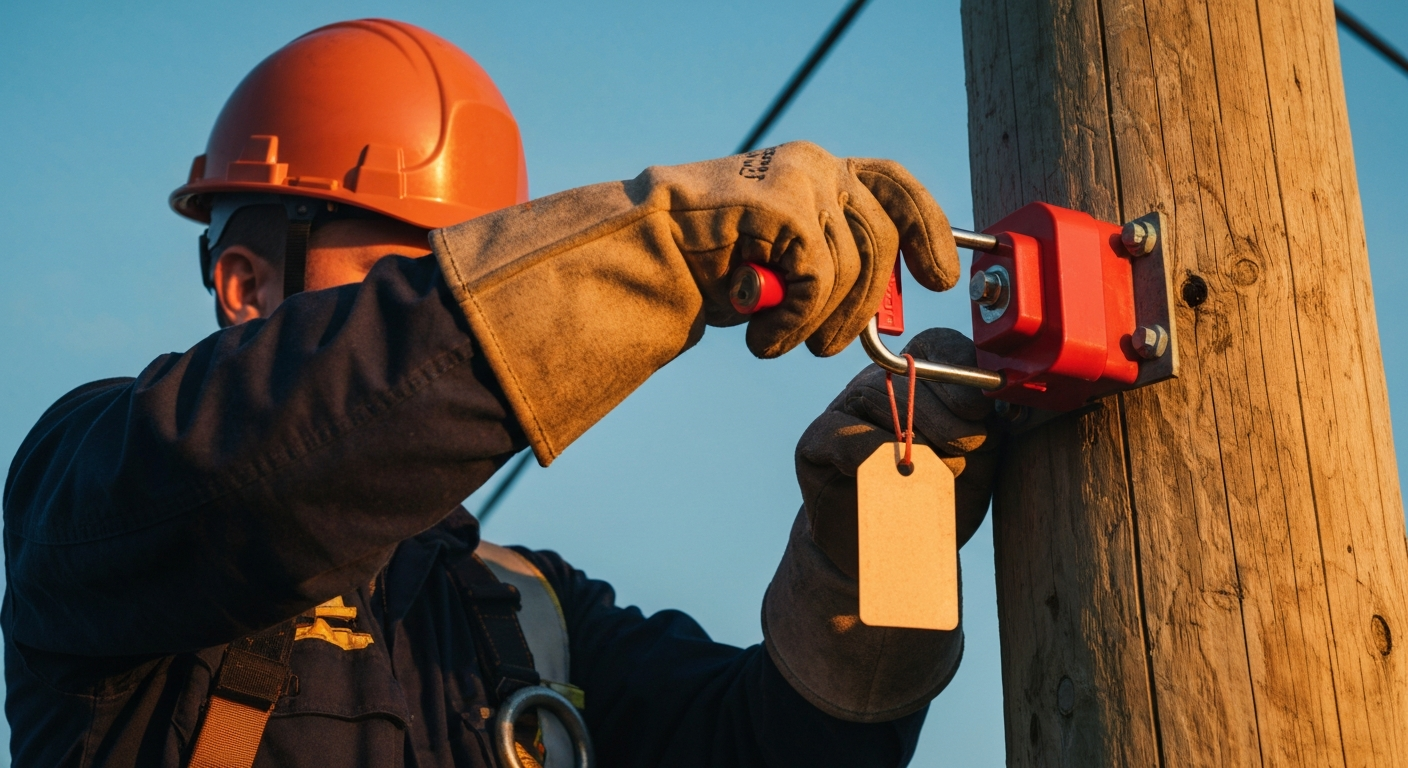
Lockout/Tagout (LOTO) Procedures for Power Linemen
Mastering Lockout Tagout Procedures for Linemen: An Expert Guide
Lockout Tagout (LOTO) procedures for linemen are a specialized set of safety protocols designed to protect against the unexpected release of hazardous energy during work on power generation, transmission, and distribution systems. Unlike the general industry lockout/tagout rule (OSHA 1910.147), electric power work is covered by OSHA 1910.269, which contains additional, industry-specific requirements beyond simple energy isolation for generation, transmission, and distribution work. For a qualified electrical worker, mastering these steps is a matter of life and death. The process involves comprehensive planning, communication with a system operator, and meticulous steps for de-energization. A critical distinction for line work is the mandatory verification of a zero-energy state and the application of protective grounding to guard against hazards like induced voltage. Whether you are a journeyman electrician or a master electrician, understanding these advanced LOTO applications, including establishing an equipotential zone grounding system, is fundamental to preventing catastrophic accidents and ensuring compliance on high-voltage job sites.
The Lineman’s Lifeline: Why LOTO is Non-Negotiable in High-Voltage Environments
For electricians working on standard commercial or residential systems, a LOTO procedure might end at the breaker panel. However, for a power lineman dealing with an electrical transformer or high-voltage lines, the risks are exponentially greater. The governing standard, OSHA 1910.269, provides a detailed framework specifically for these environments. Compliance is not optional; it is the cornerstone of safety in the utility industry. OSHA estimates that effective control of hazardous energy under the lockout/tagout program prevents roughly 120 fatalities and 50,000 injuries each year. For linemen, who work daily with immense electrical power, these procedures are the most critical defense against electrocution, severe burns from arc flash protection failures, and other life-threatening incidents.
Core Principles of Energy Isolation for High Voltage Work
The fundamental goal of LOTO is energy isolation, but for linemen, this goes far beyond flipping a circuit breaker. It involves a coordinated effort to ensure a section of the power grid is completely separated from all sources of electrical potential. This process of de-energization must be systematic and verifiable.
A key player in this process is the system operator, the individual responsible for managing the relevant portion of the power system. De-energizing a transmission or distribution line typically requires coordinated switching by the system operator, issuance of a formal clearance, and communication of the switching status. The lineman who receives this permission often becomes the clearance holder, assuming responsibility for the safety of the crew in the isolated zone, subject to employer and utility procedures. The complexity of disconnecting a recloser or isolating a substation transformer demands a higher level of coordination and verification than standard electrical work.
The Step-by-Step LOTO Procedure for Power Linemen
While the principles are universal, the application for linemen under OSHA 1910.269 is uniquely rigorous. Every qualified electrical worker must follow these steps without deviation.
- Preparation and Job Hazard Analysis (JHA): Before any work begins, a thorough job hazard analysis or job briefing is required by employer procedures and industry guidance. This assessment identifies all potential energy sources, the steps to isolate them, and the necessary personal protective equipment (PPE). If the work absolutely cannot be de-energized, an energized work permit is required, outlining the stringent precautions to be taken.
- Notification and Communication: The lead worker or clearance holder must communicate the plan to the system operator to request de-energization. All affected workers on the crew must be notified that a LOTO procedure is underway. Clear, unambiguous communication is essential to prevent misunderstandings.
- Shutdown and De-energization: The system operator executes the shutdown sequence, remotely opening switches and disconnects. The lineman on-site may then operate local disconnecting means as instructed, ensuring the targeted equipment is isolated from all energy sources.
- Application of Locks and Tags: The clearance holder applies the company’s required clearance device(s) or a personal lock and tag where the hardware permits; where isolating devices cannot be locked, employers must follow company-approved clearance and tagging procedures. Tags should identify the worker, the purpose of the control, and the time applied. Some employers require each affected employee to apply their own lock or other confirmation of protection, but practices vary by utility or employer.
- Release of Stored and Induced Energy: High-voltage equipment can store dangerous amounts of energy even after being disconnected. This step involves discharging capacitors and, most importantly for linemen, addressing the risk of induced voltage from adjacent energized lines. This is a primary reason for the next critical step.
- Verification of Isolation: This is the “trust but verify” phase. The lineman must use a properly rated voltage detector and test equipment to test the lines and equipment to confirm a zero-energy state. This test should include checks phase-to-phase and phase-to-ground as appropriate. Assuming a circuit is dead just because a switch is open is a fatal mistake. After verification, protective grounds can be applied.
Beyond the Lock: Protective Grounding and Equipotential Zones
For a lineman, true safety is only achieved after the application of protective grounding. Unlike work inside a building, overhead lines can be re-energized by accident, equipment failure, or even induced voltage from parallel lines. Protective grounds provide a low-impedance path intended to reduce dangerous voltages and, where system conditions permit, to establish a fault current path that will encourage operation of upstream protective devices; depending on system configuration and distance to protection, the grounds may not always cause an immediate trip.
Furthermore, linemen must establish an equipotential zone grounding system. This involves bonding the conductive equipment, the structure (like a pole or tower), and the worker (via approved bonding connections such as bonding jumpers attached to the worker’s harness, conductive tools, or mats as specified by employer procedures) to the same grounding system. By bonding everything together, it helps ensure there is minimal difference in electrical potential between any two points a worker might touch, providing robust arc flash protection and reducing the likelihood of current flowing through the lineman’s body. A deep understanding of these principles, often detailed in standards like NFPA 70E, separates a novice from an expert master electrician or journeyman lineman.
Key Considerations for Lineman LOTO
A successful and safe LOTO procedure requires attention to several critical details. Both a journeyman electrician and a seasoned lineman must remain vigilant of these factors:
- Minimum Approach Distance: Even on a de-energized and grounded line, maintaining a safe minimum approach distance from adjacent energized conductors is mandatory.
- Complex Systems: On systems with multiple energy sources, such as those involving an electrical transformer with backfeed potential, all sources must be identified and placed under appropriate control. Consulting relevant schematics is crucial for identifying all disconnecting means. For more on this, review this lesson on how to properly identify disconnecting means.
- Shift Changes: Procedures must be in place for the orderly transfer of LOTO responsibility from one clearance holder to another. A new worker must never remove another’s lock unless following the employer’s formal transfer or removal procedures.
- Induced Voltage: The risk of induced voltage is always present when working near other high voltage lines. Protective grounding and bonding are primary defenses against this invisible killer.
The Role of the Qualified Electrical Worker and Training
OSHA defines a qualified electrical worker as one who has demonstrated skills and knowledge related to the construction and operation of electrical equipment and installations and has received safety training to recognize and avoid the hazards involved. For linemen, this goes beyond standard electrician training. It requires specialized instruction on high-voltage theory, protective grounding techniques, and the specifics of OSHA 1910.269.
Continuous education is vital. Standards and technologies evolve, and so must a lineman’s expertise. Staying current with updates to safety standards, such as those found in NFPA 70E, is essential for effective job safety planning. You can learn more about how NFPA 70E 2024 updates have changed electrical job safety planning to stay ahead.
Before starting any task, ensure every circuit is de-energized when practicable and that required verifications and grounding are completed. Master LOTO for line work.
Primary Sources
- OSHA Standard 1910.269 – Electric Power Generation, Transmission, and Distribution
- NFPA 70E® – Standard for Electrical Safety in the Workplace®
Frequently Asked Questions (FAQ)
What is the main difference in lockout tagout procedures for linemen compared to plant electricians?
The primary difference is the handling of external hazards after de-energization. While a plant electrician’s LOTO focuses on isolating a machine or breaker panel, a lineman’s procedure under OSHA 1910.269 must also account for risks like accidental re-energization from the grid, equipment failure, and induced voltage from nearby lines. This necessitates the frequent use of protective grounding after verification of isolation and often involves different clearance and switching coordination practices than a plant environment.
What is an equipotential zone and why is it critical for high voltage work?
An equipotential zone grounding system connects all conductive objects in a workspace (the line, the pole, the worker, and the ground) to the same electrical potential by bonding them together using approved bonding methods. This prevents hazardous voltage differences from developing between objects, ensuring that if the system unexpectedly becomes energized, current is more likely to flow through the grounding conductors rather than the body of a qualified electrical worker, providing critical protection against electrocution and arc flash.
Is a job hazard analysis required for every lineman LOTO procedure?
OSHA and industry guidance require that hazards be identified and communicated before work begins; a job hazard analysis (JHA) or job briefing is an essential part of pre-job planning for tasks covered by OSHA 1910.269 and is expected as part of an employer’s safety program. Employers must ensure hazards are evaluated and workers are briefed in accordance with the regulation and company policy.
How does NFPA 70E relate to OSHA’s LOTO standards for linemen?
NFPA 70E and OSHA’s LOTO standards are companion documents for electrical safety. While OSHA 1910.269 provides the regulations for power generation and distribution work, NFPA 70E provides the “how-to” details on best practices for electrical safety, including selecting appropriate PPE, performing risk assessments, and establishing an electrically safe work condition. It gives detailed guidance on concepts like arc flash protection and defining the minimum approach distance, which are essential for any master electrician or lineman working with high voltage.
Continuing Education by State
Select your state to view board-approved continuing education courses and requirements:

Disclaimer: The information provided in this educational content has been prepared with care to reflect current regulatory requirements for continuing education. However, licensing rules and regulations can vary by state and are subject to change. While we strive for accuracy, ExpertCE cannot guarantee that all details are complete or up to date at the time of reading. For the most current and authoritative information, always refer directly to your state’s official licensing board or regulatory agency.
NEC®, NFPA 70E®, NFPA 70®, and National Electrical Code® are registered trademarks of the National Fire Protection Association® (NFPA®)
You may also like
Colorado Electrical Licensing Requirements and Reciprocity Guide
Standby Generators in DE: Navigating Coastal Storm Regulations

 Login with Google