
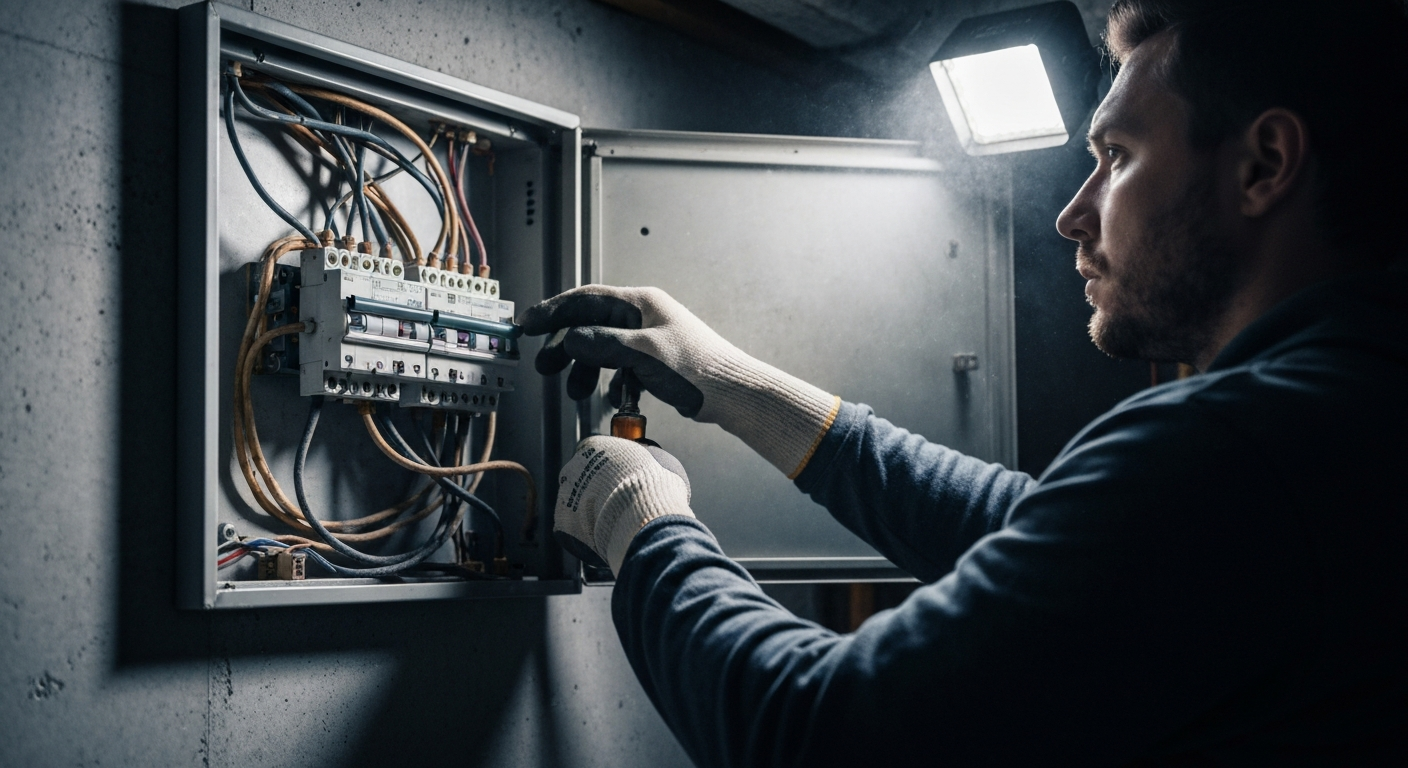
Identifying and Replacing Obsolete & Dangerous Breakers
A Professional’s Guide to Identifying and Replacing Obsolete Breakers and the Federal Pacific Electrical Panel
Article Summary: Identifying and replacing obsolete overcurrent protection is a critical duty for licensed electricians. The Federal Pacific electrical panel, particularly the Stab-Lok design, has been shown in independent testing to have elevated rates of breaker failure to trip compared with modern, listed breakers. Similarly, the Zinsco electrical panel and its components are known for bus-contact and overheating problems that can render protection ineffective. A complete electrical panel replacement is commonly recommended by safety professionals for these and many other outdated systems like certain Challenger and Pushmatic installations. This guide provides electricians with the essential knowledge for identifying these dangerous panels, understanding the risks, and performing a safe, NEC-compliant circuit breaker replacement and service upgrade to protect clients and their property. An electrician for electrical panel replacement should be proficient in recognizing these hazards and in how to communicate options to clients.
The Electrician’s Duty: Recognizing and Mitigating Hidden Dangers
As licensed professionals, our responsibility extends beyond simple installations and repairs. We are on the front lines of public safety, tasked with identifying latent hazards within a client’s electrical system. Among the most critical of these are obsolete and inherently unreliable circuit breaker panels. A poorly performing Federal Pacific electrical panel or a deteriorating Zinsco panel can function without incident for years, lulling a homeowner into a false sense of security. However, when an overcurrent or short-circuit event occurs, the failure of these devices to operate as designed can lead to catastrophic equipment damage and fire. Recognizing these systems is a non-negotiable skill for any serious electrician.
The Most Wanted List: Obsolete Panels to Target for Replacement
While many older panels may simply be outdated, a few manufacturers and panel types are widely flagged for replacement due to long-standing performance and safety concerns. Knowing their names and visual identifiers is key.
The Notorious Federal Pacific Electrical Panel (Stab-Lok)
If there is one name that should set off alarm bells, it’s Federal Pacific Electric (FPE). The Federal Pacific Stab-Lok series of breaker boxes has been the subject of numerous independent tests and safety discussions. Independent laboratories and researchers have reported elevated failure-to-trip behavior in many Stab-Lok breakers compared with modern listed breakers. Because independent studies vary in reported percentages and methods, quoting a single failure-rate figure is misleading; the appropriate takeaway for field work is that these assemblies have a well-documented history of unreliable operation. When you encounter a Federal Pacific panel, the conservative and widely recommended approach is replacement of the panelboard and all overcurrent protective devices with new, listed equipment.

The Dangers of the Zinsco Electrical Panel and Sylvania/GTE
Another major hazard is the Zinsco electrical panel (also sold under related labels such as Sylvania or GTE-Sylvania). Zinsco-style breakers frequently show evidence of poor contact with the bus, loose connections, and overheating. In many inspections the breaker becomes fused or welded to the bus and loses its ability to open under fault conditions. Because this condition can leave circuits energized despite a supposed ‘off’ position, industry practice is to replace Zinsco panels rather than attempt to service individual components.
Other Problematic Brands: Challenger, Pushmatic, and More
While FPE and Zinsco are the most commonly called-out examples, other brands and older equipment types often warrant careful evaluation and, in many cases, replacement.
- Challenger Panels: Certain Challenger components and specific production runs have been the subject of safety notices and, in some cases, recalls. Always check the exact model number and consult CPSC recall lists and the manufacturer’s service information when you encounter Challenger equipment. Finding a safe, listed replacement for older models can be challenging.
- Pushmatic Bulldog Breakers: These push-button breakers can become stiff or worn over time; the unusual mechanical design makes troubleshooting and parts replacement impractical in many cases, so replacement of the panel is commonly recommended when Pushmatic equipment is found to be unreliable.
- ITE, Crouse-Hinds, and Bryant: Many older panels from these manufacturers are now obsolete. While not every individual panel from these makers is inherently unsafe, the combination of age, wear, and lack of available listed replacement parts often leads professionals to recommend a modern panelboard replacement. Understanding the 2023 NEC rules on refurbishing equipment underscores the preference for new, listed components over unverified or refurbished parts.
Step-by-Step Guide to Professional Panel Replacement
Once an obsolete or unsafe panel is identified, a systematic approach to replacement ensures safety and compliance. Knowing how to change a breaker is just one small part of a complete electrical service upgrade.
- Initial Assessment and Client Communication: Inspect the existing installation, including the breaker panel, service entrance conductors, grounding, and bonding. Document your findings as part of your inspection report. Clearly explain the risks to the client, cite the observed deficiencies, and provide a written estimate for the cost to change electrical panel, including any permitting and utility coordination.
- Perform a Residential Load Calculation: Before selecting a new panel, perform a load calculation in accordance with NEC Article 220 to determine if the existing service is adequate or if an upgrade (for example, from a 100 amp breaker box to a 200 amp breaker box) is required. Do not assume service size without the calculation.
- Select Modern, Compliant Equipment: Choose a new listed panelboard and breakers that are appropriate for the installation and compatible with each other. Reputable manufacturers include Square D, Eaton, and Siemens. Select the correct main breaker size and only use breakers listed for the specific panelboard model as required by listing and labeling rules.
- Execute a Safe Replacement: Follow all safety protocols, including lock-out/tag-out procedures at the service disconnect and local utility procedures for removal of the meter or de-energizing the service where required. Carefully disconnect branch circuits, remove the old panel, and install the new panel. Torque all connections per manufacturer specifications and NEC guidance. Use multi-pole breakers on multiwire branch circuits and ensure handle ties or common-trip breakers are used where required.
- Finalize, Label, and Test: Produce a complete, accurate panel schedule and label every circuit. Test every circuit and verify correct operation of protective devices. Provide the client with documentation and safety recommendations. For further reading on panelboard replacement procedures and code considerations, this overview of 2023 NEC rules is useful.
Critical Considerations for Modern Installations
A modern 200 amp panel upgrade involves more than swapping the box. Pay close attention to these key details:
- Service and Feeder Sizing: A new 200 amp main breaker panel requires appropriately sized service-entrance conductors and grounding. Any new subpanel must be wired correctly with separate neutrals and equipment grounding conductors where required.
- Breaker Sizing and Application: Match breaker sizes to conductor ampacity and appliance nameplate ratings. Typical branch-circuit examples are a 15 amp breaker for 14 AWG branch circuits and a 20 amp breaker for 12 AWG, but always follow the NEC and appliance manufacturer instructions.
- Specialized Breakers and Circuits: Modern installations commonly require AFCI and GFCI protection in many locations; dual-function breakers are available where the code permits. Understand limitations on tandem (skinny) breakers and panel-specific allowances.
- Disconnects and Service Equipment: Verify that meter sockets, mains, and any transfer equipment, disconnects, or meter-main combinations are properly listed, rated, and installed. Coordinate with the utility where required for any service equipment changes.
- Component Compatibility: Only use breakers listed for the panelboard in which they are installed. Mixing brands or unlisted parts can compromise the connection to the bus and create a code and liability issue.
Diagnosing Persistent Breaker Tripping
A common client complaint is “why does my breaker keep tripping?” While this could signal a failing breaker, it is often working as intended. Start by isolating the specific branch circuit. Use a circuit breaker finder or tracer to identify the circuit, then determine whether the symptom is from an overload (too many devices), a short circuit, or a ground-fault. Appliance-specific failures are common (for example, an AC compressor with mechanical issues). Test protective devices with appropriate methods and measure currents to find the root cause before condemning the breaker.
Your Call to Action
Protect your clients from electrical hazards. Learn to spot dangerous equipment. Elevate your expertise and stay ahead of the curve with ExpertCE’s comprehensive courses for licensed electricians.
Primary Sources & Official Guidance
For authoritative information on electrical safety standards and code compliance, always refer to the primary sources:
- NFPA 70, National Electrical Code (NEC): The benchmark for safe electrical design, installation, and inspection.
- Underwriters Laboratories (UL): Standards such as UL 489 apply to circuit breakers and molded-case equipment.
- U.S. Consumer Product Safety Commission (CPSC): Use their database to verify recall or safety action history for specific models.
- International Association of Electrical Inspectors (IAEI): A resource for code interpretations and field applications.
Frequently Asked Questions (FAQ)
- What makes a Federal Pacific electrical panel so dangerous?
- Independent testing has shown many Stab-Lok breakers to have elevated failure-to-trip performance compared with modern listed breakers. Because reliable overcurrent protection is the first line of defense against wire overheating and fire, the presence of Stab-Lok equipment is treated as higher risk; replacement with a modern listed panelboard is generally recommended.
- What is the average cost to change electrical panel?
- Costs vary by region, local labor rates, permit and inspection fees, whether a service upgrade is required, and site conditions. For budgeting purposes many contractors cite a typical range that often runs into the multiple-thousands for a 200 A residential replacement, but always obtain local quotes and include permitting and utility coordination in the estimate.
- What are the standard circuit breaker sizes in a modern 200 amp panel?
- Common branch-circuit sizes are 15 A and 20 A for general lighting and receptacles; larger circuits for appliances and equipment use appropriately sized breakers per equipment nameplate and NEC rules. The main breaker for a 200 A panel will be rated 200 A; individual circuit sizes must match conductor ampacity and equipment requirements.
- Can I just replace a single bad Crouse Hinds or Bryant breaker in an old panel?
- Although a single replacement may be technically possible if a correct listed replacement is available, many old panels are obsolete and lack properly listed replacement parts. Using unlisted, refurbished, or mismatched breakers is a liability and is generally discouraged; in many cases a panel replacement is the safer, long-term option.
Continuing Education by State
Select your state to view board-approved continuing education courses and requirements:

Disclaimer: The information provided in this educational content has been prepared with care to reflect current regulatory requirements for continuing education. However, licensing rules and regulations can vary by state and are subject to change. While we strive for accuracy, ExpertCE cannot guarantee that all details are complete or up to date at the time of reading. For the most current and authoritative information, always refer directly to your state’s official licensing board or regulatory agency.
NEC®, NFPA 70E®, NFPA 70®, and National Electrical Code® are registered trademarks of the National Fire Protection Association® (NFPA®)
You may also like
Colorado Electrical Licensing Requirements and Reciprocity Guide
Standby Generators in DE: Navigating Coastal Storm Regulations

 Login with Google