
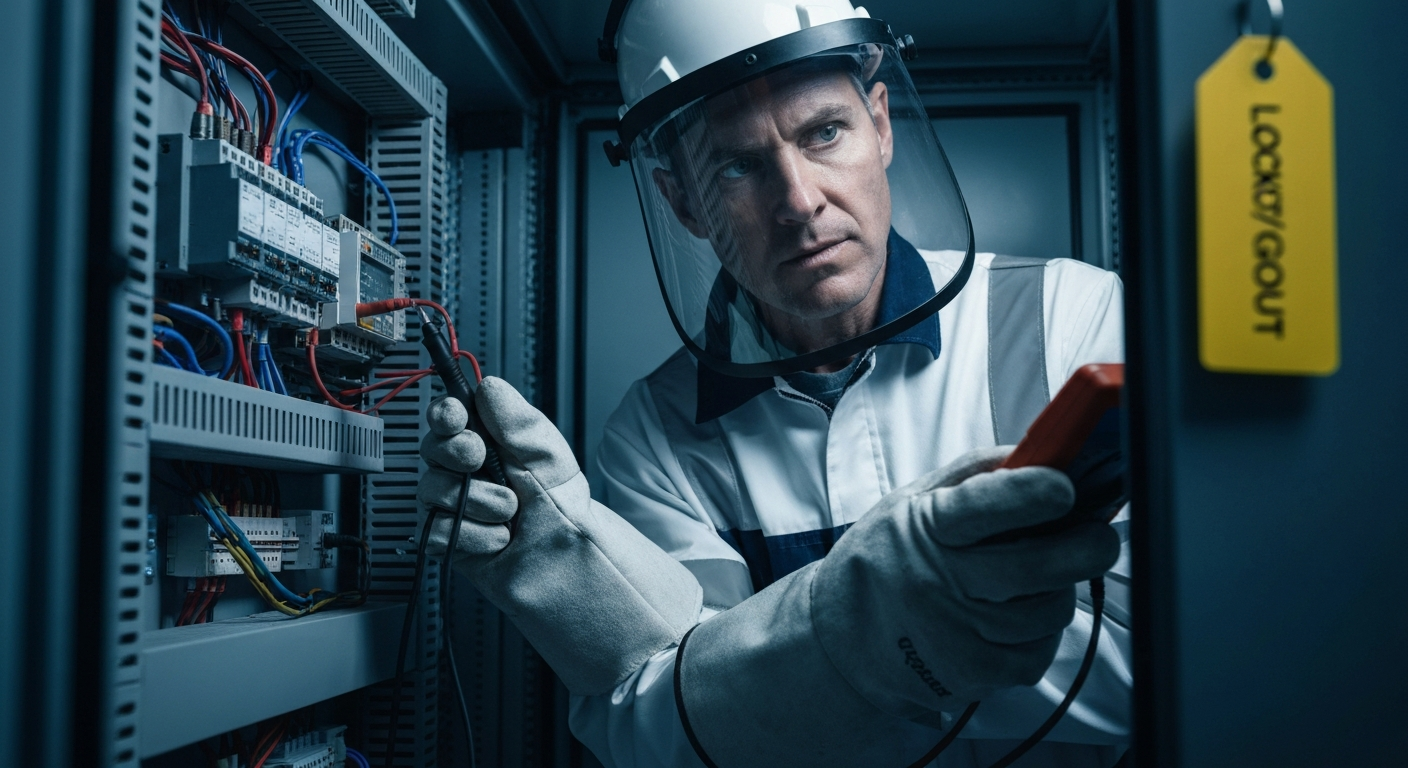
Human Error & Electrical Safety: The ‘Swiss Cheese’ Model
Human Error & Electrical Safety: The ‘Swiss Cheese’ Model
Understanding and preventing human error in electrical safety is a cornerstone of modern job site management. While technical failures occur, statistics show that human factors are a leading cause of electrical incidents. The ‘Swiss Cheese’ model provides a powerful framework for visualizing how accidents happen, not from a single mistake, but from a series of systemic weaknesses aligning. In this model, each layer of defense—such as training, procedures, and PPE—is a slice of cheese. The holes represent flaws or weaknesses. An incident occurs when the holes in multiple slices line up, allowing a hazard to pass through all defenses. This highlights the importance of not just focusing on active failures (the electrician’s immediate mistake) but also on latent conditions like poor training or a weak safety culture. A robust electrical safety risk assessment, aligned with NFPA 70E compliance, must therefore address these deeper human factors in electrical safety to create a truly resilient system that protects every worker on site.
The Unseen Holes: Understanding Human Error in Electrical Safety
On any job site, from a simple residential service call to a complex industrial installation, the potential for an electrical incident is always present. While we often focus on equipment malfunction or environmental hazards, many electrical injuries are avoidable and result from human factors like errors in judgment, poor maintenance, or a lack of training. For electricians, this reality is underscored by tragic statistics. According to analyses of U.S. Bureau of Labor Statistics data and reports from the Electrical Safety Foundation International (ESFI), electrical incidents have resulted in hundreds of workplace fatalities and thousands of injuries over recent years.
It’s crucial to redefine what we mean by “human error.” It isn’t about placing blame. Instead, it’s about recognizing that mistakes are symptoms of deeper problems within a system. This is where the Swiss Cheese Model of accident causation becomes an invaluable tool for both the apprentice and the seasoned master electrician.
Introducing the Swiss Cheese Model of Accident Causation
Developed by psychologist James Reason, the Swiss Cheese Model illustrates that a single, catastrophic failure is rarely the cause of an accident. Instead, incidents arise from a chain of events where multiple small failures align. Imagine a stack of Swiss cheese slices. Each slice represents a defense or barrier against failure. These defenses include:
- Engineering Controls (e.g., an AFCI breaker)
- Administrative Controls (e.g., Lockout/Tagout (LOTO) procedures)
- Personal Protective Equipment (PPE)
- Comprehensive electrician training
- Supervision and a strong electrical safety culture
The holes in each slice represent weaknesses or flaws. A hole could be a poorly written procedure, an exhausted worker, or a piece of faulty equipment. On most days, the slices are not aligned, and a mistake is caught by another layer of defense. An accident occurs only when the holes in all the slices momentarily line up, creating a direct path from a hazard to a loss. These weaknesses are categorized into two main types: latent conditions and active failures.
The Three Types of Human Error on the Jobsite
To effectively plug the holes in our safety defenses, we must first understand the different kinds of mistakes that can occur. While James Reason’s original framework also includes “violations” (intentional deviations from rules), human errors in the field are generally categorized into three types for operational training.
Skill-Based Electrical Errors
These are “slips” or “lapses” that happen during highly practiced, routine tasks performed almost automatically. The primary cause is a lapse in attention, often stemming from complacency in electrical work, distraction, or fatigue. A classic example is a qualified electrician performing a complex but familiar Lockout/Tagout (LOTO) procedure and, due to an interruption, forgetting to verify the absence of voltage—the final, critical step.
Rule-Based Electrical Mistakes
These errors occur when a rule or procedure is misapplied or when a bad rule is followed. This could involve an electrician incorrectly interpreting a complex table in the NEC code book, leading to an improper installation. It can also happen when an informal “rule of thumb” contradicts established safety protocols, such as assuming a breaker that keeps tripping is a nuisance rather than investigating the root cause as required by safety standards.
Knowledge-Based Electrical Failures
These failures happen in novel or unfamiliar situations where the individual lacks the necessary training or experience to make the correct decision. A journeyman electrician, for instance, might encounter a new type of variable frequency drive without specific training, leading them to make incorrect assumptions about de-energization. This highlights the critical need for continuous learning and knowing the limits of one’s expertise. For those aiming to reach the highest level of proficiency, a comprehensive master electrician exam prep study plan is not just about passing a test; it’s about building the deep knowledge required to prevent these very failures.
Building Better Defenses: A Practical Approach to NFPA 70E Compliance
The Swiss Cheese Model is not just a theory; it provides a blueprint for strengthening our safety systems. A key takeaway is that we cannot eliminate human error entirely, but we can build more robust defenses to catch errors before they lead to an incident. The standards themselves are evolving to reflect this; a key part of understanding what NFPA 70E is involves recognizing its focus on risk management. The 2024 edition of NFPA 70E places greater emphasis on human performance and requires human factors to be considered as part of the risk assessment process; practitioners should incorporate human-performance considerations when they plan electrical work. Learning how the 2024 updates to NFPA 70E have changed job safety planning is essential for every electrical professional.
The Critical Role of Pre-Task Risk Assessment
A Pre-task risk assessment, or Jobsite safety analysis (JSA), is one of the most effective “slices of cheese” at our disposal. It forces a deliberate pause to identify hazards and weaknesses before work begins. A thorough assessment must go beyond the technical to include human factors.
- Identify Hazards: This includes obvious electrical hazards like shock and arc flash, but also situational hazards like poor lighting, confined spaces, or pressure to complete a job quickly.
- Assess Risks: Evaluate the likelihood and severity of potential incidents. An Arc flash hazard analysis is a formal component of this step for many tasks.
- Analyze Human Factors: Ask the tough questions. Is the team experienced with this specific task? Are they fatigued? Is there complacency because “we’ve done this a hundred times”? Are the procedures clear and correct?
- Implement Control Measures: Based on the analysis, deploy the hierarchy of controls. This includes engineering solutions, administrative controls like LOTO, and ensuring the correct PPE is used.
- Communicate and Review: The plan is useless if not communicated. Hold a pre-job briefing to ensure every team member understands the hazards, their roles, and the safety procedures. Empower every worker to stop the job if conditions change.
From Theory to Practice: Preventing Electrical Incidents
Applying the Swiss Cheese model means shifting focus from blaming individuals to strengthening the system. A robust safety program is multi-layered and anticipates human fallibility. Develop a world-class safety culture with our online electrical courses and safety management training.
Here are key takeaways for preventing electrical incidents on your job site:
- Invest in Continuous Training: Foundational knowledge from programs like NCCER is just the start. Ongoing electrical safety training for electricians reinforces best practices and introduces new technologies and code updates. Understanding the ‘why’ behind an issue, such as why a breaker keeps tripping, is as important as knowing how to reset it.
- Foster a Strong Electrical Safety Culture: Leadership must champion safety not as a priority (which can change) but as a core value. This means providing the right tools, sufficient time for jobs, and creating an environment where workers feel safe to report near-misses and concerns without fear of reprisal.
- Question Assumptions About Energized Work: One of the biggest holes in any safety program is the normalization of deviance. Never default to working on energized electrical equipment unless it is absolutely unavoidable and a formal energized work permit is completed.
- Learn from Mistakes: When a near-miss occurs, treat it as a free lesson. Conduct a root-cause analysis that looks for both active failures and latent conditions. What hole in which slice of cheese allowed this near-miss to happen? How can we patch that hole for good?
Frequently Asked Questions (FAQ)
- What are the most common human factors in electrical safety?
- The most common factors include complacency during routine tasks, fatigue, rushing to meet deadlines, lack of specific training on equipment, poor communication between team members, and misinterpretation of safety procedures or NEC code requirements.
- How does NFPA 70E compliance help prevent human error in electrical safety?
- NFPA 70E compliance establishes a framework for an Electrical Safety Program that inherently addresses human error. It mandates risk assessments, job safety planning, training requirements, and procedures like LOTO, which act as defensive layers (the “slices of cheese”) to catch mistakes before they cause an injury.
- What is the difference between latent conditions and active failures in electrical work?
- An active failure is an unsafe act committed by a person in direct contact with the system (e.g., an electrician failing to verify de-energization). A latent condition is a hidden weakness in the system, such as inadequate training programs, poorly maintained equipment, or production pressure from management, that creates the conditions for an active failure to occur.
- Can better electrician training really help in preventing electrical incidents caused by human error?
- Absolutely. Effective electrician training goes beyond teaching tasks; it builds competence and risk awareness. It helps electricians recognize novel situations, understand the principles behind the rules in the NEC code book, and internalize the critical importance of safety procedures, directly strengthening multiple layers of defense against human error.
Primary Sources
- National Fire Protection Association (NFPA) 70E®, Standard for Electrical Safety in the Workplace® (2024 Edition)
- Electrical Safety Foundation International (ESFI), Workplace Injury & Fatality Statistics
- U.S. Bureau of Labor Statistics (BLS), Census of Fatal Occupational Injuries (CFOI)
- Occupational Safety and Health Administration (OSHA), Accident Investigation Data
Continuing Education by State
Select your state to view board-approved continuing education courses and requirements:

Disclaimer: The information provided in this educational content has been prepared with care to reflect current regulatory requirements for continuing education. However, licensing rules and regulations can vary by state and are subject to change. While we strive for accuracy, ExpertCE cannot guarantee that all details are complete or up to date at the time of reading. For the most current and authoritative information, always refer directly to your state’s official licensing board or regulatory agency.
NEC®, NFPA 70E®, NFPA 70®, and National Electrical Code® are registered trademarks of the National Fire Protection Association® (NFPA®)
You may also like

Colorado Electrical Licensing Requirements and Reciprocity Guide
Standby Generators in DE: Navigating Coastal Storm Regulations

 Login with Google