
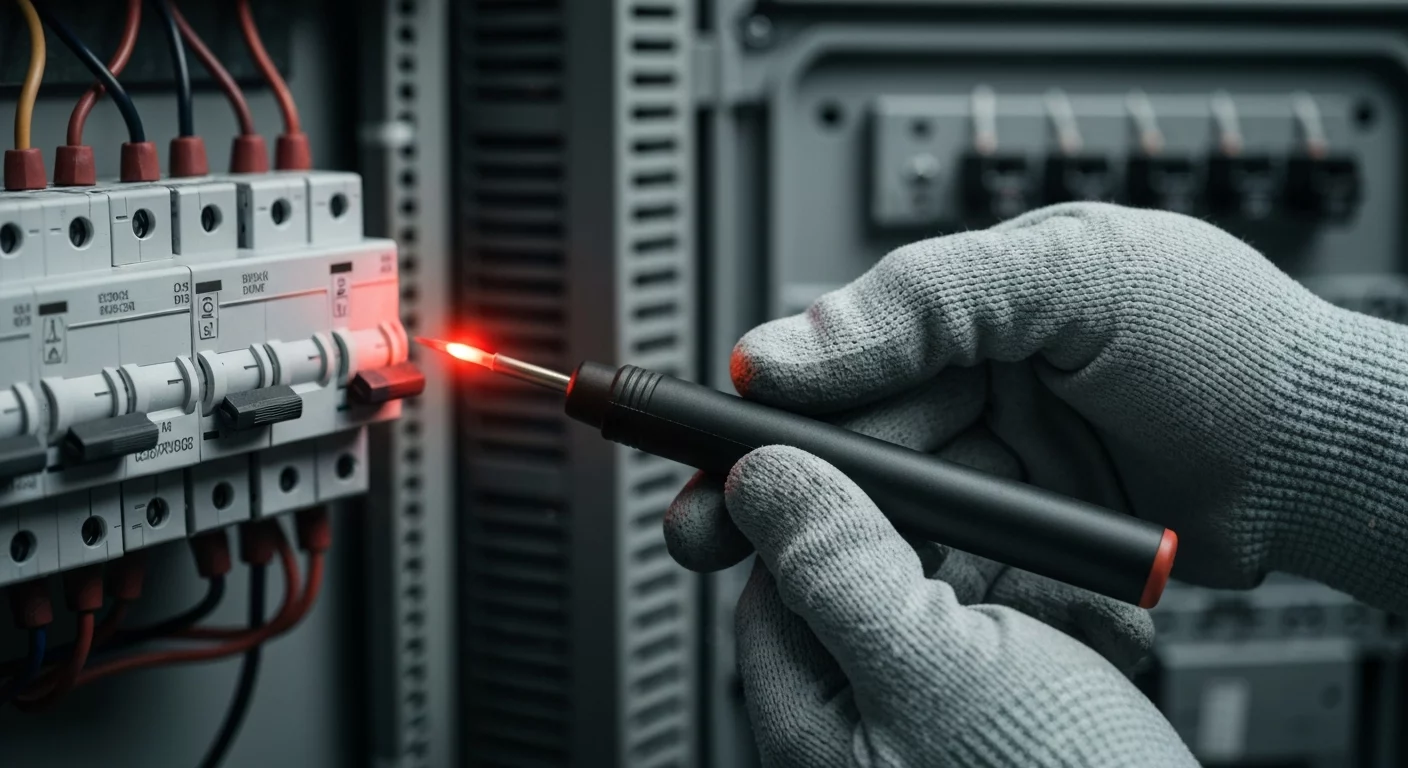
Using a Non-Contact Voltage Tester (Voltage Pen) Safely
How to Use a Voltage Pen Safely: A Guide for the Professional Electrician
A non-contact voltage tester, commonly known as a voltage pen, is a primary screening tool for any professional electrician. Knowing how to use a voltage pen is a fundamental skill for quick, initial AC voltage detection before proceeding with more rigorous verification methods. These devices work on the principle of capacitive coupling to detect an electric field around an energized conductor, providing a vital first alert. However, for a journeyman electrician, relying on a voltage pen alone is a critical mistake. True electrical safety, as required by NFPA 70E, requires verification of an electrically safe work condition with a contact-type test instrument (for example, a properly rated multimeter) as part of a full verification process. This guide provides expert instruction on using a voltage pen correctly as part of a complete safety protocol, covering the essential live-dead-live test, understanding tester limitations like ghost voltage, and selecting tools with appropriate CAT III/CAT IV safety ratings where applicable. Following these steps is a non-negotiable part of any professional’s electrical safety policy.
The Role of the Voltage Pen in a Modern Electrician’s Toolkit
For a busy professional, from an apprentice to a seasoned journeyman electrician, a voltage pen is an indispensable tool for efficiency and initial safety checks. It allows for rapid confirmation of voltage presence in outlets, lighting fixtures, switches, and wires without making direct contact. This initial check is crucial when identifying circuits, troubleshooting faults, or beginning a task like a circuit breaker replacement. Its primary function is to serve as a go/no-go gauge—a quick warning that a circuit may be live. However, extensive electrician training and standards like NFPA 70E emphasize that this is only the first step. The pen’s indication of voltage should be trusted, but its lack of indication must be questioned and verified. Never assume a circuit is dead based solely on a voltage pen; it is a tool for initial assessment, not final verification.
Understanding the Technology: How Capacitive Coupling Works
A voltage pen performs AC voltage detection without a physical connection through a principle called capacitive coupling. In essence, the tester, your body, and the ground form a capacitor. When the tip of the pen is brought near a conductor with an AC voltage, it detects the oscillating electric field that surrounds the wire. This electric field “couples” with the sensor in the tester, completing a circuit through your body’s own capacitance to ground, which triggers the pen’s light and/or alarm.
This mechanism is also why these testers have inherent limitations. Most non-contact testers detect AC only; they typically cannot reliably detect DC because DC does not produce the alternating electric field these testers sense. Furthermore, they are often ineffective on shielded cables or wires in metal conduit, as the metal shield or conduit can block or attenuate the electric field, leading to a dangerous false negative.
The Critical Importance of Safety: CAT Ratings and PPE
An essential aspect of tool selection and professional practice is understanding equipment safety ratings. Measurement tools, including voltage pens and multimeters, are given Overvoltage Installation Category (CAT) ratings that indicate the environment for which the tool is designed and its ability to withstand high-energy transients.
- CAT II is typically for local load connections such as receptacles or plug-in equipment.
- CAT III covers distribution systems, including circuit breaker panels, feeders, and fixed equipment.
- CAT IV applies to the origin of the installation, such as service entrances and utility connection points.
Using a tool with a CAT rating too low for the environment is a serious safety risk. A transient on a CAT IV system could destroy a lower-rated tester and cause an arc event. Always select a tester rated for the highest potential category you might encounter and follow the manufacturer’s instructions for use.
Furthermore, tool selection is no substitute for personal protective equipment (PPE). Electrical work requires an arc-flash risk assessment and PPE selected to match the task; insulated gloves, face protection, and other PPE may be required depending on the assessed hazard. This aligns with the principles found in both the NEC code book and NFPA 70E, the Standard for Electrical Safety in the Workplace.
How to Use a Voltage Pen: The Live-Dead-Live Test Procedure
The only safe way to use a voltage pen is as part of the universally recognized live-dead-live test. This three-step process ensures both your tester is working and the circuit is de-energized. Failing to follow this procedure can lead to catastrophic accidents.
- LIVE Test: Verify Tester Operation
Before testing your target circuit, test your voltage pen on a known live source, such as a nearby receptacle you know has power. The pen should light up and/or beep. This confirms the batteries are good and the sensor is functioning correctly. This first step to verify tester operation is non-negotiable. - DEAD Test: Test the Target Circuit
Immediately move to the circuit you intend to work on—the one you believe is de-energized. Place the tip of the tester on or near all conductors within the box or on the device, including terminals on a circuit breaker or outlet. The tester should give no indication. If it does, stop immediately; the circuit is still live. - LIVE Test: Re-Verify Tester Operation
After testing the “dead” circuit, immediately return to the known live source and test it again. This final step confirms your tester did not fail during the dead test. If it fails to indicate voltage on the known live source this time, you cannot trust the “dead” reading you just took. You must acquire a new tester and start the process over.
This procedure is the bedrock of safe electrical work. For anyone seeking to advance their skills, our online electrical courses provide in-depth training on these and other critical safety practices.
The Limitations of NCVTs: Understanding False Positives and False Negatives
A professional must be acutely aware of a voltage pen’s limitations. Misinterpreting a reading can be just as dangerous as not testing at all. Both false positives and false negatives can occur.
Decoding False Positives: Ghost Voltage, Induced Voltage, and Static
A common issue is when a tester indicates voltage on a conductor that is not actually energized, a phenomenon often called ghost voltage, induced voltage, or stray voltage. This happens when a de-energized wire runs parallel to a live conductor. The electric field from the live wire can induce a small voltage in the adjacent dead wire through capacitive coupling, which is enough to set off the sensitive detector. While a false positive is generally less dangerous than a false negative, it can cause confusion and lead to unnecessary troubleshooting. A contact multimeter will typically show a negligible or zero reading on a line with ghost voltage.
The Dangers of False Negatives
The most dangerous scenario is a false negative, where a tester fails to indicate voltage on a live circuit. This can happen for several reasons:
- Shielded Cables: The metallic sheath on armored cable (AC), metal-clad (MC) cable, or other shielded cables can block or attenuate the electric field, preventing a reliable reading.
- User Isolation: If the user is not providing sufficient capacitance to ground (for example, due to certain footwear, insulating mats, or other isolation), the capacitive circuit may be weak and the pen may not trigger.
- Tester Malfunction: Dead batteries or internal damage can cause the tester to fail. This is why the live-dead-live test is essential.
- Conductor Orientation: In tightly bundled or twisted multi-conductor runs, fields from adjacent conductors can partially cancel and reduce a detectable field at the tester tip.
Given these risks, it’s clear why one must never rely solely on a non-contact tester before working on electrical equipment.
NCVTs and NFPA 70E: A Matter of Compliance
NFPA 70E sets the standard for creating an Electrically Safe Work Condition (ESWC). While a voltage pen is a useful preliminary tool, it does not substitute for the contact verification step required by NFPA 70E when establishing an electrically safe work condition. The NCVT’s role is to add a layer of safety before the required contact test is performed, not to replace it. For additional guidance on how verification requirements have evolved, see how NFPA 70E has changed voltage verification for electrical safety and how the 2023 NEC improves electrical worker safety.
Key Takeaways for Safe Voltage Pen Use
- Always perform the Live-Dead-Live test. No exceptions.
- NEVER use a voltage pen as the sole method to verify a de-energized state. Always follow up with a properly rated contact test instrument.
- Be aware of ghost voltage. Understand that a positive reading may be induced and requires verification.
- Understand the limitations. Remember that shielded cables, user isolation, and tester condition can all lead to a false negative.
- Use PPE per an arc-flash risk assessment. Insulated gloves and other PPE should be selected according to NFPA 70E and the task-specific risk assessment.
- Select the right tool for the job. Ensure your tester has the correct CAT rating for the environment you will encounter and follow the manufacturer’s instructions.
Always verify a circuit is de-energized. For additional guidance on electrical safety and establishing electrically safe work conditions, Learn more about NFPA 70E.
Frequently Asked Questions (FAQs)
1. Why is my voltage pen beeping when the switch is off?
This is likely due to ghost voltage or induced voltage. Even when a circuit is switched off, wires running alongside live conductors can pick up enough of an electric field to trigger a sensitive voltage pen. Use a contact multimeter to confirm that there is no hazardous voltage present.
2. How do you use a voltage pen to find a circuit breaker?
A voltage pen can be used as a rudimentary circuit breaker finder. Turn on the device you wish to identify (e.g., a light or appliance). At the panel, switch off one breaker at a time. After switching a breaker off, test the device with your voltage pen. If the pen no longer indicates voltage, you have likely found the correct breaker. Always perform the full live-dead-live test before beginning work.
3. Are voltage pens reliable for a journeyman electrician?
Voltage pens are reliable as a preliminary tool for quick checks and initial AC voltage detection. A professional journeyman electrician knows that its main value is convenience and speed for identifying potentially live circuits. However, it is not reliable for the final verification of a de-energized state, where NFPA 70E requires contact verification and establishment of an electrically safe work condition.
4. Can a voltage pen detect low voltage?
Most standard voltage pens are designed for mains voltage ranges (often specified by manufacturer models — for example, nominal ranges commonly start around household mains voltage). Some models are specifically designed for low-voltage applications (e.g., control, HVAC, or thermostat circuits). Always check the manufacturer’s specifications to ensure the tester is appropriate for the voltage you are testing.
5. What is the difference between CAT III and CAT IV safety ratings?
CAT III ratings are for equipment in fixed installations, like distribution panels and circuit breakers inside a building. CAT IV ratings are for the origin of the installation—the point where power enters a building, such as service drops and utility meters. CAT IV environments have the highest potential for dangerous high-energy transients, so tools used there require the highest level of protection.
Continuing Education by State
Select your state to view board-approved continuing education courses and requirements:

Disclaimer: The information provided in this educational content has been prepared with care to reflect current regulatory requirements for continuing education. However, licensing rules and regulations can vary by state and are subject to change. While we strive for accuracy, ExpertCE cannot guarantee that all details are complete or up to date at the time of reading. For the most current and authoritative information, always refer directly to your state’s official licensing board or regulatory agency.
NEC®, NFPA 70E®, NFPA 70®, and National Electrical Code® are registered trademarks of the National Fire Protection Association® (NFPA®)
You may also like

Colorado Electrical Licensing Requirements and Reciprocity Guide

Standby Generators in DE: Navigating Coastal Storm Regulations

 Login with Google