
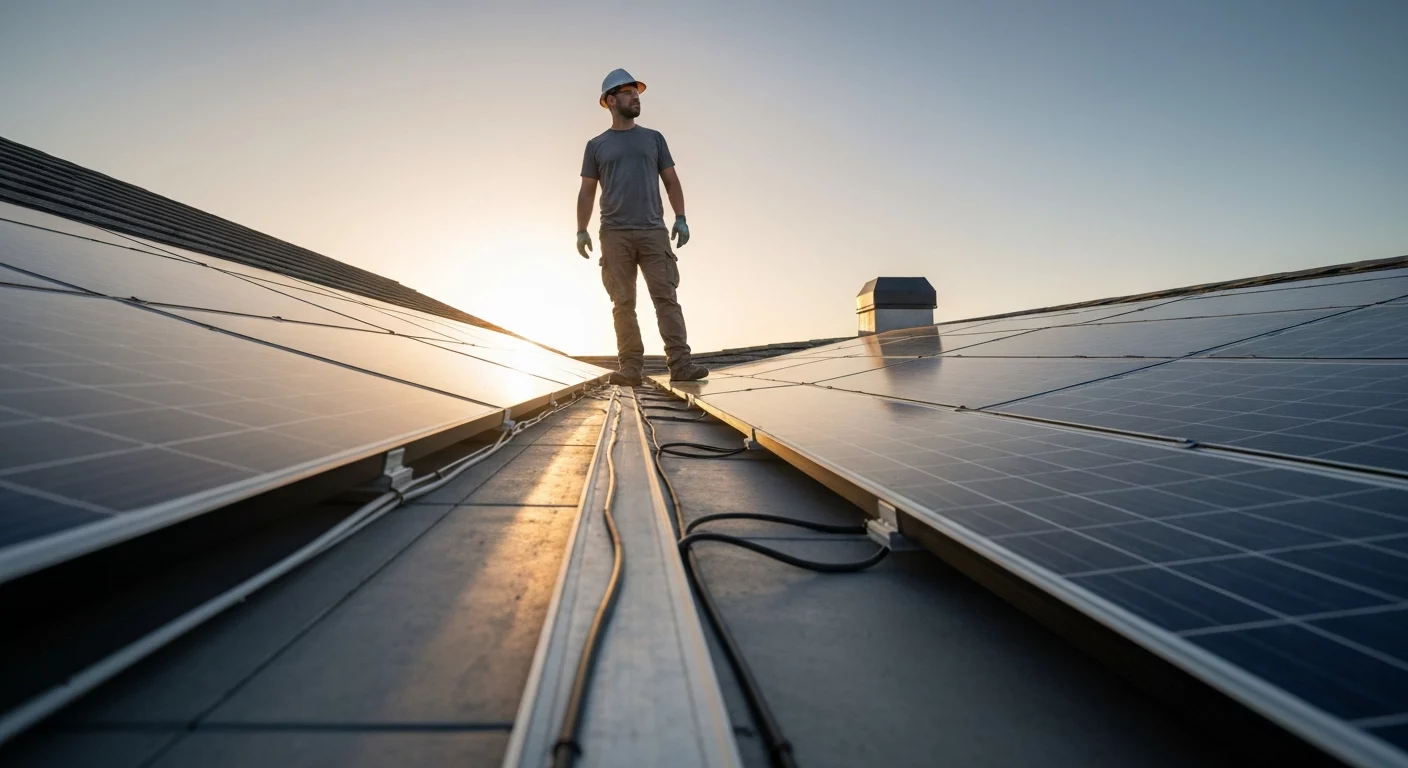
Fire Code Requirements for Rooftop Solar (IFC Guide)
A Master Electrician’s Guide to Fire Code Solar Installation Requirements
Ensuring a compliant fire code solar installation requires mastering two distinct but equally important sets of regulations: the International Fire Code (IFC) for firefighter safety and rooftop access, and the National Electrical Code (NFPA 70) for all electrical components. For a master electrician or journeyman electrician, a successful and safe photovoltaic (PV) project hinges on satisfying both. Key electrical considerations are governed by NFPA 70; for PV systems, NEC Article 690 is the primary electrical reference and includes rapid shutdown requirements designed to reduce hazards for first responders. On the structural side, the IFC and locally adopted amendments dictate the layout, including firefighter access pathways and rooftop setbacks. Ultimately, the local Authority Having Jurisdiction (AHJ) has the final say, making early coordination and a thorough understanding of the adopted codes essential for any project.
The Two Pillars of Solar Safety: IFC and NEC
A compliant solar installation rests on two foundational documents: the International Fire Code (IFC) and the National Electrical Code (NEC), also known as NFPA 70. While they work in tandem, they govern different aspects of the project. Misunderstanding their distinct roles can lead to failed inspections, costly rework, and significant safety hazards.
The IFC’s primary concern is the safety of building occupants and first responders. For rooftop solar, this translates to rules about physical layout. It ensures that firefighters can safely access and move around a roof, ventilate a building during a fire, and have a clear understanding of the system’s presence. Its regulations focus on elements like access pathways and setbacks, though the exact numeric widths and distances are set by the adopted code edition and local amendments.
The NEC, specifically NEC Article 690, is the electrician’s core text for the project, governing all electrical aspects of the PV system. It covers everything from conductor sizing and overcurrent protection to critical safety functions that reduce shock hazards. Navigating this code is essential, and our guide to the 2023 NEC code book can provide a valuable overview. The final arbiter for both codes is the local Authority Having Jurisdiction (AHJ), which may adopt specific versions or have local amendments. For example, some states or municipalities adopt amendments that modify national model code language, so plan review coordination is essential.
IFC Firefighter Safety Requirements for Rooftop PV
The IFC establishes a blueprint for rooftop layouts to ensure first responders are not hindered by a PV array during an emergency. These rules are designed to provide space for movement, ventilation, and rapid egress. Exact pathway widths, number of pathways, and setback distances depend on the adopted IFC edition and any local amendments, so verify the AHJ’s requirements early in the design phase.
Understanding Rooftop Setbacks and Firefighter Access Pathways
Two of the most critical IFC concepts are setbacks and pathways. Firefighter access pathways are unobstructed channels on the roof that allow firefighters to move from the eave to the ridge and access roof features. Many jurisdictions require multiple access pathways and often reference pathway widths such as 36 inches (914 mm) in guidance documents, but the AHJ determines the exact requirements for your project.
Rooftop setbacks are clear areas around roof features such as ridges and hips that provide space for travel and vertical ventilation. Some jurisdictions adopt setback schemes tied to array coverage or specific distances; some guidance materials reference ’18-inch’ or ’36-inch’ elements as examples, but setback rules vary by adopted code edition and local amendment. Confirm the exact setback metric with the AHJ and the adopted code edition before finalizing the layout.
Marking and Labeling Requirements
Clear communication is a life-saving tool. Both the IFC and NEC require clear labeling to inform first responders about the PV system and any rapid shutdown capability. NEC Article 690 contains labeling requirements for PV systems and rapid shutdown; labels typically identify the presence of a PV source, provide basic shutdown instructions, and indicate the location of disconnects. Confirm the NEC language and any local AHJ labeling expectations when preparing plans and labels.
Decoding NEC Article 690 for Solar Installations
For electricians, NEC Article 690 is the definitive guide for the electrical portion of a PV system. It has evolved since its introduction to address safety challenges posed by systems that can remain energized whenever exposed to sunlight.
The Critical Role of Rapid Shutdown Requirements
Rapid shutdown requirements were introduced in recent NEC cycles to reduce the shock hazard for firefighters and maintenance personnel. The NEC specifies how quickly and to what voltage level controlled conductors must be reduced after rapid shutdown initiation. Achieving compliance is commonly accomplished with module-level power electronics (MLPE) — microinverters, DC optimizers, or listed rapid-shutdown systems — or inverter-based solutions that are listed for the intended use. Because the NEC language and acceptable methods have changed across editions, always verify the adopted NEC edition for the precise rapid shutdown requirements that apply to your project.
PV System Disconnecting Means: Location and Types
A PV system disconnecting means is essential for isolating the PV system for maintenance or emergency response. The NEC details requirements for disconnects, including their location, ratings, and marking. Disconnects must be clearly labeled and readily accessible; depending on system design and the adopted code, multiple disconnects may be required at points such as the inverter, array combiner, and the point of connection to the building’s wiring.
Supply-Side vs. Load-Side Source Connections
The point where a PV system connects to the building’s electrical system is an important design choice. A load-side source connection ties into a breaker in the main panel and is commonly used for smaller PV systems, but it is constrained by panel bus and breaker ratings. A supply-side source connection (often discussed in NEC Article 705 for interconnected systems) connects on the utility side of the main service disconnect and is often used for larger systems; it requires utility coordination and careful attention to overcurrent protection and metering rules. Verify which connection approach is appropriate for the system size and the local utility’s interconnection requirements.
Essential Electrical System Protections
Beyond Article 690, a safe installation depends on fundamental electrical principles, from proper grounding and bonding to correctly sized circuit protection. Accurate calculations for conductor sizing, voltage drop, and conduit fill are essential to a robust and code-compliant design.
Grounding and Bonding for PV Systems
Proper grounding and bonding are non-negotiable. All metallic parts that could become energized — module frames, racking, and enclosures — must be effectively bonded together and connected to the building grounding electrode system in accordance with NEC Article 250. Whether a supplemental grounding electrode is required depends on the installation details; consult Article 250 and the AHJ when designing grounding electrode conductor paths.
Electrical Circuit Protective Systems
All circuit protective devices (fuses, breakers) must be sized to protect conductors from overcurrent and to coordinate with system operation. Use wire ampacity tables and temperature/ambient corrections per the NEC, perform a voltage drop calculation to ensure proper inverter voltage at full load, and validate conduit fill to prevent overheating and to meet fill rules. These calculations should be included with the project documentation submitted to the AHJ.
Considering Energy Storage Systems (ESS)
When PV systems include energy storage systems (ESS), NEC Article 706 and IFC provisions applicable to ESS must be considered. ESS installations often require additional equipment listings (for example, UL 9540 for ESS), ventilation, separation, and working-space provisions. Equipment such as inverters and ESS enclosures should be listed to the appropriate safety standards (e.g., UL 1741 for many inverters), and the AHJ may require additional fire protection or detection depending on the installation and local amendments.
Step-by-Step: Verifying Compliance with the AHJ
A smooth project requires a systematic approach to compliance. Follow these steps to ensure your installation meets all fire and electrical code requirements.
- Identify Local Codes: Contact the local building department to identify which editions of the IFC, NEC (NFPA 70), and any state or local amendments are adopted by the AHJ. Note any local amendments that affect rooftop access, setbacks, labeling, or interconnection requirements.
- Develop a Compliant Plan: Create a plan set that shows firefighter access pathways, rooftop setbacks, and the location of major electrical equipment. Include a one-line electrical diagram that details the PV system components and points of connection.
- Specify Listed Equipment: Ensure all major components — inverters, energy storage (if used), MLPE — are listed to the appropriate safety standards such as UL 1741 (inverters) and UL 9540 (ESS). Document equipment model numbers and listing information on the plans.
- Document Calculations: Include electrical calculations (voltage drop, conductor ampacity, conduit fill) and structural/loader assessments for rooftop mounting. These calculations justify your design choices and are typically required by the AHJ.
- Submit for Review: Submit the complete plan set and calculations to the AHJ for plan review before beginning work. Early review reduces costly field changes.
- Coordinate Inspections: Schedule required inspections (e.g., rough-in, grounding, final) and be prepared to walk the inspector through the installation and demonstrate compliance with the approved plans and adopted codes.
Early AHJ engagement and careful plan documentation are the keys to a safe, compliant PV installation.
Key Takeaways for Compliant Solar Installations
- Two Codes, One Goal: A safe installation must comply with the IFC for physical layout and NFPA 70 (NEC) for electrical safety; both aim to protect occupants and first responders.
- AHJ is Final Authority: The local AHJ enforces the adopted codes and any amendments. Always confirm the adopted code editions and local requirements.
- Rapid Shutdown is Critical: Rapid shutdown requirements in the NEC are focused on reducing shock hazards for first responders. Implement listed rapid-shutdown methods and label systems accordingly.
- Pathways and Setbacks: Design rooftop layouts with firefighter access pathways and rooftop setbacks per the adopted IFC edition and AHJ direction.
- Document Everything: Provide a complete plan set with calculations, equipment listings, and grounding/bonding details for plan review and inspections.
- Follow Workplace Safety Standards: Use NFPA 70E and other workplace safety guidance to protect installers and maintenance personnel from arc flash and shock hazards.
Related Resources
- Firestopping Electrical Penetrations Guide
- How to Navigate the 2023 NEC Code Book
- Understanding Alaska’s NEC Amendments
Frequently Asked Questions
What is the main purpose of rapid shutdown requirements in a fire code solar installation?
The primary purpose of rapid shutdown requirements is to reduce the shock hazard for firefighters and other first responders. Rapid shutdown is intended to quickly reduce voltages on controlled conductors, enabling safer roof and interior operations during an emergency. Check the adopted NEC edition for the exact required voltage and time limits.
Do I need to leave firefighter access pathways for all rooftop solar systems?
Generally, AHJs expect rooftop access pathways for many rooftop solar systems to ensure safe access and vertical ventilation. Whether they are required for every rooftop system — and exactly how they are laid out and dimensioned — depends on the adopted IFC edition, local amendments, and the building type. Detached non-habitable structures or carports are sometimes treated differently; verify with the AHJ.
Where can I find the specific rooftop setbacks and electrical rules for my area?
The definitive source is your local Authority Having Jurisdiction (AHJ). They can tell you the exact adopted editions of the IFC, NEC, and any local amendments that affect rooftop setbacks and electrical installation rules. Utilities may also have interconnection requirements to follow for supply-side connections.
How does NEC Article 690 relate to the International Fire Code?
NEC Article 690 and the IFC are complementary: the IFC focuses on building and firefighter safety (access, setbacks, ventilation), while NEC Article 690 governs electrical safety (wiring, disconnects, rapid shutdown). A compliant installation meets both codes as adopted locally and any applicable listing standards for equipment.
Continuing Education by State
Select your state to view board-approved continuing education courses and requirements:

Disclaimer: The information provided in this educational content has been prepared with care to reflect current regulatory requirements for continuing education. However, licensing rules and regulations can vary by state and are subject to change. While we strive for accuracy, ExpertCE cannot guarantee that all details are complete or up to date at the time of reading. For the most current and authoritative information, always refer directly to your state’s official licensing board or regulatory agency.
NEC®, NFPA 70E®, NFPA 70®, and National Electrical Code® are registered trademarks of the National Fire Protection Association® (NFPA®)
You may also like

Colorado Electrical Licensing Requirements and Reciprocity Guide
Standby Generators in DE: Navigating Coastal Storm Regulations

 Login with Google