
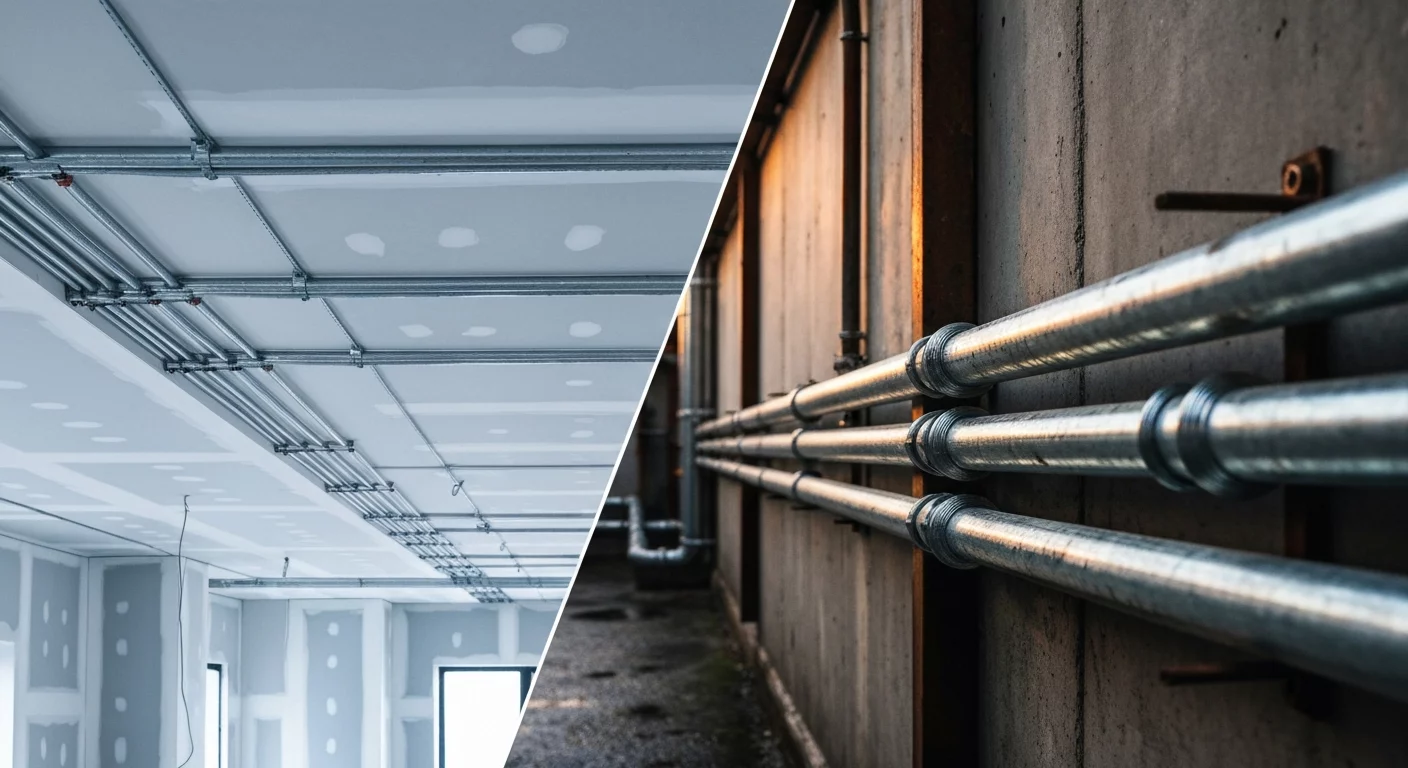
EMT vs. Rigid Conduit: When and How to Use Each Type
EMT vs. Rigid Conduit: When and How to Use Each Type
Choosing the right conduit is a critical decision in any electrical installation, balancing code compliance, safety, and cost. In the debate of EMT vs Rigid conduit, the choice hinges on the environment and the level of protection required. Electrical Metallic Tubing (EMT), governed by NEC Article 358, is a lightweight, thin-walled raceway ideal for many indoor commercial and residential applications where it won’t be subject to severe physical damage. Conversely, Rigid Metal Conduit (RMC), covered in NEC Article 344, is the heavyweight champion, offering the highest degree of physical damage protection. Its thick, threaded walls make it a preferred choice for demanding industrial environments and outdoor installations. In hazardous (classified) areas you must use equipment and wiring methods listed for the classification (see NEC Article 500/501). While EMT offers faster installation and lower costs, RMC provides durability and — when the raceway and fittings are installed to provide electrical continuity and bonding — can be part of the equipment grounding conductor path per NEC requirements.
Understanding the Fundamentals: NEC Article 358 and NEC Article 344
The National Electrical Code (NEC) provides the essential framework for safely installing electrical systems. For metallic raceways like EMT and RMC, two articles are paramount. Understanding these sections is the first step in any professional’s journeyman test prep or daily work.
Electrical Metallic Tubing (EMT) – NEC Article 358
Often called “thin-wall” conduit, EMT is a lightweight steel or aluminum raceway. According to NEC Article 358, its primary purpose is to protect conductors from impact and moisture in non-hazardous locations. Because it is unthreaded, sections are joined using either setscrew vs compression fittings, and compression fittings are required where a watertight seal is necessary. Its light weight and the ease with which it can be bent make it a favorite for commercial interior wiring, significantly reducing labor time compared to heavier conduit types.
Rigid Metal Conduit (RMC) – NEC Article 344
RMC is the thickest and heaviest of the metallic conduits. Governed by NEC Article 344, it can be made of steel or aluminum and features tapered threads on both ends. This threaded conduit system provides robust connections and superior protection for conductors. RMC is commonly used where the highest level of mechanical protection is required, such as in industrial plants, outdoor runs, and service or feeder applications where heavy-duty protection is needed; the exact permitted uses and corrosion protection depend on the material and the requirements in the Code.
Key Differences: EMT vs Rigid Conduit in the Field
The choice between EMT and RMC directly impacts project safety, longevity, and budget. Here’s a breakdown of their core differences in practical application.
Protection Against Physical Damage
This is the most significant differentiator. RMC’s thick walls provide a very high level of protection against impact, crushing, and puncture, as specified in NEC Article 344. It is the go-to solution for raceways run where mechanical damage is likely. EMT offers good protection for most interior applications but is not intended where it would be subject to severe physical damage; in such cases IMC or RMC is commonly used as a step up in protection.
Corrosion Protection and Application Environments
Both EMT and RMC are typically galvanized to provide corrosion protection. For severe or chemical environments, RMC and IMC are available in more resilient materials or with supplemental coatings. RMC’s threaded connections and heavier wall thickness are commonly used on outdoor or industrial jobs where ruggedness is required, and the selection of fittings and corrosion protection is important. EMT is permitted for use in wet locations per the NEC, but wet-location-rated fittings and corrosion-resistant components must be used to maintain the installation’s integrity. For additional guidance on conduit choices in specially corrosive settings, you may also find this overview of LFNC and related 2023 guidance helpful.
Applications in Hazardous Locations
When it comes to hazardous (classified) locations, the rules are strict. NEC Articles 500 and 501 require listed equipment and approved protection techniques for Class I Division 1 locations (where flammable gases or vapors are present under normal operating conditions). Threaded metallic raceways such as RMC or IMC are commonly used where the Code permits them as part of a listed method, but installation must use equipment and fittings listed for the classification — you cannot rely on unlisted joints or fittings. EMT is not used for Class I Division 1 locations; it may be permitted in Division 2 in limited circumstances spelled out in NEC Article 501 (consult the Article for the full list of acceptable wiring methods and restrictions).
Installation: Bending, Fittings, and Support Requirements
Labor is a major cost factor, and installation methods for EMT and RMC vary dramatically.
Conduit Bending and Workability
Conduit bending for EMT is straightforward and can be done with a simple hand bender for common sizes; its light weight makes it easy to handle and route on a job site. RMC, due to its wall thickness, requires significantly more effort. Bending RMC typically requires a mechanical or electric bender for all but the smallest sizes, and many electricians prefer using factory-made elbows for precise angles. Mastery of bending is a practical skill that saves time and reduces rework.
Expertise in bending all types of raceways is a hallmark of a skilled electrician. If you want to sharpen that skill, you can become a conduit bending pro with our comprehensive raceway courses and elevate your capabilities.
Fittings and Conduit Bodies
EMT utilizes simple and fast fittings. Setscrew fittings are common for dry, indoor locations; for wet locations, compression fittings or other fittings listed for wet locations must be used to create a watertight seal. RMC relies on a threaded conduit system — connections must be made with listed threaded fittings and proper sealing where required. Conduit bodies (like LBs, LLs, and LRs) for RMC are also heavier and designed to align with the threaded system.
NEC Conduit Support Requirements
Properly securing and supporting raceways is a key safety requirement. The NEC conduit support requirements differ for EMT and RMC:
- EMT (per NEC Article 358): EMT must be installed and supported in accordance with the Code; it is commonly supported at intervals not exceeding 10 feet and fastened in accordance with the NEC’s general support rules.
- RMC (per NEC Article 344): RMC must be securely fastened near terminations (the Code commonly references about 900 mm / 3 ft near outlets) and supported at intervals generally not exceeding 10 feet; exceptions for longer spans in certain larger trade sizes may apply as allowed by the Code for specific installations.
These support rules are fundamental knowledge for any licensed professional and a frequent topic in electrical training online programs.
Practical Considerations: Cost, Labor, and Conduit Fill
Beyond the technical specs, the financial and logistical impacts are crucial for bidding and planning jobs.
Material and Labor Costs
EMT generally offers an advantage in both material and labor costs for standard indoor applications. The conduit itself is less expensive and easier to bend and join, which reduces installation time. RMC is more expensive per foot, and its fittings and installation labor (threading, tightening, and heavier handling) add to project cost.
Calculating Conduit Fill: A Step-by-Step Guide
Properly sizing your conduit is essential to avoid damaging wire insulation and to comply with the NEC. A conduit fill calculator is a useful tool, but understanding the manual process using the Code book is vital. Here’s a simplified process using the NEC Annex C tables for conductors of the same size:
- Identify Your Wires: Determine the size (e.g., 12 AWG) and insulation type (e.g., THHN) of the conductors you will be pulling.
- Determine Number of Conductors: Count the total number of conductors you need to install in the raceway.
- Consult NEC Annex C: Go to the Annex C tables in your NEC code book. Find the table corresponding to your conduit type (Annex C includes tables for common metallic raceways).
- Find Your Conductor Type: In the correct table, locate the row for your conductor’s insulation type (THHN).
- Cross-Reference Size: Follow that row across to find your conductor size (12 AWG). Then read to the column showing allowable counts for given conduit trade sizes to determine the smallest conduit size you can legally use.
For combinations of different wire sizes, you must use the calculations outlined in Chapter 9, which involve calculating cross-sectional areas and applying the percentage fill limits in the Code.
Related Resources
- How are 2023 NEC rules for PVC conduit use in concrete and high stress applications?
- How do expansion fittings protect underground PVC conduits?
Frequently Asked Questions (FAQ)
When is it mandatory to use rigid conduit instead of EMT?
Use of RMC or IMC is often necessary where a higher degree of mechanical protection is required, such as raceways that will be subject to severe physical damage, service entrance or certain feeder applications, and many hazardous-location installations where wiring methods and equipment must be listed for the class and division. Always consult the applicable NEC article and local authority having jurisdiction for the final determination.
Can EMT be used as the equipment grounding conductor (EGC)?
Yes. The NEC allows certain metallic raceways, including EMT, to be used as part of the equipment grounding path when the raceway and fittings provide electrical continuity and the installation meets the bonding and grounding requirements of Article 250. Many electricians still prefer to pull a separate green EGC for long runs or where vibration or corrosion could compromise mechanical continuity over time.
What are the main differences between IMC and RMC?
Intermediate Metal Conduit (IMC) is a lighter, thinner alternative to RMC but is still thicker and stronger than EMT. IMC and RMC are both threaded metallic conduits and are often interchangeable for many applications; IMC reduces weight and can be easier to handle while retaining good mechanical protection and threadable connections.
Are the NEC conduit support requirements the same for EMT and Rigid?
They are similar in that both raceways must be secured and supported per the Code, but the NEC specifies certain near-termination fastening requirements for rigid raceways and generally requires support at commonly used intervals (for example, support at intervals not exceeding 10 feet in typical runs). Always use the specific article for the raceway type (Article 358 for EMT, Article 344 for RMC/IMC) to confirm the required support spacing for your installation.
Continuing Education by State
Select your state to view board-approved continuing education courses and requirements:

Disclaimer: The information provided in this educational content has been prepared with care to reflect current regulatory requirements for continuing education. However, licensing rules and regulations can vary by state and are subject to change. While we strive for accuracy, ExpertCE cannot guarantee that all details are complete or up to date at the time of reading. For the most current and authoritative information, always refer directly to your state’s official licensing board or regulatory agency.
NEC®, NFPA 70E®, NFPA 70®, and National Electrical Code® are registered trademarks of the National Fire Protection Association® (NFPA®)
You may also like

Colorado Electrical Licensing Requirements and Reciprocity Guide

Standby Generators in DE: Navigating Coastal Storm Regulations

 Login with Google