
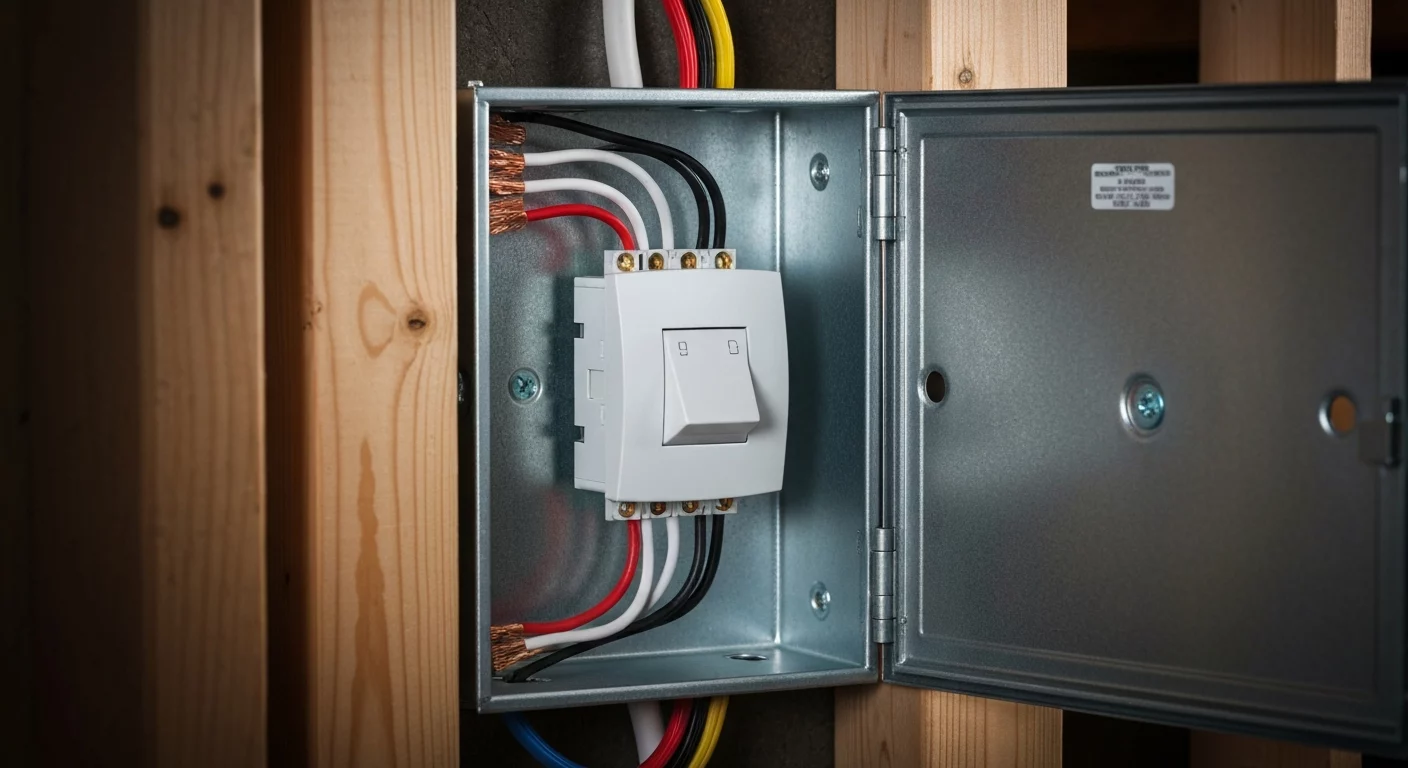
Device Box Fill Calculations: Sizing for Receptacles and Dimmers
Device Box Fill Calculations Guide (NEC 314.16)
Properly performing device box fill calculations is a fundamental skill for any journeyman or master electrician, ensuring safety, compliance, and a professional installation. Governed by NEC Article 314.16, these calculations prevent the dangerous overcrowding of conductors and devices within an electrical box. Overstuffing a box can lead to damaged wire insulation, excessive heat buildup, and an increased risk of fire or short circuits. This guide provides a comprehensive breakdown of how to accurately calculate box fill, with a special focus on sizing for modern devices like a bulky receptacle or dimmer light switch. Mastering these box volume calculations is essential for passing inspections and avoiding costly rework.
What is Box Fill and Why Does it Matter?
Box fill is the total volume occupied by all conductors, clamps, support fittings, and devices inside an electrical box. The National Electrical Code (NEC) sets strict limits on this volume to ensure there is enough free space to accommodate conductors, terminations, and device hardware without damaging insulation. Overheating and conductor insulation damage are primary hazards that box fill rules help prevent. For any professional electrician, understanding these rules is not just about following the NEC; it’s about ensuring the long-term safety and integrity of the electrical system. Electrical inspectors frequently cite improper box fill as a common code violation, making a correct calculation critical for a passed rough-in inspection.
The Core Components of Box Fill Calculations (Conductor Equivalents)
The foundation of device box fill calculations is adding up the “volume allowance” for every item installed in the box. According to NEC 314.16(B), you count “conductor equivalents” and then multiply by the volume allowance for the specific wire gauge you are using.
- Conductors: Every wire that starts outside the box and either terminates or is spliced inside the box counts as one conductor. A conductor that just passes through the box without being cut is also counted once. A conductor that does not leave the box at all (for example, a pigtail that is entirely inside the box and not connected outside) is not counted.
- Internal Cable Clamps: If a box contains one or more internal cable clamps, add a single volume allowance based on the largest conductor entering the box. External connectors or fittings outside the box do not count toward box fill.
- Support Fittings: Items like luminaire studs or hickeys used to mount a light fixture each count as a single volume allowance based on the largest conductor present.
- Device Yokes (Receptacles & Switches): Any device mounted on a yoke or strap — such as a receptacle, a standard switch, or a dimmer light switch — counts as a double volume allowance. This double-count rule is based on the largest conductor connected to that device.
- Equipment Grounding Conductor (EGC): The rule for grounds can be nuanced. Per NEC Article 314.16(B)(5), a single volume allowance is made for up to four equipment grounding conductors entering a box, based on the largest equipment grounding conductor. For each additional equipment grounding conductor beyond those first four, a 1/2 volume allowance (based on the largest EGC present) is required.
Step-by-Step Guide to Device Box Fill Calculations
Follow this systematic process to ensure your box fill is always compliant. For this example, we’ll focus on sizing a box with common nonmetallic sheathed cable (Romex).
- Identify Total Box Volume: First determine the box’s cubic inch capacity. Most boxes are marked with their volume. If a box is not marked, consult NEC Table 314.16(A) or the manufacturer’s published volume. Remember to add the volume of any plaster rings, extension rings, or listed extenders when used; their volume is added to the box volume.
- Determine Volume Per Conductor: Next, find the volume allowance per conductor for the wire gauge you are using in NEC Table 314.16(B), “Volume Allowance Required Per Conductor.” Typical values commonly used are: #14 = 2.00 in³, #12 = 2.25 in³, #10 = 2.50 in³, #8 = 3.00 in³, #6 = 5.00 in³. Use the official NEC table when performing your calculation.
- Count Your Conductor Equivalents: Carefully count every item that contributes to the fill as detailed above. Note that a loop or coil of conductor that is at least twice the minimum length required for free conductors (NEC 300.14) is counted twice.
- Calculate the Total Fill Volume: Multiply your total number of conductor equivalents by the volume per conductor (for the largest conductor size used when applicable). This gives you the total required cubic inch capacity.
- Compare and Verify: Compare your total required fill volume to the box’s rated volume (including any extension rings or domed covers). The calculated fill must be less than or equal to the box’s capacity. If it exceeds the capacity, use a larger or deeper box or reduce what’s inside the box.
Avoid inspection failures on your rough-in. For more hands-on training, explore our online electrical courses designed for the professional journeyman electrician and master electrician.
Example Calculation: Single-Gang Box with a GFCI Receptacle
Let’s apply these steps to a common scenario: installing a GFCI receptacle in a plastic single-gang box with one 12/2 NM cable coming in and another 12/2 NM cable going out.
- Box Volume: The plastic box is stamped “22.5 cu. in.” (Use whatever volume is stamped on your actual box or use the value from NEC Table 314.16(A) for unmarked boxes.)
- Volume per Conductor: For #12 wire the volume allowance is 2.25 in.³ per conductor.
- Conductor Equivalents Count:
- Current-Carrying Wires: 4 (hot and neutral from the incoming 12/2, hot and neutral from the outgoing 12/2) — each conductor that originates outside the box and is spliced or terminated inside counts once.
- Equipment Grounding Conductors: 1 (both bare equipment grounds entering the box are covered by the single allowance for up to four EGCs).
- Device (GFCI Receptacle): 2 (double volume allowance for the device yoke/strap).
- Internal Clamps: 0 (this example assumes the plastic box has no internal clamps).
- Total Equivalents: 4 + 1 + 2 = 7
- Total Fill Volume Calculation: 7 equivalents × 2.25 in.³/conductor = 15.75 in.³
- Verification: The calculated fill of 15.75 in.³ is less than the box’s 22.5 in.³ capacity. This installation meets the NEC box fill requirement.
Sizing for Modern Dimmers and Smart Devices
While the NEC provides the rules for minimum legal sizing, practical experience is also key. Many modern devices like a new dimmer light switch, smart switch, or GFCI/AFCI receptacle are significantly bulkier than their older counterparts. Even if your device box fill calculations are technically correct, fitting a large device along with stiff wires into a standard-depth box can be a struggle. This can lead to damaging the device or conductors. As a best practice, always consider using deeper electrical boxes or those with a larger cubic inch capacity when installing these modern components to ensure a safe and clean installation. For complex layouts, a detailed guide on how to calculate junction box size can provide further clarity.
Primary Sources
This article is based on the requirements outlined in the National Fire Protection Association’s NFPA 70, National Electrical Code (NEC), primarily referencing Article 314, “Outlet, Device, Pull, and Junction Boxes; Conduit Bodies; Fittings; and Handhole Enclosures.” For official requirements, always consult the latest edition of the NEC and your local Authority Having Jurisdiction (AHJ).
Frequently Asked Questions
- What does NEC Article 314.16 cover?
- NEC Article 314.16 details the rules for determining the minimum size for a junction box or device box based on the number and size of conductors, clamps, fittings, and devices it will contain. It provides the tables and methodology for performing compliant box volume calculations.
- Do wire nuts or pigtails count in device box fill calculations?
- No. Wire connectors and any conductor that does not leave the box (for example, a pigtail whose entire length is inside the box) are not counted toward box fill. A loop or coil that meets the twice-the-minimum free conductor length rule is counted twice.
- How many conductors can I put in a single-gang box?
- The number depends entirely on the box’s cubic inch capacity and the gauge of the conductor. There is no single answer — always perform a box fill calculation using NEC Table 314.16(A) and 314.16(B) to get the correct number for your situation.
- Is a conduit fill calculator the same as a box fill calculator?
- No. A conduit fill calculator determines how many wires can be run through a raceway based on cross-sectional area and conductor size. Device box fill calculations determine the required cubic inch volume in a box based on a system of conductor equivalents under NEC Article 314.
Continuing Education by State
Select your state to view board-approved continuing education courses and requirements:

Disclaimer: The information provided in this educational content has been prepared with care to reflect current regulatory requirements for continuing education. However, licensing rules and regulations can vary by state and are subject to change. While we strive for accuracy, ExpertCE cannot guarantee that all details are complete or up to date at the time of reading. For the most current and authoritative information, always refer directly to your state’s official licensing board or regulatory agency.
NEC®, NFPA 70E®, NFPA 70®, and National Electrical Code® are registered trademarks of the National Fire Protection Association® (NFPA®)
You may also like

Colorado Electrical Licensing Requirements and Reciprocity Guide

Standby Generators in DE: Navigating Coastal Storm Regulations

 Login with Google