
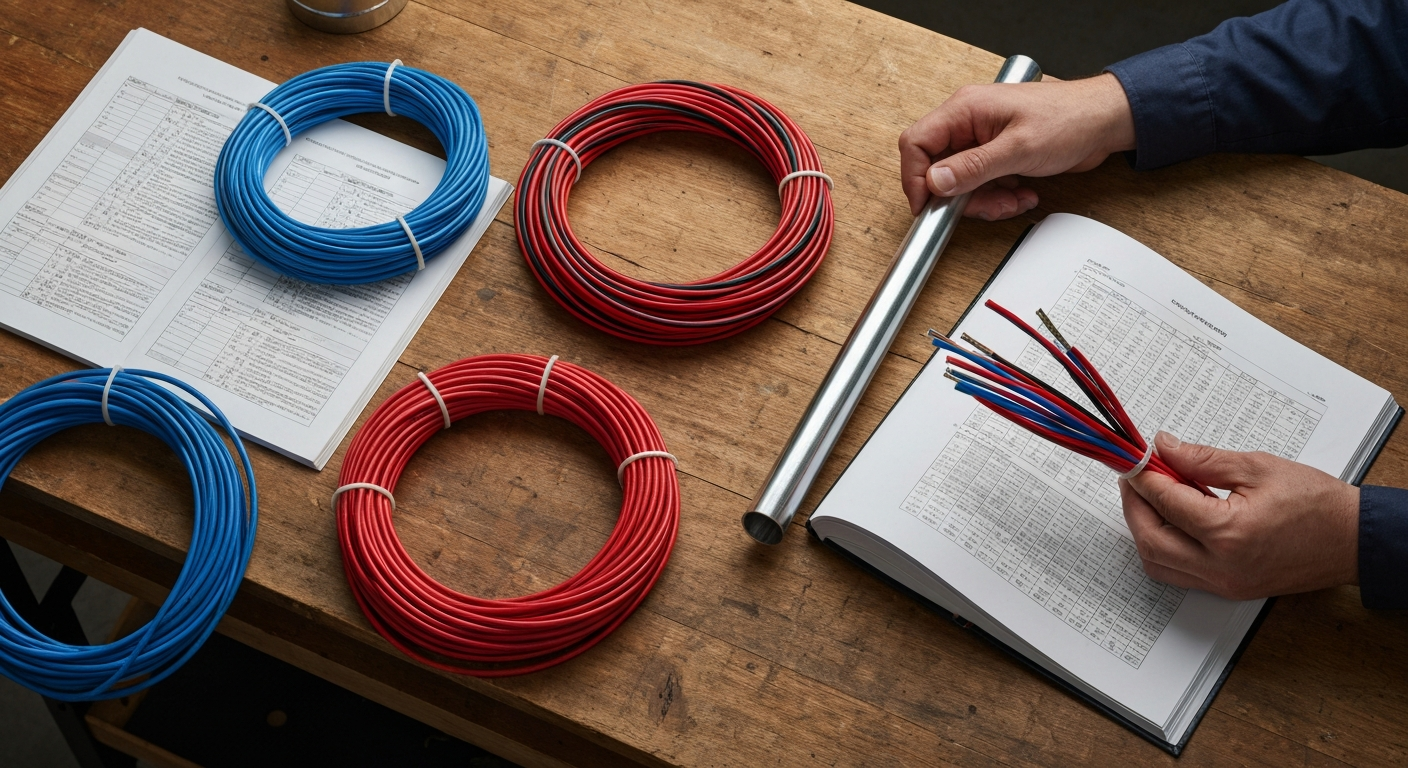
Calculating Conduit Fill for Different Wire Sizes in One Raceway
Why Accurate Conduit Fill Calculation is Non-Negotiable
For a professional journeyman electrician, getting the raceway sizing right is not just about following rules—it’s about safety, efficiency, and professional integrity. An overfilled conduit can lead to a host of problems, including insulation damage during pulling, excessive heat buildup that affects conductor ampacity, and significant code violations. The National Electrical Code (NEC) provides clear guidelines to prevent these issues. Proper electrician training emphasizes that these calculations protect the longevity of the electrical system and the safety of the property. Ignoring these standards can lead to failed inspections, costly rework, and a tarnished professional reputation. Furthermore, understanding the principles behind the calculation, rather than solely relying on a conduit fill calculator, is essential for passing certification exams and handling complex, non-standard scenarios in the field.
Understanding the Core Concepts: NEC Rules for Raceway Sizing
The foundation for any conduit fill calculation is found in the NEC code book, primarily within Chapter 9. These rules are designed to ensure conductors can be installed without damage and can dissipate heat effectively. Before diving into the math, it’s critical to understand the two main components of the calculation: the allowable fill percentage and the NEC tables that provide the necessary data. For a complete overview, electricians can refer to our comprehensive NEC guide to conduit fill.
Allowable Fill Percentage: The Core Rule
NEC Chapter 9, Table 1 sets the primary limits for allowable fill percentage. This is one of the most important rules in raceway design. The percentage varies based on the number of conductors within the raceway:
- 1 Conductor: 53% Maximum Fill
- 2 Conductors: 31% Maximum Fill
- Over 2 Conductors: 40% Maximum Fill
For nearly all practical applications involving mixed wire sizes, you will be working with the 40% fill rule. This limit provides adequate space to prevent wire jamming during pulls and allows for air circulation to help manage heat.
Key NEC Tables for Your Calculation
To perform a manual calculation, you will need to become very familiar with the relevant Chapter 9 tables in the NEC:
- NEC Chapter 9, Table 1: This table provides the permitted fill percentages for raceways.
- The Chapter 9 conduit area table (the table in Chapter 9 listing internal areas for conduit types such as Electrical Metallic Tubing (EMT) and Rigid Metal Conduit (RMC)): For each conduit trade size it lists the internal cross-sectional area in in² and mm².
- The Chapter 9 conductor area table (the table in Chapter 9 that lists the approximate areas for insulated conductors): This lists the approximate area in in² and mm² for different insulated conductor types and sizes and is where you locate data for common wires such as THHN or THWN.
Step-by-Step Guide: The Conduit Fill Calculation for a Combination of Conductors
When you have a mix of wire sizes, you cannot use a simple conduit fill chart. You must perform a cross-sectional area calculation. Follow these steps for an accurate result.
- Identify Your Conductors and Conduit: List every wire you plan to install. Note the quantity, wire gauge (AWG or kcmil), and the conductor insulation type (e.g., THHN, XHHW, THWN). Also, identify your planned conduit trade size and type (e.g., 1-inch EMT conduit).
- Find the Cross-Sectional Area of Each Wire Type: Go to the Chapter 9 conductor area table. Find the row for your first wire size and insulation type. Look up its “Approximate Area” in square inches. Multiply this area by the number of conductors of that specific size. Repeat this for every different wire size in your raceway.
- Calculate the Total Conductor Area: Sum the total areas you calculated in the previous step. This gives you the total square inches that will be occupied by all your wires combined. This is the most critical part of the wire size computation.
- Determine the Allowable Fill Area for Your Conduit: Refer to the Chapter 9 conduit area table for your chosen conduit type and size. Find the “Total Area” (100% Area) listed. Since you have more than two conductors, multiply this total area by 0.40 (the 40% allowable fill percentage) to find the maximum permitted fill area.
- Compare and Verify: Compare the total conductor area from Step 3 with the allowable fill area from Step 4. If the total conductor area is less than or equal to the allowable fill area, your design is compliant. If it’s greater, you must upsize your conduit and recalculate.
Practical Example: A Real-World Wire Size Computation
Let’s apply the steps. Imagine a journeyman electrician needs to run the following conductors in one raceway:
- Conductors: (5) 10 AWG THHN wires and (4) 12 AWG THWN wires.
- Conduit: 3/4-inch EMT conduit.
Step 1 & 2: Find Conductor Areas (from the Chapter 9 conductor area table)
- Area of one 10 AWG THHN wire = 0.0211 in²
- Total area for 10 AWG wires: 5 x 0.0211 in² = 0.1055 in²
- Area of one 12 AWG THWN wire = 0.0133 in² (Conductor area values should always be verified from the applicable Chapter 9 conductor area table for your NEC edition; THHN and THWN often share the same approximate insulated conductor areas in the NEC tables.)
- Total area for 12 AWG wires: 4 x 0.0133 in² = 0.0532 in²
Step 3: Calculate Total Conductor Area
- Total Area = 0.1055 in² + 0.0532 in² = 0.1587 in²
Step 4: Determine Allowable Conduit Area (from the Chapter 9 conduit area table for EMT)
- Total internal area of 3/4″ EMT = 0.533 in²
- Allowable fill area (40%): 0.533 in² x 0.40 = 0.2132 in²
Step 5: Compare and Verify
- Is 0.1587 in² (Total Wire Area) ≤ 0.2132 in² (Allowable Fill Area)?
- Yes. The design is compliant with the NEC (verify against the Chapter 9 tables for your NEC edition to be certain).
Understanding conductor properties is key to these calculations. For more detail on wire specifics, you can explore our guide on NEC Chapter 9, Table 8 conductor properties.
Manually performing these calculations builds expertise, but modern tools can help you verify your work and simplify complex conduit fill scenarios. Simplify complex conduit fill scenarios. Check out our calculation courses.
Important Considerations Beyond the Basic Calculation
While the math is straightforward, experienced electricians consider other factors that influence a successful installation. These go beyond what a basic conduit fill calculator might tell you.
- Jam Probability and Conduit Bends: The NEC’s 40% rule is a baseline. However, long runs with multiple bends can drastically increase pulling friction and the jam probability. Many professionals voluntarily derate their fill to 30-35% to make pulling easier and prevent insulation damage, especially in runs with more than 360 degrees of bends between pull points. For tips on making clean, compliant bends, see our article on how to bend EMT conduit.
- Future-Proofing: Leaving extra space in a conduit is a smart practice. If additional circuits are needed later, having that buffer can save you from having to run an entirely new raceway. A slightly larger conduit upfront is a small cost compared to a major retrofit.
- Ampacity Adjustment: Remember that when you have more than three current-carrying conductors in a single raceway, you must apply ampacity adjustment factors as per NEC Article 310 adjustment rules. Overfilling a conduit exacerbates heat issues, making proper derating even more critical for safety and performance.
- Conduit Body Fill: The rules for fill in conduit bodies (like LBs, LLs, and LRs) are different and are covered in NEC provisions for raceway fittings and boxes. Do not assume the 40% rule applies here; the fill is often limited by a volume calculation or by specific box/fitting rules.
Frequently Asked Questions (FAQ)
What is the easiest way to perform a conduit fill calculation?
The quickest method is to use a digital conduit fill calculator, which many manufacturers and industry sites provide. However, every professional should know how to perform the manual wire size computation using the NEC Chapter 9 tables. This ensures you understand the principles and can verify the tool’s accuracy, which is a critical part of electrician training.
Where can I find a reliable conduit fill chart?
While generic charts exist online, the only truly reliable source is the National Electrical Code itself. A conduit fill chart is most accurately represented by the data in NEC Chapter 9, specifically the Chapter 9 conduit area table for conduit dimensions and the Chapter 9 conductor area table for conductor dimensions. These tables are the standard for all compliant calculations; always consult the NEC edition that applies to your jurisdiction.
Does the allowable fill percentage change for different conduit types like EMT vs. RMC?
No, the allowable fill percentage (for example, 40% for more than two conductors) remains the same regardless of conduit material. However, the total internal area for the same conduit trade size can differ between types like Electrical Metallic Tubing (EMT) and Rigid Metal Conduit (RMC) due to varying wall thicknesses. You must use the Chapter 9 conduit area table to look up the correct area for your specific conduit type and edition of the NEC.
Why can’t I just fill a conduit to 100%?
Filling a conduit completely is a major code violation and extremely dangerous. It creates several problems: it makes pulling wires nearly impossible without damaging their insulation, increases the jam probability, and prevents heat from dissipating. Trapped heat can degrade insulation and drastically lower a wire’s safe current-carrying capacity, creating a serious fire hazard. The NEC’s fill limits are designed to mitigate these risks.
Primary Sources
- NFPA 70, National Electrical Code (NEC), 2023 Edition
Continuing Education by State
Select your state to view board-approved continuing education courses and requirements:

Disclaimer: The information provided in this educational content has been prepared with care to reflect current regulatory requirements for continuing education. However, licensing rules and regulations can vary by state and are subject to change. While we strive for accuracy, ExpertCE cannot guarantee that all details are complete or up to date at the time of reading. For the most current and authoritative information, always refer directly to your state’s official licensing board or regulatory agency.
NEC®, NFPA 70E®, NFPA 70®, and National Electrical Code® are registered trademarks of the National Fire Protection Association® (NFPA®)
You may also like

Colorado Electrical Licensing Requirements and Reciprocity Guide

Standby Generators in DE: Navigating Coastal Storm Regulations

 Login with Google