
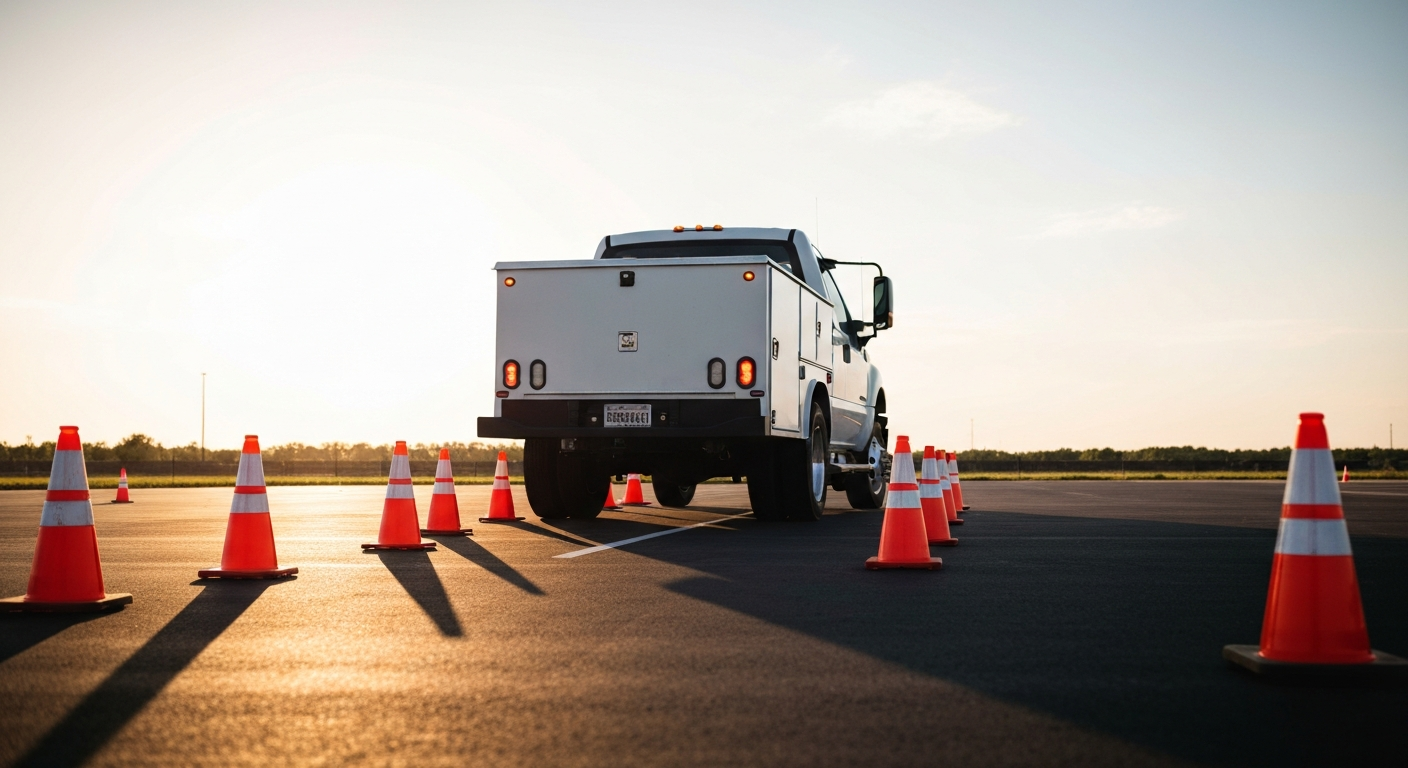
CDL Skills Test: Straight Line Backing Maneuver
Mastering the CDL Straight Line Backing Maneuver: A Guide for Electricians
The straight line backing maneuver is a fundamental skill required to pass the Commercial Driver’s License (CDL) skills test. For any journeyman electrician or master electrician aiming to operate larger service vehicles, mastering this skill is non-negotiable. This maneuver requires the driver to back a commercial vehicle in a straight line between boundary markers or cones without touching them and stop with the rear of the vehicle within a designated area as directed by the examiner. Excelling at this is crucial for passing utility-truck CDL testing and is a key component of effective electrical contractor vehicle training. As job sites become more complex, proficiency in skills like straight line backing directly impacts electrical service truck safety, especially when navigating confined job sites or positioning vehicles near energized equipment. Obtaining a Class B CDL for utility trucks is a significant career step, and this guide provides the foundational knowledge to succeed.
Why a CDL is Becoming Essential for Modern Electricians
In today’s competitive electrical industry, technical skill with wiring and conduits is only part of the job. For many roles, especially in utility, industrial, and large-scale commercial construction, the ability to operate heavy vehicles is just as important. This is why a growing number of employers are seeking candidates who hold both an electrical license and a Commercial Driver’s License (CDL). Possessing a CDL opens up advanced career paths for a journeyman electrician and can significantly impact how much an electrician makes over their career. It qualifies you to operate bucket trucks, digger derricks, and trucks hauling heavy equipment or a utility trailer, making you a more versatile and valuable asset to any team.
This dual qualification is especially critical for linemen and utility workers. Developing expert lineman truck backing skills is not just about passing a test; it’s about daily operational safety and efficiency. For an electrical contractor, having a crew with certified driving skills minimizes risk, reduces insurance liability, and ensures that expensive equipment can be positioned correctly and safely on any job site.
Understanding the Modernized CDL Skills Test
The Federal Motor Carrier Safety Administration (FMCSA) has established minimum requirements for CDL testing and prescribes the Entry-Level Driver Training (ELDT) rule that training providers must follow; states implement and administer the CDL skills test itself and may adopt modernized formats or local procedures aligned with FMCSA guidance. Under the Entry-Level Driver Training (ELDT) rule effective February 7, 2022, new applicants for a CDL class A or B (and certain upgrades) must complete required theory and behind-the-wheel training from a registered training provider before taking the skills test. Before any maneuver is attempted, a driver must perform the commercial vehicle pre-trip inspection and demonstrate awareness of any safety defects. Critical safety defects or conditions that create an unsafe vehicle can prevent testing or lead to test disqualification in many jurisdictions.
The CDL skills test is commonly organized into three parts — pre-trip inspection, basic vehicle control (which includes one or more backing maneuvers), and the on-road driving test. The basic vehicle control portion may require one of several backing maneuvers — for example, straight-line backing, alley-dock backing, offset backing, parallel/side backing, or similar exercises — with the exact set and number of maneuvers determined by the administering state or testing location. Common maneuvers include:
- Forward Stop
- Straight Line Backing
- Alley Dock Backing (or alley dock exercise)
- Offset backing or parallel/side backing
The straight line backing portion, while seemingly simple, is a frequent point of failure for many candidates. It is the cornerstone of other backing skills and demonstrates understanding of vehicle dynamics and pivot points.
Step-by-Step Guide to Perfect Straight Line Backing
This maneuver is a pure test of fine motor control and spatial awareness. The goal is to back your vehicle (and trailer, if applicable) straight through the designated backing area or lane marked by cones or other boundary markers and stop within the designated area without striking markers; exact lane length and width vary by state and testing site. Here’s how to approach it methodically.
Setup and Initial Job Site Vehicle Positioning
Proper setup is half the battle. Before you begin, your truck and trailer must be straight and centered in front of the lane. Pull up just far enough so you have a clear view of the entire lane in both of your side mirrors. Taking an extra moment to ensure you are aligned will prevent the need for major corrections later.
The Technique: A Step-by-Step Process
- Begin Backing Slowly: Put the vehicle in reverse and release the clutch gently if applicable. Speed is your enemy here. The slower you go, the more time you have to recognize and react to any deviation.
- Use Your Mirrors Constantly: Your mirrors are your eyes. You should be able to see the boundary markers on both sides. Avoid fixating on one mirror; continuously scan between left and right mirrors to maintain a complete picture.
- “Chase” the Trailer: As you back up, the rear of the trailer will inevitably drift. To correct this, turn the steering wheel in the direction of the drift. If the trailer drifts left, make a slight left steering input; if it drifts right, make a slight right input to bring it back to center.
- Make Small, Smooth Corrections: The most common mistake is oversteering. Small steering inputs are often all that is needed. Turn the wheel, let the trailer react, and then return the steering wheel to straight. This is important for bucket trucks and other tall or long vehicles that react strongly to sharp movements.
- Anticipate the Pivot: There is a delay between your steering input and the trailer’s reaction. For long combos like digger derricks this delay is more pronounced — make your correction early and small.
- Know When to Stop: The final step is to stop with the rearmost part of your vehicle inside the designated area without pulling too far through it or stopping short. Use a consistent reference point on the vehicle (light, bolt, or marker) to gauge final position.
Practice builds muscle memory. Consistent practice with utility-vehicle backing exercises will make this technique repeatable on test day and on the job.
Job Site Application: Beyond the Utility Truck CDL Test
Passing the CDL test is the first step. Applying these skills in a dynamic, high-risk work environment is where true expertise is shown. The skills learned from mastering straight line backing are directly applicable to daily tasks and, most importantly, to safety.
Navigating Confined Job Sites and Energized Equipment
Real-world job sites are rarely as forgiving as a test course. Mastering vehicle control is essential for navigating confined job sites, which are often cluttered with materials, other vehicles, and personnel. The precision required for backing a utility trailer in a tight space is a skill learned and perfected through exercises like straight line backing.
Furthermore, the consequences of a mistake are far greater when maneuvering around energized equipment. A slight miscalculation could lead to contact with live conductors. This is where electrical service truck safety protocols are paramount. Precise job site vehicle positioning minimizes these risks and helps ensure a safe perimeter is maintained.
The Critical Role of a Spotter
While you perform the CDL test alone, you should almost never back a large vehicle on a job site without a spotter. Effective spotter safety procedures for electricians are a critical part of any safety program. Both the driver and spotter must agree on hand signals before any movement begins, maintain constant visual contact, and understand the vehicle’s blind spots and pivot points. The spotter’s role is to be an extra set of eyes, especially for hazards that are low to the ground or outside the driver’s mirror view.
The Value of Continuous Electrician Training
Just as a master electrician must stay current with the NEC through continuing education, driving skills also require ongoing development. Certifications from organizations like NCCER provide strong technical training, but practical skills like vehicle operation need dedicated CDL training. An electrician school might provide the basics, but ongoing practice and employer-sponsored training builds the professional capability needed on the job.
Key Takeaways for Success
- Practice is Non-Negotiable: Repetition is the only way to build the muscle memory required for smooth, intuitive vehicle control.
- Less is More: Small, smooth steering corrections are far more effective than large, sudden movements. Avoid oversteering.
- Understand Your Vehicle: Every truck and trailer combination has a unique pivot point and turning radius. Get a feel for your specific vehicle.
- Safety First, Always: The skills test is a solo event, but on the job, always default to the safest method. Use a spotter, perform walk-arounds, and be aware of your surroundings, especially when maneuvering around energized equipment.
- Master the Pre-Trip Inspection: Treat the commercial vehicle pre-trip inspection as a foundational safety habit that protects you, your equipment, and the public.
Frequently Asked Questions (FAQ)
Is straight line backing hard for the utility truck CDL test?
While it’s considered one of the more basic maneuvers, straight line backing is a common point of failure because it requires a high degree of precision and finesse. The primary challenges are oversteering and not making corrections quickly enough. Consistent practice is the key to making it feel natural and repeatable.
What kind of CDL is typically needed for a journeyman electrician operating a bucket truck?
Typically, a Class B CDL is required for operating a single vehicle with a gross vehicle weight rating (GVWR) of 26,001 pounds or more, which covers many bucket trucks and digger derricks. Some specialized vehicles or combinations may require a Class A CDL or additional endorsements depending on the vehicle and state rules.
How can I practice lineman truck backing skills safely?
Find a large, empty, and safe area like a vacant parking lot. Use cones or other soft markers to create a practice lane. Start by getting a feel for the vehicle’s turning and backing characteristics without the pressure of staying in a strict lane. Gradually incorporate markers and focus on the step-by-step technique. Always perform these exercises in a controlled environment with safety in mind.
Does my electrician training or NCCER certification cover a CDL for electricians?
Generally, no. Standard electrician training and NCCER curriculum focus on electrical theory, code (like the NEC), and installation practices. CDL training is a separate, specialized field of vocational training that must be pursued through a dedicated driving school or an in-house program that complies with FMCSA’s ELDT rule.
What are the most important spotter safety procedures for electricians?
The most critical procedures are: 1) Agree on clear, unambiguous hand signals before moving the vehicle. 2) The spotter must remain visible to the driver. 3) The driver must stop immediately if they lose sight of the spotter. 4) The spotter should never place themselves between the vehicle and a fixed object. These rules are crucial for overall electrical service truck safety.
Continuing Education by State
Select your state to view board-approved continuing education courses and requirements:

Disclaimer: The information provided in this educational content has been prepared with care to reflect current regulatory requirements for continuing education. However, licensing rules and regulations can vary by state and are subject to change. While we strive for accuracy, ExpertCE cannot guarantee that all details are complete or up to date at the time of reading. For the most current and authoritative information, always refer directly to your state’s official licensing board or regulatory agency.
NEC®, NFPA 70E®, NFPA 70®, and National Electrical Code® are registered trademarks of the National Fire Protection Association® (NFPA®)
You may also like
Colorado Electrical Licensing Requirements and Reciprocity Guide
Standby Generators in DE: Navigating Coastal Storm Regulations

 Login with Google