
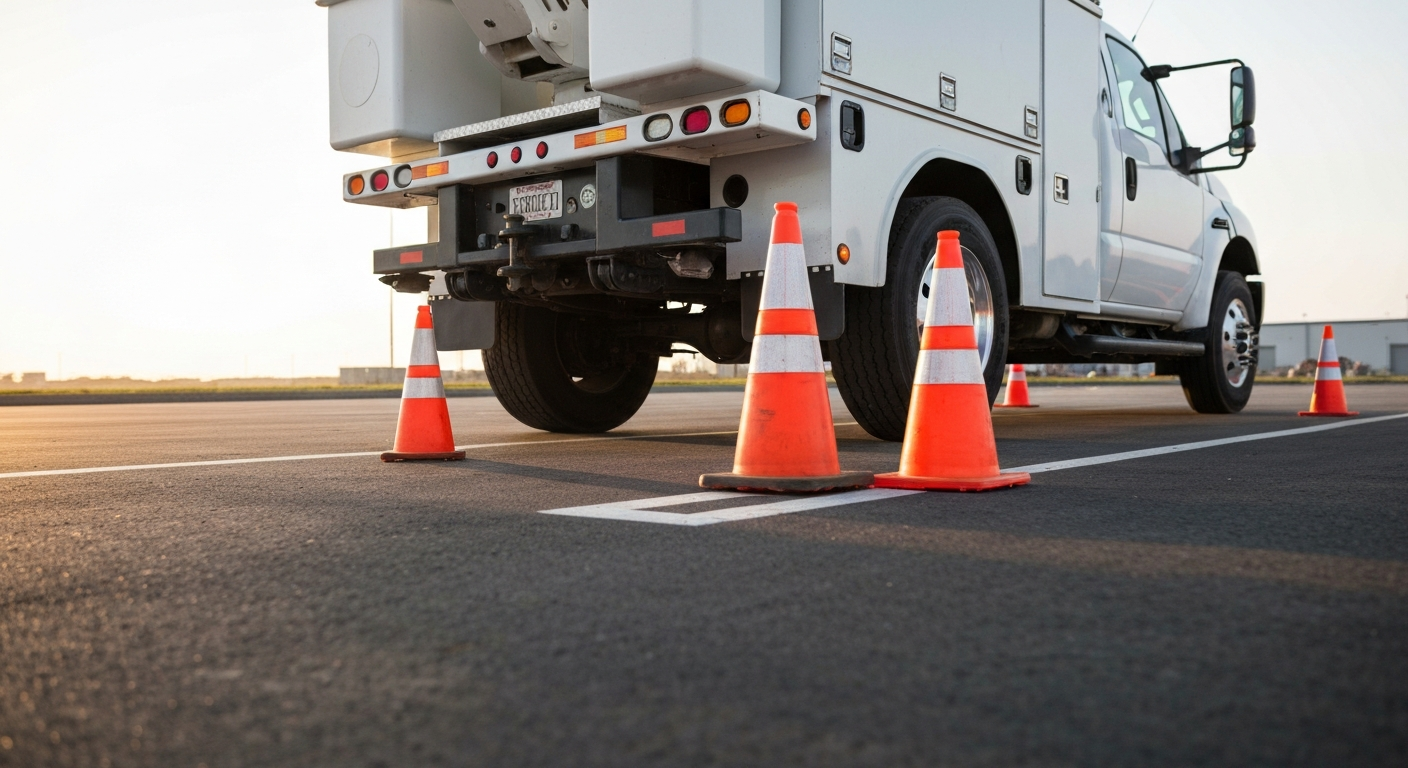
CDL Skills Test: Parallel Parking Maneuver (Conventional)
CDL Skills Test: Mastering the Conventional Parallel Parking Maneuver
The parallel parking maneuver has long been a core component of the Commercial Driver’s License (CDL) skills test, proving an operator’s control and spatial awareness. For a journeyman electrician or master electrician, mastering this skill is crucial, especially when operating large service vehicles like bucket trucks in tight urban job sites. However, the testing landscape is changing. Many states are adopting a modernized test that replaces traditional parallel parking with a new “Reverse Offset Backing” exercise. This shift doesn’t diminish the real-world value of precise vehicle handling. Effective electrician CDL training still emphasizes these foundational skills, ensuring operators can safely perform a utility truck skills test and position their vehicles on any job site. Understanding both the old and new standards is key for any electrician seeking to obtain or maintain their CDL.
Why Electricians Increasingly Need a Class B CDL
For many electricians, the tools of the trade are getting bigger. Whether you’re a residential electrician working on service drops or a master electrician managing large-scale commercial projects, the need to operate vehicles over 26,001 pounds is becoming more common. This is the threshold that, according to FMCSA regulation 49 CFR Part 383, defines when a Class B CDL is required (a single vehicle with a GVWR of 26,001 pounds or more). Vehicles like a heavy-duty bucket truck, a digger derrick for setting poles, or a large reel truck all fall into this category. A CDL is more than a license; it’s a qualification that demonstrates the holder can safely manage the unique challenges of parking large service vehicles, a critical skill for line crew and utility work.
The Modernized CDL Test: A Shift Away from Traditional Parking
In August 2022, the Federal Motor Carrier Safety Administration (FMCSA) approved a modernized CDL skills test developed by the American Association of Motor Vehicle Administrators (AAMVA). This new test standard is not mandatory; states may voluntarily adopt it on their own schedules, and adoption timelines vary by state.
A major change in the modernized test is the replacement of the standalone parallel parking maneuver and alley dock exercises. Instead, applicants must complete four integrated maneuvers: Forward Stop, Straight-Line Backing, Forward Offset Tracking, and Reverse Offset Backing. The Reverse Offset Backing maneuver tests a driver’s ability to back a vehicle from an offset lane into a designated parking space or simulated loading dock. This change was designed to better reflect real-world crash causation factors and streamline the test.
How to Execute the Conventional Parallel Parking Maneuver
Even with the new test, understanding the classic conventional cab parking maneuver is an invaluable skill for any operator. Many states still use the traditional test, and the fundamental techniques are essential for real-world job site vehicle positioning. It’s important to note that the following steps are a general guide; the exact dimensions, cone placements, and rules, such as the number of pull-ups and “looks” (exiting the vehicle to check your position), can vary by state. Always consult your state’s official CDL manual for the specific procedure you will be tested on. This maneuver tests your ability to place the entire vehicle within a marked space. The dimensions of this space vary significantly by state; for example, some states may use a space that is the vehicle’s length plus 15 feet, while others might use 1.5 times the vehicle’s length. Because there is no single standard, it is critical to consult your state’s official CDL manual for the exact dimensions you will be tested on.
Here is a step-by-step guide to performing the conventional parallel parking maneuver with a Class B straight truck:
- Initial Setup: Pull your truck up parallel to the entrance of the parking space, maintaining a distance of two to three feet from the outer cones. Stop when the rear bumper of your truck is aligned with the first cone of the space.
- Backing and Turning: Turn your steering wheel fully to the right (for a passenger-side park) and begin backing slowly. Use your left-side (driver-side) mirror to watch the cones that mark the rear of the space.
- Straighten and Align: Once you see the third rear cone of the parking space appear in your left-side mirror, stop and straighten your steering wheel (turn it back to the center). Continue backing straight until the back of your truck has entered the space and is clear of the corner cone.
- Final Turn into the Box: Stop again and turn your steering wheel fully to the left. Continue to back up slowly, allowing the front of your truck to swing into the parking space. Use both side mirrors to monitor your vehicle’s position relative to the front and rear cones.
- Final Positioning and Pull-Up: As the truck becomes parallel with the space, straighten the steering wheel while continuing to back up until the entire vehicle is inside the boundary lines. If you are not straight or centered, use one of your allowed pull-ups. Pull forward, turning the steering wheel to adjust, and then back into the final position. Proper service vehicle cone placement awareness is critical. Once fully inside the box, put the vehicle in neutral, set the parking brake, and sound the horn to signal completion.
Beyond the Test: Practical Commercial Vehicle Maneuvering for Electricians
Passing the CDL exam is just the first step. For professional electricians, the real test comes on the job. Skills like aerial lift truck maneuvering in a crowded substation or executing precise digger derrick parking techniques next to a busy road are paramount for safety and efficiency. These scenarios often require more finesse than the test itself.
Crucially, precise vehicle positioning is not just about convenience—it’s a safety mandate. Furthermore, OSHA standards for electric power generation, transmission, and distribution work—most notably 29 CFR 1910.269 for general industry—contain requirements related to operating mechanical equipment near energized lines, and employers must follow those rules and any applicable construction or state standards. These rules necessitate careful vehicle positioning to ensure stability (for example, through the proper use of outriggers) and to maintain minimum approach distances from power lines, which is crucial when operating aerial lifts and other equipment.
Urban work zone vehicle handling presents unique challenges. Tight streets, traffic, pedestrians, and overhead obstructions demand a high level of skill. Mastering CDL backing skills for utility work ensures you can position a line truck or service rig perfectly the first time, minimizing disruption and creating a safe work zone. This is where dedicated electrician training focused on large vehicle operation pays dividends, turning test maneuvers into practical, on-the-job expertise. Many principles from the test, such as reference points and understanding pivot points, are directly applicable to parking large service vehicles in complex environments. Parallel parking a big rig is easy with the right technique. Learn it here.
Key Takeaways for Electricians Pursuing a CDL
- Check Your State’s Requirements: CDL testing is not uniform across the country. Some states use the modernized test, while others stick to the traditional format. Always consult your state’s official CDL manual.
- A CDL is a Career Enhancer: For a journeyman or master electrician, a Class B CDL is typically sufficient and opens doors to higher-paying roles in utility, line work, and large-scale industrial projects that use straight trucks, bucket trucks, or digger derricks. A Class A CDL is required for operating combination vehicles (like tractor-trailers), which are less common in the electrical trade.
- Training is Essential: Don’t just aim to pass the test. Invest in quality electrician CDL training that covers real-world scenarios. Look for programs registered with the FMCSA’s Training Provider Registry (TPR) to ensure they meet federal standards for Entry-Level Driver Training.
- Practice Makes Perfect: Whether it’s the bucket truck parallel parking maneuver or the newer reverse offset, practice in a vehicle similar to the one you’ll use for work and testing.
- It’s Not Just About Parking: The skills test also includes a thorough pre-trip vehicle inspection and an on-road driving test. All three components are equally important.
Frequently Asked Questions (FAQ)
Do I need a Class B CDL as a journeyman electrician?
You need a Class B CDL if your job requires you to operate a single vehicle with a gross vehicle weight rating (GVWR) of 26,001 pounds or more. Many jobs for journeyman and master electricians, especially in utility or industrial sectors, involve operating bucket trucks, digger derrick trucks, or large service vehicles that exceed this weight, making a CDL a requirement.
What is replacing the conventional parallel parking maneuver in the CDL test?
In states that have adopted the modernized CDL skills test, the traditional parallel parking and alley dock maneuvers are replaced by the Reverse Offset Backing exercise. This single, more complex maneuver tests a driver’s ability to back into a space from an offset lane, combining the skills of both previous exercises.
How is parking a bucket truck different from a standard truck?
Parking a bucket truck involves additional considerations. The boom and basket create a higher center of gravity and can shift the vehicle’s balance. Operators must also be acutely aware of the boom’s swing radius and height to avoid contact with overhead lines, buildings, or trees. This makes precise job site vehicle positioning and aerial lift truck maneuvering even more critical.
Where can I find electrician CDL training for my crew?
Many technical colleges, dedicated truck driving schools, and some union-affiliated electrician school programs offer specialized electrician CDL training. To ensure the program meets federal requirements, verify they are listed on the FMCSA’s Training Provider Registry (TPR). These programs often provide instruction on vehicles common to the trade, like utility trucks, and focus on skills like the utility truck skills test and safe operation around electrical hazards.
Continuing Education by State
Select your state to view board-approved continuing education courses and requirements:

Disclaimer: The information provided in this educational content has been prepared with care to reflect current regulatory requirements for continuing education. However, licensing rules and regulations can vary by state and are subject to change. While we strive for accuracy, ExpertCE cannot guarantee that all details are complete or up to date at the time of reading. For the most current and authoritative information, always refer directly to your state’s official licensing board or regulatory agency.
NEC®, NFPA 70E®, NFPA 70®, and National Electrical Code® are registered trademarks of the National Fire Protection Association® (NFPA®)
You may also like
Colorado Electrical Licensing Requirements and Reciprocity Guide
Standby Generators in DE: Navigating Coastal Storm Regulations

 Login with Google