
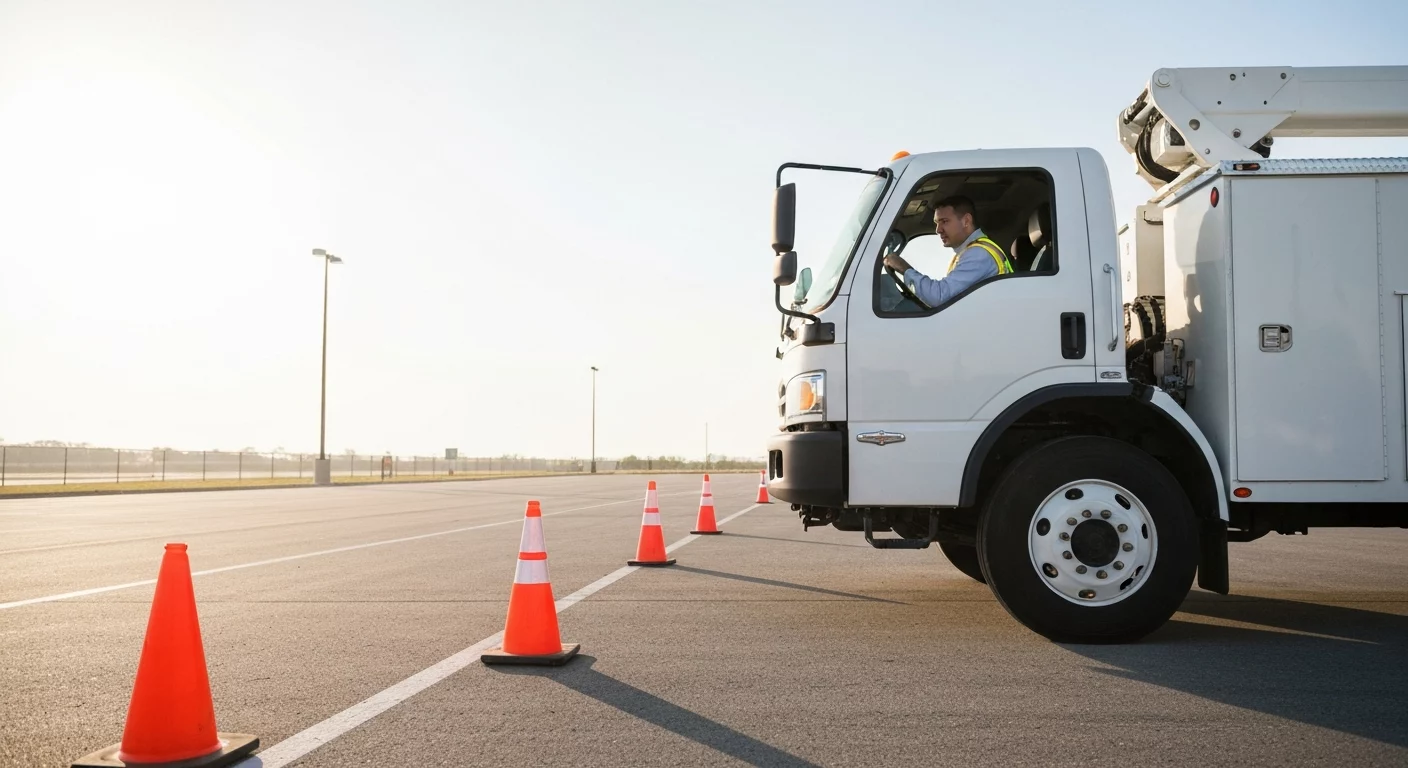
CDL Skills Test: Offset Backing Maneuver Guide
CDL Offset Backing Maneuver: A Guide for Electricians
The offset backing maneuver is a crucial skill for passing the modernized Commercial Driver’s License (CDL) test and a daily necessity for electricians operating large service vehicles. This maneuver tests a driver’s ability to back a truck from one lane into an adjacent lane, a common requirement on congested job sites. For a journeyman electrician or master electrician whose work involves bucket truck operation or hauling electrical equipment, mastering this technique is essential for safety, efficiency, and career advancement. For electricians in roles requiring the operation of large vehicles, strong utility truck driving skills are no longer optional but a core competency, ensuring precise job site vehicle positioning even in the most challenging environments.
Why the Offset Backing Maneuver is a Critical Skill for Electricians
For many electricians, the workplace extends far beyond the service panel. A significant part of the job, especially for those in utility, construction, or large-scale industrial maintenance, involves operating heavy-duty vehicles. Many utility companies and contractors require a CDL for electricians as a condition of employment. This is because vehicles like bucket trucks, digger derricks, and line trucks often exceed a 26,000-pound gross vehicle weight rating; operating a single vehicle with a GVWR of 26,001 pounds or more typically requires a Class B CDL under federal and state regulations. Mastering the offset backing maneuver is not just about passing a test; it is about demonstrating the control and spatial awareness needed for safe and effective maneuvering large service vehicles on active and often crowded work sites. This skill directly translates to greater efficiency in positioning for overhead line work and navigating the complex logistics of a modern construction project.
Understanding the Modernized CDL Skills Test
The Federal Motor Carrier Safety Administration (FMCSA) has approved a modernized CDL skills test, which many states have adopted. This new test standardizes the backing portion, featuring a sequence of maneuvers such as forward stop, straight-line backing, and reverse offset backing. The offset backing maneuver specifically evaluates a driver’s ability to back their vehicle from its current lane into an adjacent lane (lane widths used by testing sites can vary; many sites use lanes around 12 feet wide). Success requires precision, as the goal is to enter and straighten the vehicle within the new lane without hitting boundary cones or crossing lines. Under the FMCSA model, and with ELDT training requirements (49 CFR Part 380) governing entry-level driver training, the offset backing maneuver is included as a standardized skill. However, the federal model does not prescribe a specific number of permitted “pull-ups” or “get-out-and-looks” (GOALs); those allowances are determined by state testing standards or the testing site’s procedures, so check your state’s DMV or testing authority before testing.
Step-by-Step Guide to Executing the Perfect Offset Backing Maneuver
Executing a flawless offset back requires small, deliberate movements and constant observation. These instructions are specifically for a non-articulated straight truck (e.g., a Class B bucket truck). It’s less about speed and more about precision and understanding how your steering inputs affect the vehicle’s path. Conquer the offset back. Follow our step-by-step instructions.
- Initial Setup: Position your truck straight and as far forward as possible in the starting lane. Ensure your vehicle is parallel to the lane you are in. A good setup is the foundation of a successful maneuver.
- Initiate the Turn: Begin to slowly reverse. To move the rear of the truck to the right, turn the steering wheel to the left. To move the rear to the left, turn the steering wheel to the right. The initial turn should be deliberate to get the back of the truck moving toward the target lane, but not so sharp that you can’t recover.
- Counter-Steer to Straighten: As the rear of the truck enters the target lane, you must counter-steer (turn the wheel in the opposite direction of your initial turn) to begin straightening the vehicle. The goal is to get the truck’s body aligned with the new lane’s boundary lines as soon as possible.
- Straighten and Center: Once your truck is mostly aligned within the target lane, you can begin straight-line backing. Make very small steering corrections to keep it centered. If you see the rear of the truck drifting too far right in your mirrors, turn the steering wheel slightly to the right to correct it, and vice-versa.
- Finishing the Maneuver: Continue backing in a straight line until the front bumper has cleared the designated stopping line or cones per the examiner’s instructions. Stop the vehicle, set the parking brake (or place the transmission in park per examiner instructions), and await the examiner’s directions. Keep your movements slow and deliberate throughout the process.
Common Mistakes and How to Avoid Them
Even experienced drivers can struggle with the offset backing maneuver. Awareness of common pitfalls is the first step to avoiding them.
- Oversteering: The most frequent mistake is making large, jerky steering corrections. This causes the rear of the truck to swing out too severely, making it difficult to straighten out. All adjustments should be small and gradual.
- Incorrect Setup: Starting crooked or too close to the boundary lines puts you at an immediate disadvantage. Take the extra moment to ensure your initial pull-up is perfectly straight.
- Losing Sight in Mirrors: If the rear corner of the truck disappears from one of your mirrors, you have turned too sharply. This creates dangerous utility vehicle blind spots. If this happens, your best option is often to use a “pull-up” to straighten out and restart the turn.
- Fixating on One Mirror: You must constantly scan between your left and right mirrors to maintain spatial awareness and see the full picture.
- Ignoring GOAL: “Get Out And Look.” The modernized test allows for “looks” for a reason. On a real job site, adhering to applicable OSHA vehicle safety standards (29 CFR 1926 contains standards for motor vehicles and mechanized equipment on construction sites) means never backing if you are unsure of your path. Taking a moment to verify clearances is a sign of a professional, not a novice.
Training and Real-World Applications for Electricians
For an aspiring journeyman electrician or master electrician, required competencies can extend beyond theoretical knowledge of the electrical code. While formal electrician training through an electrician school or programs like NCCER provides foundational knowledge, practical skills like vehicle operation are a separate requirement often learned on the job or through specialized CDL training. Many companies now invest in electrical contractor CDL training to ensure their workforce is compliant and safe.
These line truck backing techniques are not just for the test. They are vital for:
- Positioning for Overhead Line Work: A bucket truck operation in a residential street or busy commercial area requires precise placement to ensure worker safety and minimize traffic disruption.
- Hauling Electrical Equipment: Backing a truck carrying a heavy transformer or spools of cable into a secure, often tight, location is a common task that relies on expert backing skills.
- Electrical Construction Site Logistics: Navigating a dynamic construction site involves maneuvering around materials, personnel, and other equipment, making skills learned from the offset backing maneuver indispensable.
- Digger Derrick Operation: Safely and accurately positioning a digger derrick for setting poles requires precise control, often in tight access job sites where there is no room for error.
Ultimately, proficiency in maneuvering large service vehicles is a hallmark of a well-rounded and valuable electrical professional, contributing to overall job site safety and efficiency.
Frequently Asked Questions (FAQ)
What is the offset backing maneuver for the CDL test?
The offset backing maneuver is a common component of the CDL skills test in the FMCSA modernized model and is included on many state CDL tests; it assesses a driver’s ability to back a commercial vehicle out of one lane and into an adjacent lane, either to the left or right. It simulates common scenarios like repositioning a service truck on a job site or in a crowded yard.
Why do journeyman and master electricians need a CDL and skills like offset backing?
Many roles for journeyman and master electricians, especially in utility and heavy construction, require the operation of vehicles with GVWRs at or above 26,001 lbs, such as bucket trucks, line trucks, or digger derricks. Federal regulations (administered by FMCSA) require drivers to hold an appropriate CDL class to operate these vehicles; states issue and enforce the license. Skills like offset backing are essential for safe and efficient job site vehicle positioning.
How does mastering large service vehicle positioning improve job site safety?
Proficient vehicle positioning reduces the risk of collisions with structures, equipment, and personnel. It helps manage utility vehicle blind spots and ensures compliance with applicable OSHA vehicle safety standards, which govern vehicle operation on work sites. Proper placement of a bucket truck or digger derrick is also critical for the stability of the equipment and the safety of the operator in the air.
What’s the difference between a left offset and a right offset backing maneuver?
The principle is the same, but the execution is a mirror image. With a straight truck, the steering is the opposite of what you might expect: to back into a lane on your right (a right offset), you must turn the steering wheel to the left. This moves the rear of the truck to the right. For a left offset, you turn the steering wheel to the right to move the rear to the left. Drivers must be proficient at both, as the examiner will choose one randomly on test day.
Continuing Education by State
Select your state to view board-approved continuing education courses and requirements:

Disclaimer: The information provided in this educational content has been prepared with care to reflect current regulatory requirements for continuing education. However, licensing rules and regulations can vary by state and are subject to change. While we strive for accuracy, ExpertCE cannot guarantee that all details are complete or up to date at the time of reading. For the most current and authoritative information, always refer directly to your state’s official licensing board or regulatory agency.
NEC®, NFPA 70E®, NFPA 70®, and National Electrical Code® are registered trademarks of the National Fire Protection Association® (NFPA®)
You may also like
Colorado Electrical Licensing Requirements and Reciprocity Guide
Standby Generators in DE: Navigating Coastal Storm Regulations

 Login with Google