
A Guide to the CDL Road Test: What to Expect
A Guide to the CDL Road Test: What to Expect
This guide to the cdl road test provides a comprehensive overview for electricians aiming to advance their careers. Earning your Commercial Driver’s License involves passing a three-part skills test: the vehicle inspection, the basic control skills test, and the on-road driving test. For a journeyman electrician or master electrician, this certification is crucial for operating specialized equipment like bucket trucks and digger derricks. Success hinges on thorough preparation, particularly for the detailed bucket truck pre-trip inspection and the critical air brake test. As of February 7, 2022, many entry-level applicants — including those obtaining their first CDL, drivers upgrading their CDL class, and those seeking certain endorsements for the first time — must complete Entry-Level Driver Training (ELDT) from an FMCSA-listed training provider before taking the required knowledge or skills tests, standardizing entry-level commercial driver training nationwide. Understanding lineman CDL requirements and what to expect on the utility truck road test will give you a significant advantage, opening doors to more advanced roles and higher pay within the electrical trade.
Why a Commercial Driver’s License (CDL) is Essential for Electricians
For many electricians, the path to career advancement involves more than just mastering the NEC code book. As roles expand beyond residential wiring, so does the equipment. A journeyman electrician or master electrician working in utility, commercial, or industrial sectors will often need a CDL for electricians to legally operate the heavy vehicles central to their job. This includes everything from hauling electrical equipment and materials to job sites to operating specialized machinery.
The most common license for this field is the Class B license for electricians, which is required for single vehicles with a gross vehicle weight rating (GVWR) of 26,001 pounds or more, such as many bucket trucks or service trucks with cranes. Some roles, particularly those involving hauling heavy transformers or large reels of cable on trailers, may even necessitate a Class A license. Successfully operating a digger derrick or demonstrating proficiency in boom truck safety and operation are skills that start with having the proper CDL. This license is a critical credential, often listed as a prerequisite in lineman CDL requirements and for any electrical contractor CMV (Commercial Motor Vehicle) operator.
The Modernized CDL Skills Test: A Three-Part Breakdown
The Federal Motor Carrier Safety Administration (FMCSA) and the American Association of Motor Vehicle Administrators (AAMVA) have worked to modernize the CDL skills test to reflect current vehicle technology. While the on-road portion remains largely the same, significant changes have been made to the Vehicle Inspection and Basic Control Skills sections. The entire test is broken down into three distinct parts, all of which must be passed.
Part 1: The Vehicle Inspection Test
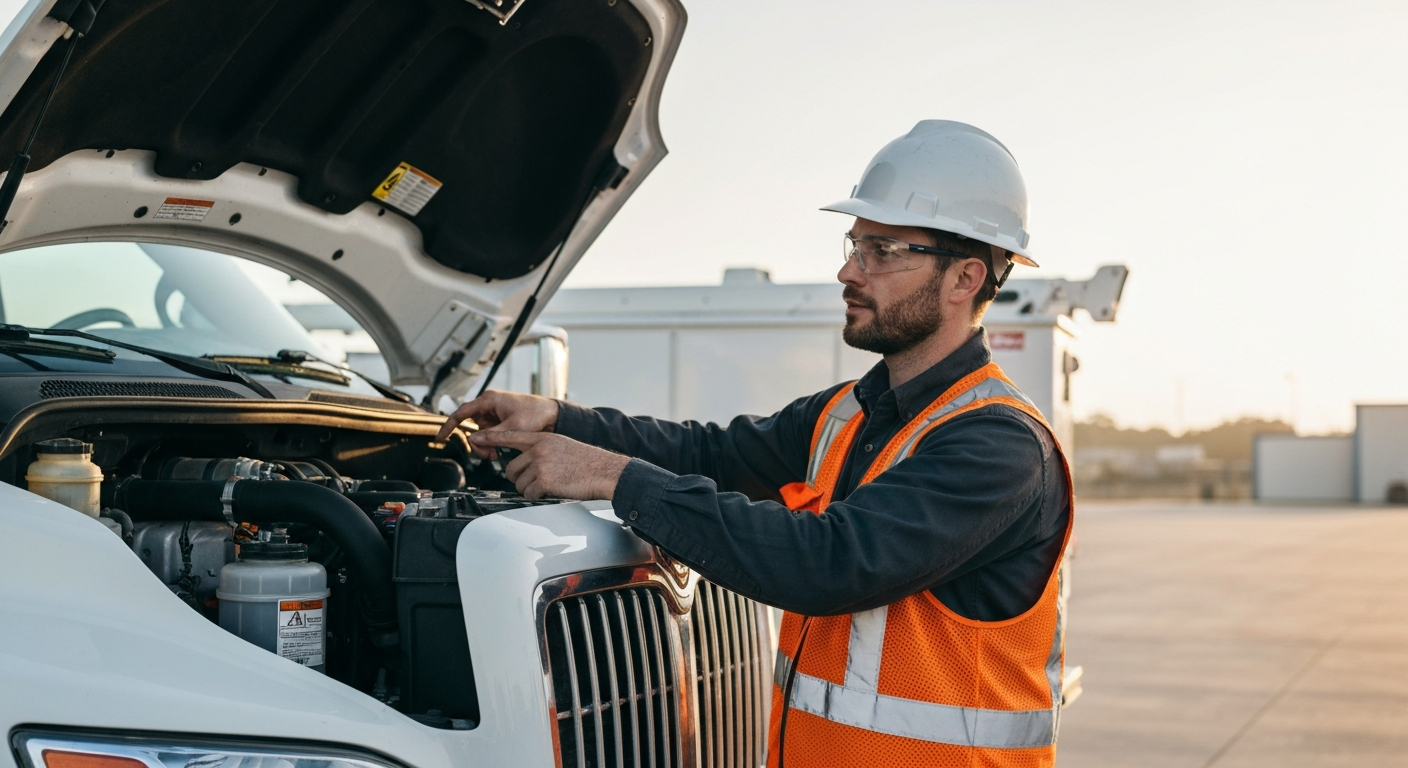
Before you even turn the key, you must prove you can determine if the vehicle is safe to operate. This is the CDL vehicle inspection for electrical work, often called the pre-trip inspection. For electricians, this means mastering the bucket truck pre-trip inspection, which includes standard truck components as well as specialized equipment like the boom, bucket, outriggers, and hydraulic systems. You’ll be required to point to or touch key parts and explain to the examiner what you’re checking and why it’s important. A crucial and frequently failed component of this test is the air brake test for service trucks. You must demonstrate the proper sequence to check for leaks, verify warning signals, and test the parking and service brakes. Failure to perform this check correctly will result in a failure of the vehicle inspection component of the test, preventing you from continuing to the skills and road test portions.
The following guide covers the applied pressure test, which is one critical part of the multi-step air brake check sequence required by FMCSA and AAMVA standards. The full test also includes checking the low air warning alarm and the automatic engagement of the emergency spring brakes.
Step-by-Step Guide to the Air Brake Check (Applied Pressure Test)
- With the air system fully charged (around 120-140 PSI), turn off the engine, but turn the key back to the “on” position so the gauges are active.
- Release the parking brakes (push in the parking-control knob(s) so the brakes are released; on some vehicles the yellow knob controls the parking brakes while the red valve controls the trailer air supply and must be set appropriately). Let the pressure stabilize.
- Firmly apply and hold the service brake (the foot pedal).
- Watch the air pressure gauge for 60 seconds. You should not lose more than 4 PSI for a combination vehicle (like a truck with a trailer) or 3 PSI for a single vehicle (like a Class B bucket truck).
- After one minute, if the pressure drop is within the acceptable limit, you have successfully tested for air leaks in the service brake system.
Part 2: Basic Control Skills (BCS)
The BCS test evaluates your ability to handle the truck in a controlled, off-road environment. Under the modernized test standards approved by the FMCSA, this section assesses your ability to perform several crucial low-speed maneuvers. While the specific set of exercises can vary by state, they typically include straight-line backing, offset backing (left or right), parallel parking (sight-side or blind-side), and the alley dock maneuver. These exercises are designed to simulate tight situations you might encounter on a job site, proving you can precisely position your vehicle without incident. This is where journeyman electrician CDL skills are put to the test. The examiner will be looking for your ability to stay within boundaries (cones), your proper use of mirrors, and your overall control of the vehicle.
Part 3: The On-Road Driving Test
The final section is the utility truck road test, where you’ll drive on public roads with the examiner. This portion assesses your ability to navigate real-world traffic situations safely and legally. The examiner will evaluate your handling of intersections, turns, lane changes, and your ability to maintain proper speed and following distance. For an electrical contractor, adherence to DOT regulations for electrical fleets is paramount, and this test is the ultimate proof of your competence. You will also be judged on your hazard perception, such as how you react to other vehicles, pedestrians, and changing road conditions. Simple mistakes like hitting a curb, rolling through a stop sign, or speeding can result in an automatic failure.
Common Pitfalls and Tips for Success
High first-time failure rates on the CDL test are common, often due to nerves and a lack of preparation, especially on the vehicle inspection. A candidate might have excellent driving skills but fail because they couldn’t properly verbalize the steps of the air brake check. From your first day at an electrician school or NCCER program, a professional mindset is key. That same discipline applies here. Whether you’re pursuing a specialized vehicle endorsement or simply aiming to be a more valuable team member, focused preparation is non-negotiable.
- Memorize the Inspection: Don’t just learn the inspection—master it. Practice verbalizing each step of your bucket truck pre-trip inspection until it becomes second nature. Some jurisdictions may allow a limited memory aid or checklist during the vehicle inspection portion, but policies vary by state and testing facility; check with your local licensing agency for their specific rules. Even if allowed, you still need to know what you’re looking for.
- Practice Makes Perfect: Spend as much time as possible practicing the basic control maneuvers. Get a feel for the truck’s pivot points and blind spots.
- Know Your Air Brakes: The air brake system is complex and a common point of failure. Study the system and practice the in-cab check repeatedly.
- Verbalize Everything: During the test, say what you’re doing and why. Announce when you’re checking mirrors, activating turn signals, and scanning intersections. This shows the examiner your thought process.
- Stay Calm: Nerves can lead to simple mistakes. Take deep breaths, listen carefully to the examiner’s instructions, and don’t rush.
Pass the final step. Know what to expect on your CDL road test. Completing your electrician training and adding a CDL to your qualifications is a powerful combination for career growth.
The Bigger Picture: CDL and Your Electrical Career
While a residential electrician may never need more than a standard driver’s license, the career trajectory for a journeyman or master electrician in the commercial, utility, or industrial fields is vastly different. A CDL is a gateway credential. It signifies that you can handle not just the intricate electrical work guided by the NEC code book, but also the heavy machinery required for hauling electrical equipment and performing large-scale jobs. It demonstrates a commitment to safety and a broader skill set that employers value highly. Just as you might take online electrical courses to stay current on code changes, earning a CDL is a form of professional development that directly translates to more opportunities and greater responsibility.
Primary Sources
- Federal Motor Carrier Safety Administration (FMCSA) – Commercial Driver’s License Program: https://www.fmcsa.dot.gov/registration/commercial-drivers-license
- American Association of Motor Vehicle Administrators (AAMVA) – CDL Testing Information: https://www.aamva.org/topics/vehicle-programs/cdl-testing
- Code of Federal Regulations, 49 CFR Part 380, Special Training Requirements: https://www.ecfr.gov/current/title-49/subtitle-B/chapter-III/subchapter-B/part-380
Frequently Asked Questions (FAQ)
What class of CDL do most electricians need?
Most electricians who require a CDL will need a Class B license. A Class B license for electricians allows them to operate single vehicles over 26,001 pounds, which covers most bucket trucks, digger derricks, and other large service vehicles. A Class A license may be required for jobs that involve towing heavy trailers with materials or equipment.
Does my electrician training from an electrician school prepare me for the CDL test?
Traditional electrician school or NCCER programs focus on electrical theory and practice, not commercial driving. To take the CDL test, you must now complete mandatory Entry-Level Driver Training (ELDT) from a provider listed on the FMCSA’s Training Provider Registry if you fall into the entry-level categories covered by the rule. This ensures you receive the specific classroom and behind-the-wheel training required to pass.
What is the hardest part of the utility truck road test?
For many applicants, the most difficult part is not the driving but the Vehicle Inspection Test. Specifically, the bucket truck pre-trip inspection and the multi-step air brake test for service trucks are where most errors occur. These sections require precise memorization and verbalization of dozens of components and safety checks.
Are there different journeyman electrician CDL skills compared to a lineman?
The fundamental CDL skills and test requirements are the same for both. Both a journeyman electrician operating a large service truck and a lineman need to master the same three parts of the test: inspection, basic controls, and the road test. However, the specific knowledge for the pre-trip inspection may differ slightly based on the vehicle (e.g., a digger derrick versus a standard bucket truck), but the core principles of boom truck safety and operation remain consistent.
Continuing Education by State
Select your state to view board-approved continuing education courses and requirements:

Disclaimer: The information provided in this educational content has been prepared with care to reflect current regulatory requirements for continuing education. However, licensing rules and regulations can vary by state and are subject to change. While we strive for accuracy, ExpertCE cannot guarantee that all details are complete or up to date at the time of reading. For the most current and authoritative information, always refer directly to your state’s official licensing board or regulatory agency.
NEC®, NFPA 70E®, NFPA 70®, and National Electrical Code® are registered trademarks of the National Fire Protection Association® (NFPA®)
You may also like
Colorado Electrical Licensing Requirements and Reciprocity Guide
Standby Generators in DE: Navigating Coastal Storm Regulations

 Login with Google