
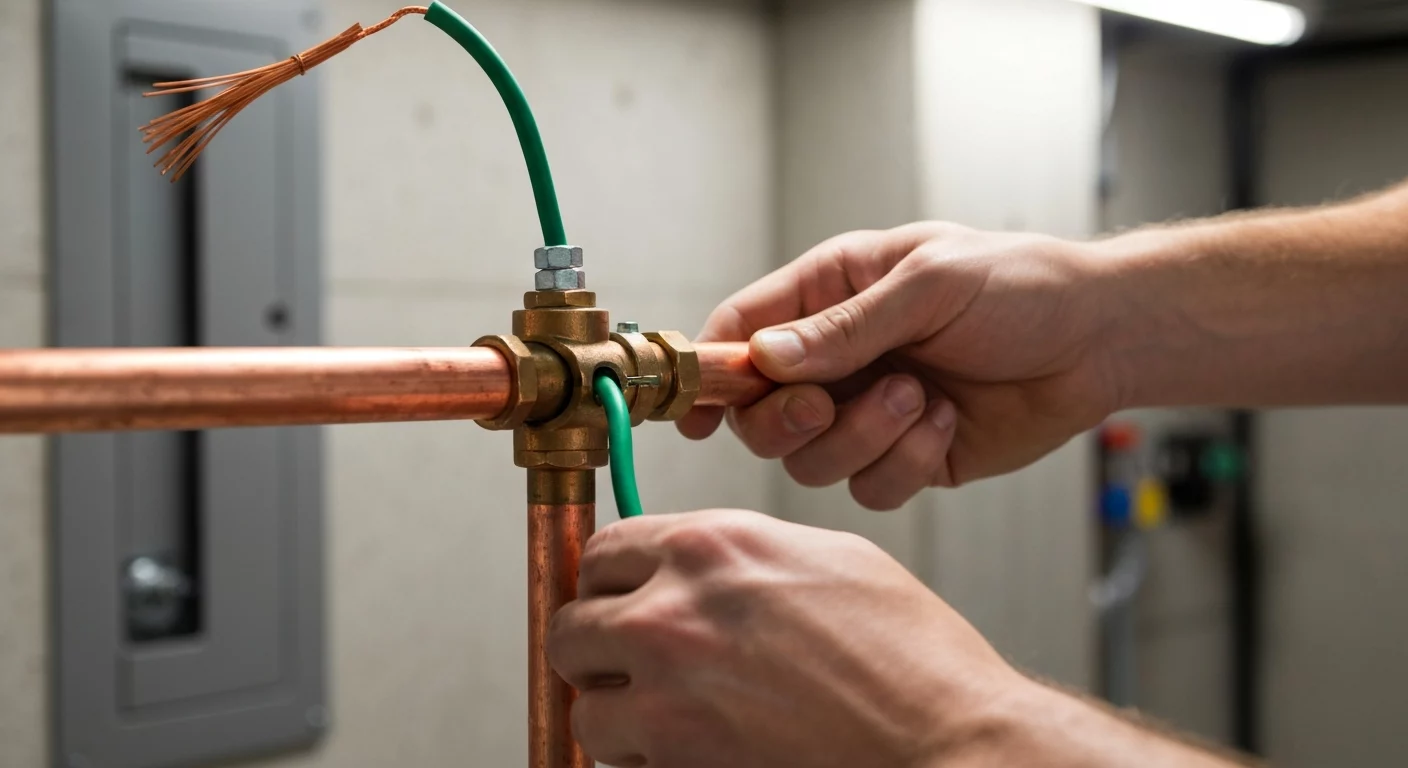
Bonding of Water Piping Systems: NEC 250.104 Explained
Bonding of Water Piping Systems: A Master and Journeyman Electrician’s Guide to NEC 250.104
Properly executing the bonding of water piping systems is a fundamental safety requirement outlined in the NEC Code Book. Governed by NEC 250.104, this critical process ensures that all metallic water piping is maintained at the same electrical potential as the rest of the grounding system, preventing a dangerous shock hazard. The primary goal is to create a low-impedance, effective ground-fault current path that allows circuit breakers to operate quickly in the event of a fault. This involves installing a correctly sized bonding jumper from the electrical service to the piping. However, with the increasing use of nonmetallic piping like PEX, ensuring electrical continuity has become more complex. Understanding when and how to bond isolated sections of metal pipe, sizing the jumper using NEC Table 250.102(C)(1), and identifying correct points of attachment are essential skills for any professional electrician.

What is Bonding and Why Is It Different From Grounding?
For any journeyman electrician or master electrician, distinguishing between grounding and bonding is crucial. So, bonding, what is it exactly? While grounding connects the electrical system to the earth (via a grounding rod or other electrode), bonding connects all metallic parts of the system that are not meant to carry current together. The purpose of bonding is not to connect to the earth, but to ensure all bonded components are at an equal electrical potential. This process of creating a single, continuous conductive path is known as equipotential bonding. In the event of a ground fault, this path provides a low-impedance route for fault current to return to its source—the breaker panel or service—tripping the overcurrent device and de-energizing the circuit. An improperly bonded metal water pipe can become energized and sit there, posing a severe shock hazard. For a deeper dive into this foundational topic, explore the differences in our detailed articles: Grounding vs. Bonding: Understanding NEC Article 250 and Grounding vs. Bonding in NEC 250.
Decoding NEC 250.104: Requirements for Metal Water Piping
NEC Section 250.104(A) specifically addresses the requirements for the bonding of metal water piping systems. It mandates that any interior metal water piping system installed in or attached to a building be bonded. This applies whether or not the metal underground water pipe is used as a grounding electrode. The goal is to ensure the piping system cannot become energized relative to other grounded surfaces. The code specifies several acceptable locations for connecting the bonding jumper to the electrical service, establishing a reliable path for fault current.
Sizing the Bonding Jumper: Using NEC Table 250.102(C)(1)
Correctly sizing the bonding jumper is non-negotiable for code compliance and safety. NEC 250.104(A)(1) directs electricians to use NEC Table 250.102(C)(1) for this task. This table sizes the jumper based on the size of the ungrounded service-entrance conductors. For example, if a service uses 400 kcmil copper conductors in a single raceway, Table 250.102(C)(1) requires a 1/0 AWG copper bonding jumper. For services with parallel conductors in multiple raceways, the sizing must be based on the equivalent size of the parallel conductors per Note 1 to the table. Note 2 to Table 250.102(C)(1) includes a critical rule: for services with phase conductors larger than 1100 kcmil copper or 1750 kcmil aluminum, the jumper must be sized at no less than 12.5% of the total cross-sectional area of the largest ungrounded phase conductor (or the equivalent area for parallel conductor installations). This ensures the bonding conductor is adequately sized for very large electrical services.
Points of Attachment for the Bonding Jumper
The NEC provides flexibility in where the bonding jumper can be connected, as long as the connection point is accessible for inspection and maintenance. According to NEC 250.104(A)(1), acceptable points of attachment include:
- The service equipment enclosure
- The grounded conductor at the service
- The Grounding Electrode Conductor (GEC), provided it is of sufficient size
- One or more of the grounding electrodes used in the grounding electrode system
The connection should be made at a convenient point, typically where the water pipe enters the building, to ensure the entire downstream piping system is bonded.
Step-by-Step: How to Bond a Metal Water Piping System
For a journeyman or master electrician, performing a compliant water pipe bond is a routine but critical task. Follow these steps to ensure a safe and effective installation:
- Identify the Piping System: Determine if the building uses a continuous metal water piping system. Locate where the main water service enters the building.
- Determine Service Conductor Size: Check the size of the ungrounded service entrance conductors supplying the building. This information is necessary for sizing the bonding jumper.
- Size the Bonding Jumper: Using the service conductor size from Step 2, consult NEC Table 250.102(C)(1) to determine the minimum required size for your copper or aluminum bonding jumper. Remember the sizing rules from NEC Table 250.102(C)(1), including the 12.5% calculation required per Note 2 for services with conductors exceeding the table’s limits, which is based on the equivalent area for parallel sets.
- Select a Point of Attachment: Choose an accessible and code-compliant connection point at the service, such as the grounded conductor bus (neutral bus) within the service disconnect, the service equipment enclosure, or the grounding electrode conductor itself.
- Ensure Electrical Continuity: If there are components like water meters, pressure-reducing valves, or filters that could break the flow of electricity, you must install a bonding jumper around them. This maintains electrical continuity across the entire piping system.
- Install the Jumper: Securely install the bonding jumper using listed and approved clamps. Ensure all connections are tight and meet the installation requirements of NEC 250.64. The attachment points must remain accessible.
The Rise of Nonmetallic Piping and Its Impact on Bonding
A significant trend in modern construction is the widespread adoption of nonmetallic piping such as PEX and CPVC. This shift away from conductive copper or steel piping has major implications for electrical safety. Because plastic pipes are insulators, they break the electrical continuity of the plumbing system. While NEC 250.104(A) mandates bonding for the “metal water piping system” as a whole, it does not explicitly use the phrase “likely to become energized.” This concept, however, is found in NEC 250.104(B) for other metal piping. Because AHJ interpretation varies on whether isolated sections are part of the “system,” many electricians and inspectors apply the logic from 250.104(B) as interpretive guidance. Professional judgment is used to determine if an isolated section could pose a shock hazard and therefore warrants bonding.
When Does an Isolated Metal Pipe Section Require Bonding?
Applying the “likely to become energized” principle from NEC 250.104(B) as guidance for water piping requires professional judgment. An isolated stub-out for a sink faucet is generally not considered likely to become energized. However, a section of metal pipe that runs adjacent to or through electrical equipment, or one that has an appliance connected to it (like a gas water heater with electrical controls), is a different story. If an electrical fault could reasonably energize the pipe section, it must be bonded. In these cases, the equipment grounding conductor of the circuit supplying the appliance is often permitted to serve as the bonding means.
The nuances of bonding and grounding can be complex, especially as building materials evolve. Get bonding and grounding right every time. Sign up for our online electrical courses to stay current with the nec code book.
Special Considerations for Water Pipe Bonding
Beyond the basic requirements, several special conditions require attention from a qualified electrician.
- Supplemental Electrode: If a metal underground water pipe is used as a grounding electrode per NEC 250.52(A)(1) (meaning it is in direct contact with the earth for 10 feet or more), NEC 250.53(A)(2) requires it to be supplemented with at least one additional electrode, such as a grounding rod. This supplemental electrode must be bonded to the water pipe, the service equipment enclosure, or the grounding electrode conductor where it is of sufficient size.
- Separately Derived Systems: When a building contains a separately derived system, such as a transformer, its own bonding and grounding rules apply. According to NEC 250.104(D), any metal water piping in the area served by the system must be bonded to the grounded conductor of that system.
- Intersystem Bonding Termination (IBT): To prevent potential differences between different utility systems (e.g., electrical, cable TV, telephone), NEC 250.94 requires an intersystem bonding termination. This device provides a dedicated connection point for bonding these other systems to the electrical service’s grounding electrode system. Read more about it in our guide to the Intersystem Bonding Termination.
- Equipotential Bonding for Pools: The concept of equipotential bonding is taken to another level in special locations like swimming pools (NEC Article 680). Here, all conductive surfaces, including water, must be bonded together to prevent dangerous voltage gradients. Learn more about recent changes in our lesson on 2023 NEC changes for swimming pool equipotential bonding.
Primary Sources
- NFPA 70, National Electrical Code (NEC), 2023 Edition
Frequently Asked Questions (FAQ)
- What is the main purpose of the bonding of water piping systems?
- The primary purpose is safety. Bonding ensures that in the event of an electrical fault that energizes the metal pipes, the current has a safe, low-resistance path back to the source. This creates an effective ground-fault current path that will quickly trip the breaker or blow the fuse, preventing a prolonged shock hazard.
- Do I need to bond the water pipe if my house has nonmetallic piping like PEX?
- If your system is entirely nonmetallic piping, there is nothing conductive to bond. In hybrid systems, NEC 250.104(A) applies to the “metal water piping system.”. Short, isolated sections of metal pipe may not be considered part of this system. While 250.104(A) does not contain a “likely to become energized” clause, this principle (from 250.104(B)) is often used by electricians as interpretive guidance to determine if an isolated section near electrical equipment poses a risk and therefore requires bonding.
- How do I size the bonding jumper for a water pipe?
- You must use NEC Table 250.102(C)(1), which sizes the bonding jumper based on the service entrance conductors. For very large services (over 1100 kcmil copper or 1750 kcmil aluminum), the jumper must be calculated as at least 12.5% of the total cross-sectional area of the largest phase conductor (or the equivalent area for parallel conductors), as required by Note 2 to the table.
- Does the water pipe count as my only grounding electrode?
- No. If a metal underground water pipe is in direct contact with the earth for 10 feet or more, it must be used as a grounding electrode. However, the NEC requires it to be supplemented with another electrode, such as a driven grounding rod, to ensure a reliable connection to the earth in case the water pipe is ever replaced with plastic.
Continuing Education by State
Select your state to view board-approved continuing education courses and requirements:

Disclaimer: The information provided in this educational content has been prepared with care to reflect current regulatory requirements for continuing education. However, licensing rules and regulations can vary by state and are subject to change. While we strive for accuracy, ExpertCE cannot guarantee that all details are complete or up to date at the time of reading. For the most current and authoritative information, always refer directly to your state’s official licensing board or regulatory agency.
NEC®, NFPA 70E®, NFPA 70®, and National Electrical Code® are registered trademarks of the National Fire Protection Association® (NFPA®)
You may also like
Colorado Electrical Licensing Requirements and Reciprocity Guide
Standby Generators in DE: Navigating Coastal Storm Regulations

 Login with Google