
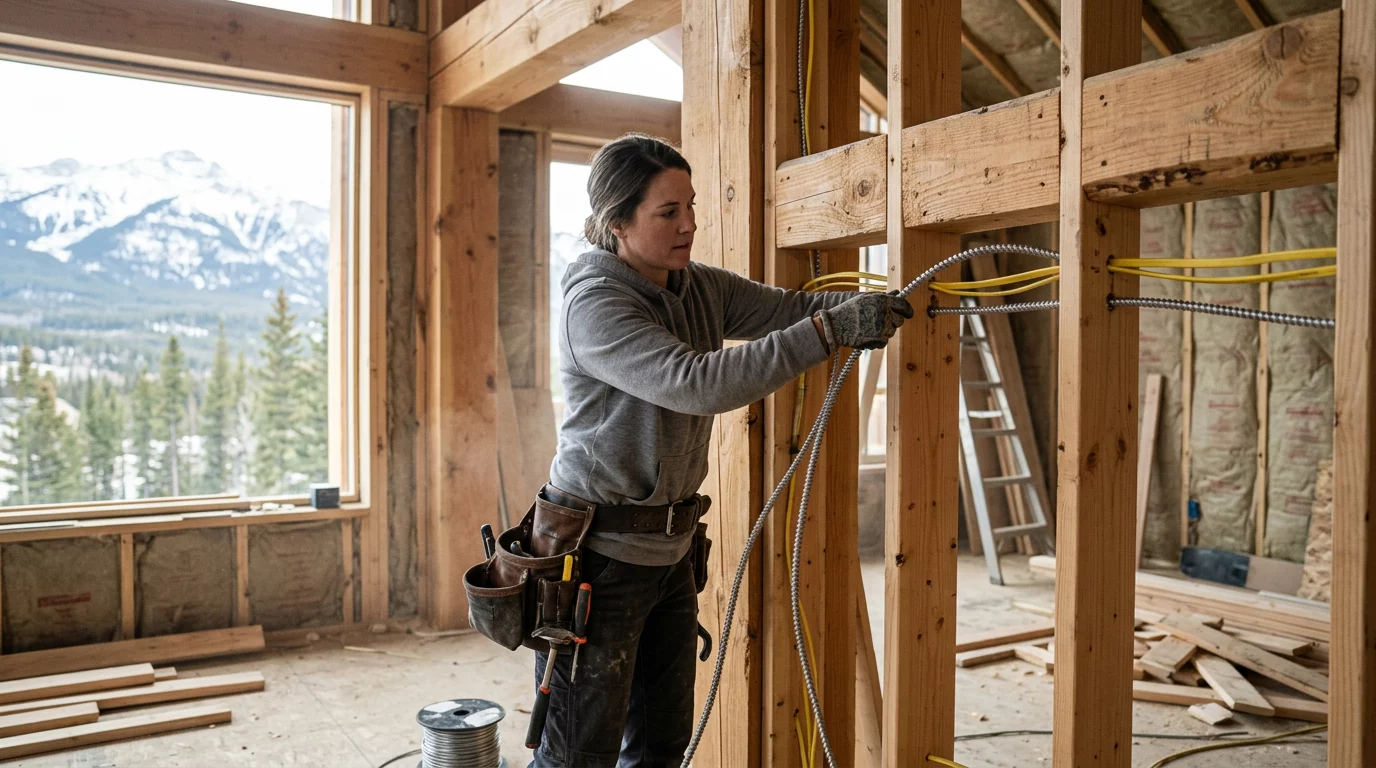
Wiring Methods for Colorado Mountain Homes: MC vs. Romex
Wiring Methods for Colorado Mountain Homes: MC vs. Romex
The Core Debate: MC Cable vs. Romex (NM-B)
At its heart, the choice between Metal-Clad (MC) cable and Non-Metallic (NM-B) cable, commonly known by the brand name Romex, is a trade-off between cost, installation speed, and physical protection. While both are workhorses in the residential world, their suitability changes when faced with the unique conditions of a mountain environment.
The Case for Romex (NM-B) Wire
There’s a reason romex wire is the default for a huge number of residential projects across the country. It’s affordable, familiar to every licensed electrician, and fast to install in protected wall cavities. Governed by NEC Article 334, NM-B cable is a compliant choice for interior branch-circuit wiring when properly installed inside walls, floors, and ceilings that provide adequate physical protection as described in the Article.
However, its nonmetallic sheathing is vulnerable in exposed applications. In the rustic, open-beam designs common in mountain architecture, or in basements and garages where wiring might be run along surfaces, NM-B often requires additional protection, such as being run through EMT conduit or other approved mechanical protection per the NEC. This can reduce its initial cost and speed advantages if surface protection is required.
The Case for MC Cable: The Armored Advantage
This is where mc cable shines. Defined by NEC Article 330, its built-in metallic armor offers superior protection against physical damage. This makes it a prime candidate for a variety of challenges specific to mountain construction:
- Rodent-Resistant Wiring: The metal jacket of MC cable provides substantial physical protection that makes it far less vulnerable to rodent chewing and mechanical damage than NM-B sheathing. NEC Article 330 permits MC cable to be used in exposed and concealed work (Section 330.10(A)(4)), provided it is not subject to physical damage (Section 330.12(1)).
- Exposed Installations: MC cable can be run in exposed locations without additional conduit where the NEC permits exposed metal-clad cable and where the run is not subjected to severe physical damage, making it suitable for open-concept and rustic-industrial aesthetics popular in mountain lodges.
- Durability: Mountain homes often see more ongoing modification and more extreme environmental swings. The inherent toughness of MC cable contributes to overall electrical system durability when installed correctly.
While making connections with MC requires the usual listed fittings and attention to listed terminations, and the material itself is more expensive than Romex, the labor savings from not having to install separate conduit for exposed runs can make MC the more efficient choice on many mountain projects.
Code Compliance in the High Country: NEC 2023 and Local Rules
The Colorado State Electrical Board adopted the 2023 NEC effective August 1, 2023, establishing it as the minimum standard for the state. Always verify the specific code cycle and amendments with the local authority having jurisdiction (AHJ) for the project. For a summary of major changes in the 2023 cycle, see NEC 2023 key changes.
It’s important to note that AHJs decide which edition and what amendments apply locally. You should confirm project-specific requirements with the city or county building department rather than assume uniform adoption. Key code requirements such as AFCI protection and GFCI protection are enforced by the NEC (see Article 210 and related requirements), and you must provide the required protection on the appropriate circuits regardless of whether you use NM-B or MC cable.
High-Altitude Challenges for Electricians
Working at 8,000 feet or higher introduces variables flat-landers don’t always plan for. These environmental factors directly impact calculations and equipment choices:
- High-Altitude and Equipment Ratings: Some equipment listings limit operation by altitude. Transformers, motors, and certain electronic devices may have listing limitations that require derating or alternate equipment if installed at high altitude—check the manufacturer’s instructions and listings before specifying equipment.
- Ambient Temperature Correction: Ambient temperature is a frequent concern. Spaces exposed to direct sun or poorly ventilated attics can reach high temperatures; the NEC requires applying ambient temperature correction factors to conductor ampacity and choosing equipment rated for the expected environment. See the NEC ampacity correction guidance when sizing conductors, and follow manufacturer temperature limitations.
- Snowmelt and Outdoor Systems: Driveway and roof snowmelt systems are power-hungry and require dedicated circuits, careful load calculations, and ground-fault protection of equipment (GFPE). Some jurisdictions have energy or permitting rules that affect how and when these systems can be installed—check with the Authority Having Jurisdiction (AHJ) for any special permitting or energy budget requirements.
Making the Right Connections
Regardless of cable choice, secure, code-compliant terminations and splices are essential. Use listed connectors and follow the manufacturer’s instructions and NEC requirements for terminations on both NM-B (Article 334) and MC cable (Article 330). Faults are often the result of poor connections or improper grounding, so good technique and listed materials (wire nuts, listed push-in connectors where allowed, or rated termination hardware) are non-negotiable. For a practical comparison of connector types, see push-in vs. twist-on wire connectors, and for grounding pitfalls see top grounding and bonding mistakes.
Conclusion: The Best Choice is a Site-Specific Choice
So, what’s the final verdict for wiring mountain homes? There is no single right answer. For protected, standard stud-bay wiring, Romex wire (NM-B) remains a cost-effective and NEC-compliant solution. However, for exposed runs, locations prone to pests or physical abuse, or whenever the installation calls for the higher level of physical protection, MC cable is often the superior option. Most experienced electricians use a hybrid approach: NM-B inside protected cavities and MC or other metallic wiring methods where the run is exposed or at risk.
Always confirm the adopted code edition, any local amendments, and permit requirements with the AHJ before starting work. By understanding environmental challenges, applying NEC requirements (Articles 210, 250, 310, 330, 334, etc.), and checking manufacturer listings, you can deliver a safe, reliable, and durable electrical system for mountain homes.
As codes evolve and new challenges arise, staying current with your knowledge is key. ExpertCE is here to help you stay at the top of your game. Browse our courses to find state-approved continuing education that fits your needs.
Colorado Continuing Education Courses
Explore our board-approved continuing education courses for Colorado professionals:
View CE Requirements


Colorado 2023 NEC – 24 hours Electrical License Renewal Package

Disclaimer: The information provided in this educational content has been prepared with care to reflect current regulatory requirements for continuing education. However, licensing rules and regulations can vary by state and are subject to change. While we strive for accuracy, ExpertCE cannot guarantee that all details are complete or up to date at the time of reading. For the most current and authoritative information, always refer directly to your state’s official licensing board or regulatory agency.
NEC®, NFPA 70E®, NFPA 70®, and National Electrical Code® are registered trademarks of the National Fire Protection Association® (NFPA®)
You may also like
Standby Generators in DE: Navigating Coastal Storm Regulations

Upgrading to a Master Electrician License in Delaware
 Login with Google