
Delaware’s EV Charging Growth: A Guide for Pro Electricians
The Numbers Driving the Boom: Rebates and Federal Dollars
The surge in EV charging Delaware isn’t just happening on its own. It’s being fueled by a powerful combination of market demand and policy initiatives. Various initiatives often support the market, potentially including EV charger rebates and grant opportunities that lower the cost of entry for homeowners, businesses, and developers. Availability of such incentives can fluctuate with funding.
Key areas you need to know about include:
- Multi-Family Dwelling Incentives: Property owners frequently seek support for multi-family dwelling EV charger installation projects; eligibility and scope vary, so verifying current requirements is essential before estimating job pricing.
- Commercial and Workplace Charging: Commercial entities may utilize grants for commercial EV charger installation DE; coverage and terms differ by project, so checking current guidance is recommended.
- Utility Partnerships: Utilities may also offer partnerships or incentives. These programs often support the integration of Level 2 chargers. Eligibility and details change, so consulting local utility resources is advisable.
On top of state efforts, federal funding initiatives also support highway DC fast‑charging buildout. This support is intended to accelerate DC fast charging deployment along corridors and help address range‑anxiety concerns. The resulting projects create work opportunities for electricians in both public‑ and private‑sector installations.
The Residential Gold Rush: Your Bread and Butter
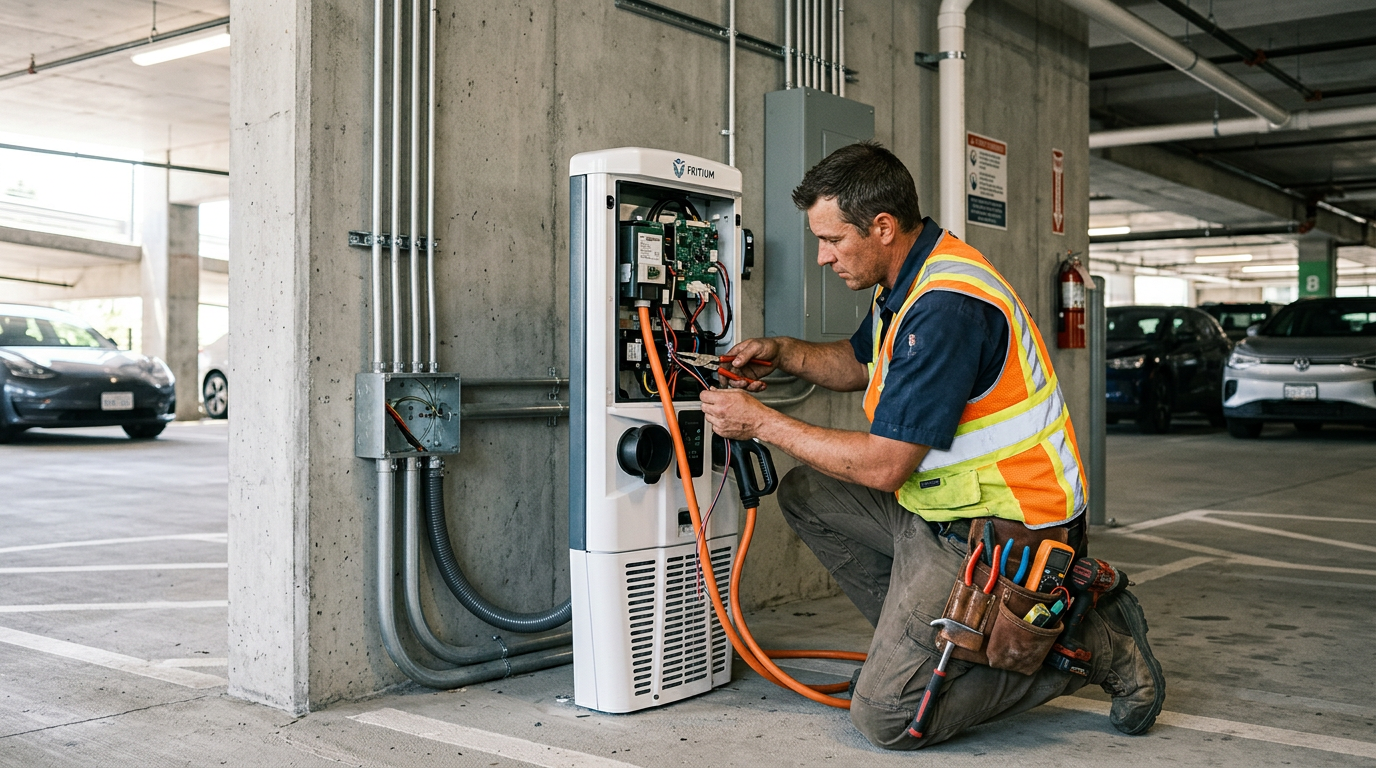
While public infrastructure makes headlines, the most consistent work for a residential EV charger electrician Delaware will be in people’s garages. Every new EV owner becomes a potential customer. The most common installation is a Level 2 EVSE (Electric Vehicle Supply Equipment) system, which offers a significant speed boost over a standard wall outlet. Understanding the hardware is key.
Many homeowners will opt for a plug-in charger that uses a NEMA 14-50 receptacle. This heavy-duty, 240-volt receptacle is the same type used for electric ranges and requires a dedicated circuit. As the expert on-site, you’ll be responsible for explaining that this isn’t a simple outlet swap. It involves running a new circuit from the panel, protected by a new breaker. For a 40‑amp continuous charger, standard code rules require conductor ampacity to be at least 125% of the continuous load; in practice that commonly leads to a 50‑amp branch circuit. For a detailed refresher, you can review the essentials on how to properly install a NEMA 14-50 receptacle.
You’ll also frequently encounter service capacity challenges. An older home with a 100-amp panel may not have the capacity for an EV charger on top of existing loads; a full load calculation is required to determine if the existing service can handle the additional load. This is a prime opportunity to propose a service upgrade to a modern 200-amp panel, improving safety and leaving room for future loads. This is where offering a licensed electrician EV installation Delaware service provides professional value over unlicensed work.
Beyond the Garage: Commercial and Public Opportunities
The money and scale get bigger in the commercial sector. Commercial expansion requires developers to rely on electricians who can plan for EV-capable parking spaces Delaware, conduit routing, panel capacity, and future load management.
Opportunities are widespread:
- Apartments and Condos: This is a hot market, driven by tenant demand and potential incentives for multi-family dwelling EV charger installation.
- Workplace Charging: Companies are adding EV charging as a perk to attract and retain talent, creating a steady stream of commercial installation jobs.
- Retail and Public Lots: Businesses are installing chargers to attract EV-driving customers who will spend time while their car charges.
Staying Compliant and Profitable: The Technical Details
EV charger installation is more than just running wires; it requires a deep understanding of electrical codes and principles. Your go-to guide is the NEC code book (NFPA 70), which is adopted by the Delaware Board of Electrical Examiners. Article 625 is dedicated to Electric Vehicle Power Transfer Systems and is essential reading. Load calculations are especially critical; Article 220 details feeder and service load calculations that are commonly applied. Staying current on how 2023 NEC changes affect EVSE load calculations and related guidance will help ensure safe, compliant installations.
Beyond load, you must consider voltage drop. For charging stations located far from the electrical panel, such as in a large parking facility, using a voltage drop calculator is critical to ensure the equipment receives adequate power. Furthermore, each municipality has its own process for EV charging station permits Delaware, and navigating this paperwork efficiently is part of providing a professional service. Many jurisdictions expect installations to be performed by licensed electrical contractors — check state licensing rules and local permitting authorities to confirm who is authorized to perform installations in your area. All of these technical demands underscore why staying current on 2023 NEC rules for EV charger installations and local requirements is critical to your business.
The Future is Electric: New Services and Career Growth
The EV boom is not a temporary trend; it’s a fundamental shift in transportation. This growth creates opportunities far beyond the initial installation. Much like the career opportunities created by the solar industry, the EV sector offers long-term potential for ambitious electricians.
Consider adding these services to your offerings:
- EV Charging Station Maintenance DE: Commercial and public chargers require regular inspection, testing, and repairs. Securing maintenance contracts provides a reliable, recurring revenue stream.
- Vehicle-to-Grid (V2G) Delaware: The next frontier is vehicle-to-grid (V2G) Delaware technology. This allows EVs to send power back to the grid during peak demand; installing bidirectional hardware and enabling V2G functionality will require specialized expertise and coordination with utilities and equipment vendors.
- Consulting Services: Both a Journeyperson Electrician and a Master Electrician can leverage their experience to consult with developers and property managers on planning large-scale charging deployments.
The demand for specialized electrician training in EV systems is growing. Staying on top of your license renewal and seeking out state-approved courses on the latest technologies will set you apart. For those looking to meet continuing education requirements, you can find a variety of state-approved Delaware CE courses to keep your skills sharp.
The message is clear: the market for EV charging Delaware is expanding. For electricians willing to invest in new skills and understand the technology, the road ahead is wide open and fully charged. Get ahead of the curve with focused training on EV charging systems.
Delaware Continuing Education Courses
Explore our board-approved continuing education courses for Delaware professionals:
View CE Requirements


Disclaimer: The information provided in this educational content has been prepared with care to reflect current regulatory requirements for continuing education. However, licensing rules and regulations can vary by state and are subject to change. While we strive for accuracy, ExpertCE cannot guarantee that all details are complete or up to date at the time of reading. For the most current and authoritative information, always refer directly to your state’s official licensing board or regulatory agency.
NEC®, NFPA 70E®, NFPA 70®, and National Electrical Code® are registered trademarks of the National Fire Protection Association® (NFPA®)
You may also like

Starting an Electrical Business in Delaware: A Contractor’s Guide
Alabama Electrician Salary & Job Outlook (2025-2026)
 Login with Google