
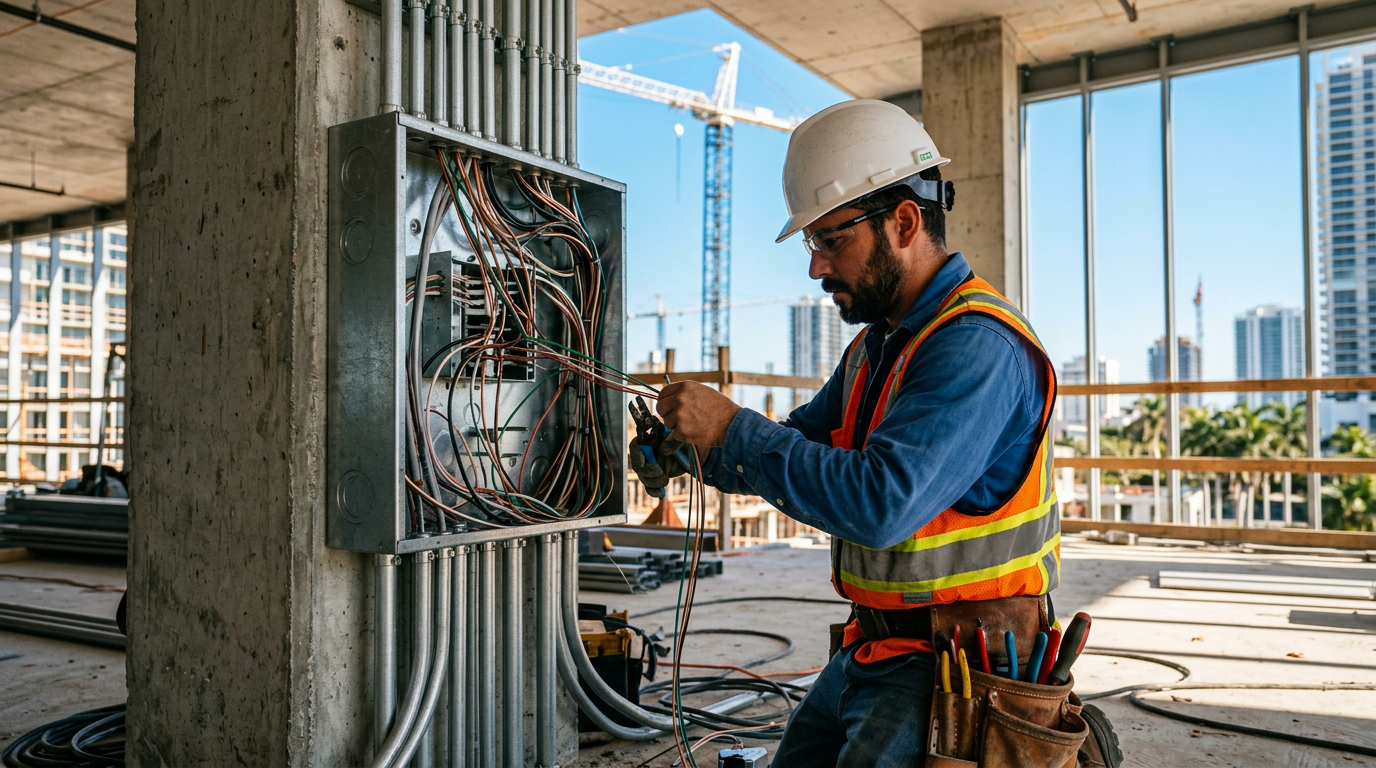
Job Outlook for Electricians in Miami and Orlando
The Driving Forces: Why Florida’s Electrical Demand is Surging
Florida’s population growth is one of the fastest in the nation, bringing an unprecedented demand for new housing, commercial centers, and infrastructure. This surge in construction growth South Florida and Central Florida is the primary engine behind the high demand. Large-scale residential and commercial projects, from luxury high-rises in Miami to sprawling theme park expansions and industrial parks in Orlando, require immense electrical work. Furthermore, a persistent skilled labor shortage means that qualified electricians are a hot commodity, leading to an increase in the Florida electrician pay scale and abundant opportunities. Whether it’s a new hospital, a massive data center, or a multi-family housing complex, the need for skilled electricians is a constant.
Spotlight on Miami: A Hub for High-End and Specialized Electrical Work
In Miami, the construction is vertical and high-tech. The city is transforming into a global finance and tech hub, attracting billions in investment. This has supercharged the commercial electrician demand for professionals who can handle complex, large-scale projects like the Waldorf Astoria Miami and the $6 billion Miami Worldcenter. These massive mixed-use developments require sophisticated electrical systems, creating countless jobs.
The luxury housing market also creates a unique niche. High-end residential electrician jobs Miami often involve custom lighting, advanced security systems, and cutting-edge smart home installation. Beyond traditional construction, Miami’s coastal location offers specialized marine electrician jobs, servicing everything from private yachts to commercial shipping vessels. According to the U.S. Bureau of Labor Statistics, the average salary for an electrician in the Miami-Fort Lauderdale-West Palm Beach metropolitan area is a mean hourly wage of $26.46 as of May 2023, but those with specialized skills can command much higher wages.
Orlando’s Expanding Universe: From Tourism to Technology
While Miami’s growth is vertical, Central Florida’s expansion is sprawling. The opportunities for Orlando electricians extend far beyond the tourism industry. The region is rapidly becoming a hub for logistics, healthcare, and technology. This diversification is fueling a wide range of projects for the Orlando industrial electrician, from massive distribution centers to advanced medical research facilities.
Of course, tourism remains a major driver, with airport expansions and new theme park attractions constantly in development. Furthermore, as a leader in green initiatives, there is a significant rise in solar installer careers Florida, with Orlando at its center. The mean annual pay for an electrician in the Orlando-Kissimmee-Sanford metropolitan area is $56,530 as of May 2023, with significant growth potential in specialized fields. The demand for talent has led to a robust network of Central Florida electrical apprenticeships, providing a clear path for new electricians to enter the trade.
Career Pathways and Advancement in the Sunshine State
For those looking to start or advance their electrical career in the Sunshine State (or ‘FLA’), the path is well-defined. Many begin with electrical apprenticeship programs Florida, often guided by standards from organizations like the NCCER. These programs combine on-the-job training with classroom instruction from an electrician school, allowing apprentices to earn while they learn.
After completing an apprenticeship—which typically requires 8,000 hours of on-the-job training for programs aligned with NCCER standards—an individual can become a journeyman electrician Florida. While Florida does not issue a statewide journeyman license, some local jurisdictions require registration or certification, as outlined in Florida Statutes Chapter 489. This certification proves an electrician has the experience to work independently under a licensed contractor. The next step for many is achieving the highest level of licensure. While Florida does not have a state license titled “Master Electrician,” the equivalent is a Certified Electrical Contractor, issued by the Florida Electrical Contractors’ Licensing Board under the Department of Business and Professional Regulation. Obtaining a Florida electrical contractor license allows an electrician to pull permits, bid on major projects, and run their own business. For those seeking union representation, the IBEW Florida job market is active, offering competitive wages and benefits on many of the state’s largest projects.
Staying Ahead of the Curve: Skills for the Future
In a rapidly evolving industry, continuous learning is key to a long and successful career. Staying current with the National Electrical Code (NEC) is not just a suggestion; it’s a necessity for safety, compliance, and professional relevance. For instance, electricians in Florida must be particularly aware of regulations for installations in unique local conditions. This includes understanding how to wire electrical systems in corrosive, salty-air environments, which is critical for coastal projects. With countless pools across the state, knowing the latest 2023 NEC changes for swimming pool bonding requirements is essential. Additionally, familiarity with common construction materials is vital, including the rules for using PVC conduit in concrete applications.
Completing your required electrical continuing education Florida is the perfect opportunity to sharpen these skills. By choosing courses that cover these modern challenges and technological advancements like EV charging stations and energy storage systems, you not only meet state requirements but also increase your value and earning potential in a competitive market. To stay on top of your game and meet your renewal requirements, you can browse our courses designed specifically for Florida electricians.
A Bright Future for Florida Electricians
The outlook for electricians in Miami and Orlando is exceptionally strong. The combination of population growth, a massive construction boom, and the push toward new technologies has created a perfect storm of opportunity. Whether you are a residential electrician wiring smart homes in Miami, an industrial electrician maintaining complex systems in Orlando, or a journeyman electrician looking to advance your career, the demand for your skills in Florida is undeniable. For those with the right training, certification, and forward-thinking mindset, the Sunshine State offers a clear path to a prosperous and dynamic career.
Florida Continuing Education Courses
Explore our board-approved continuing education courses for Florida professionals:
View CE Requirements

Florida 1 hour course on workers’ compensation

Florida 1 hour course on workplace safety

Florida 2 hours course on false alarm prevention

Florida 6 hours electrical CE course (Technical)

Florida 1 hour business practices course
Frequently Asked Questions (FAQs)
- What is the average Florida electrician pay scale?
- According to the U.S. Bureau of Labor Statistics May 2023 data, the national annual salary for electricians can range from $48,100 (25th percentile) to a median of $61,590. In Florida, the statewide median annual wage for electricians was $48,860 in May 2023, but this varies widely based on location, experience, and specialization. An experienced electrical contractor or an electrician with in-demand skills in a high-growth area like Miami can earn significantly more.
- Which electrical specializations are in high demand in Florida?
- Currently, there is high demand across the board. Key specializations include commercial electricians for large-scale construction, residential electricians with expertise in smart home technology, and industrial electricians. Additionally, emerging fields like solar panel installation and EV charging station technicians are some of the fastest-growing sectors.
- Do I need to go to an electrician school to start my career in Florida?
- While formal education at a technical college or electrician school is a common route, the most traditional path is through an electrical apprenticeship program. These programs provide paid, on-the-job training under the supervision of experienced electricians, combined with technical classroom instruction, offering a direct pathway into the profession.

Disclaimer: The information provided in this educational content has been prepared with care to reflect current regulatory requirements for continuing education. However, licensing rules and regulations can vary by state and are subject to change. While we strive for accuracy, ExpertCE cannot guarantee that all details are complete or up to date at the time of reading. For the most current and authoritative information, always refer directly to your state’s official licensing board or regulatory agency.
NEC®, NFPA 70E®, NFPA 70®, and National Electrical Code® are registered trademarks of the National Fire Protection Association® (NFPA®)
You may also like
Delaware’s EV Charging Growth: A Guide for Pro Electricians

Starting an Electrical Business in Delaware: A Contractor’s Guide
 Login with Google