
Understanding Alaska’s Amendments to the NEC
Understanding Alaska’s Amendments to the NEC
Who is the Authority Having Jurisdiction (AHJ) in Alaska?
One of the first points of confusion for electricians in Alaska is identifying the correct authority having jurisdiction (AHJ). Unlike many states with a single electrical board, Alaska splits responsibilities between two distinct state departments. Understanding this division is critical for licensing, renewals, and compliance.
- For Business Owners and Supervisors: The Division of Corporations, Business and Professional Licensing, under the Department of Commerce, Community, and Economic Development (DCCED), is the governing body for the electrical administrator license. This license is the state’s equivalent of a master electrician or contractor license and is required for at least one person in any company that contracts for electrical work. The administrator is the individual responsible for ensuring all work is done to code.
- For the Hands-On Professional: The Department of Labor and Workforce Development, Division of Labor Standards and Safety, issues the Certificate of Fitness for a journeyman electrician, residential electrician, or lineman. This certificate authorizes an individual to physically perform the electrical work under the supervision of a licensed electrical administrator.
In short, the DCCED licenses the business and its supervisor, while the Department of Labor certifies the individual electrician’s fitness to perform the work. Knowing which agency to contact for applications, renewals, and questions is the first step in maintaining your good standing.
Navigating the Core of the Alaska Electrical Code
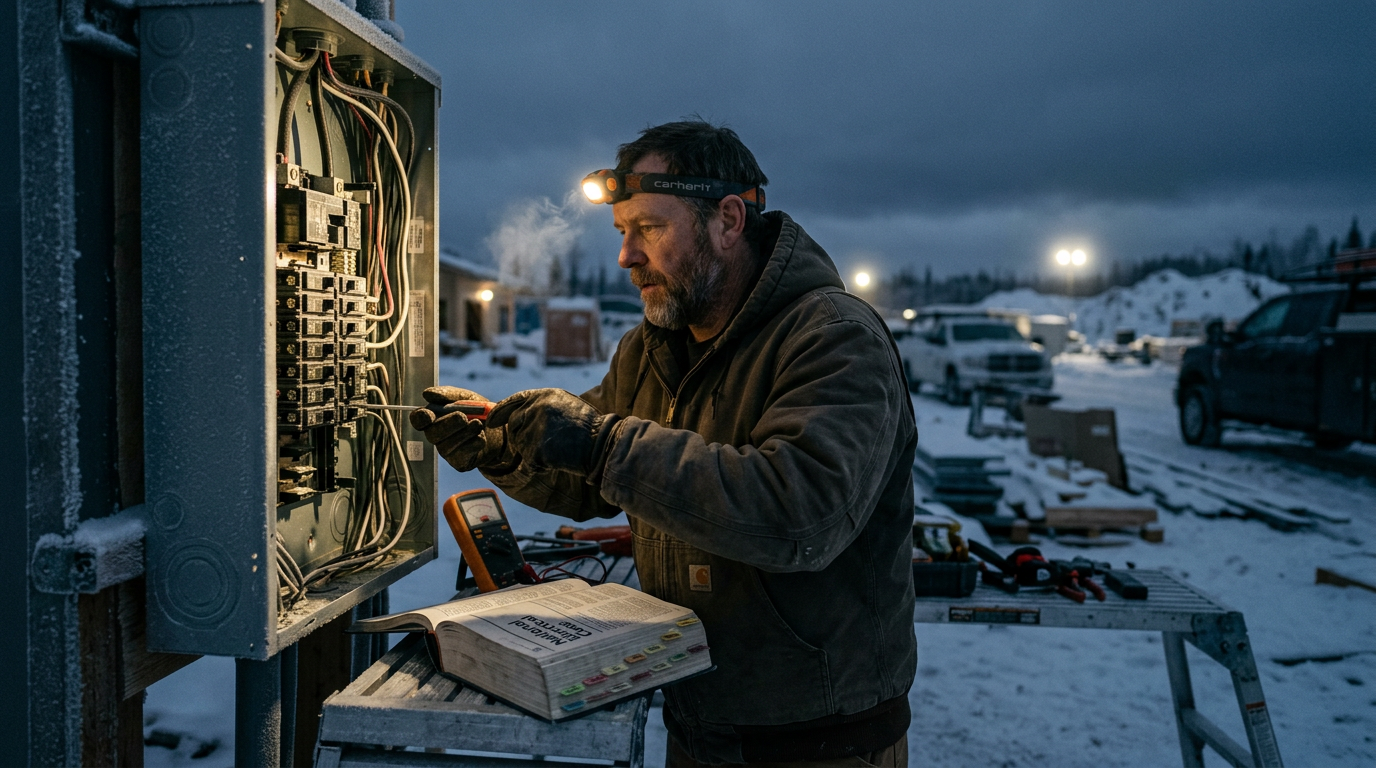
Alaska officially adopted the NEC 2020, which remains the current standard for the state. However, the state legislature grants regulatory bodies the authority to make amendments. These changes are published in the Alaska Administrative Code (AAC) and are legally binding, superseding the standard NEC text where differences occur. These amendments often address the unique geographical and environmental challenges of the state.
Key Focus Areas in Alaska’s Electrical Amendments
While electricians should always consult the latest AAC for a complete list of modifications, several themes emerge that are critical for any project in the state.
- Cold-Weather Electrical Considerations: This is perhaps the most significant area of amendment. Standard materials and practices may fail in extreme cold. While 8 AAC 70.025 adopts the NEC as the statewide minimum, specific mandates for cold-weather wiring methods, receptacles outlets, and uses permitted often stem from local municipal amendments (such as those in Anchorage or Fairbanks) and project-specific design standards rather than the state-level administrative code itself.
- Arc-Fault and Ground-Fault Protection: The requirements for GFCI outlet and arc fault breaker installation are critical for safety. While the NEC 2020 sets the baseline, local jurisdictions may adopt amendments that modify NEC 2020 requirements for where these devices are required. It is crucial to consult the state-specific text to ensure compliance, as these legally binding changes can impact installations in locations like garages, outdoors, or kitchens. Every receptacle installed must meet both the NEC 2020 standards and any specific state modifications.
- Grounding and Bonding Requirements: Permafrost and unique soil compositions can make typical grounding and bonding requirements challenging. The NEC and local amendments address these issues to ensure a reliable and effective fault current path, which is essential for the proper function of overcurrent protection devices like a GFCI breaker.
- Service Panel and Load Calculations: Given the heavy reliance on electric heat and equipment like engine block heaters, service panel and load calculations must be performed meticulously. The code ensures that services are sized to handle these significant, sustained cold-weather loads.
Licensing and Continuing Education Requirements in Alaska
Maintaining your license or certificate in Alaska requires adherence to strict continuing education requirements. The hours and topics vary significantly between license types.
Electrical Administrator License Renewal
According to the Alaska Administrative Code, licensed Electrical Administrators must complete 8 hours of continuing education every two years to renew. These hours must cover the current edition of the National Electrical Code (NEC) or National Electrical Safety Code (NESC), depending on the license category. Renewals occur in odd-numbered years, with a deadline of December 31st.
Journeyman Electrician Certificate of Fitness Renewal
A journeyman electrician must complete 16 hours of continuing education every two years for renewal. At least 8 of those hours must be on the NEC or other code-related topics. The remaining 8 hours can be industry-related. The renewal cycle for a Certificate of Fitness is every two years on the anniversary of its issuance. All work must pass an electrical inspection to ensure it meets the state’s stringent standards.
Staying Current and Compliant in a Changing Industry
The electrical field is constantly evolving. Understanding how NEC updates change fundamental rules is crucial for every electrician. For example, recent versions of the code have adjusted requirements for the accessibility of circuit breakers and switches, a key consideration for residential and commercial layouts. You can learn more about how NEC 2023 has changed accessibility rules for circuit breakers and switches to stay ahead of future code adoptions. Similarly, new rules often apply to common installation practices, and it’s vital to know how 2023 NEC updates have changed NM and NMC cable installation rules. Even basic terminology can change, which is why understanding how NEC 2023 definition changes have impacted electrical work is part of being a true professional.
Meeting your continuing education requirements with relevant, up-to-date courses is the best way to protect your license and serve your clients. ExpertCE offers a wide range of approved courses designed to meet Alaska’s specific needs. Don’t wait until the deadline—browse our courses today to stay compliant and competitive.
Alaska Continuing Education Courses
Explore our board-approved continuing education courses for Alaska professionals:
View CE Requirements
Alaska 2023 NEC (Ch 1-4), 8 hours Electrical Administrators License Renewal Package
Alaska 2023 NEC (Ch 4-7), 8 hours Electrical Administrators License Renewal Package
Alaska 2023 NEC 16 Hr Electrical License Renewal Package
Disclaimer: The information provided in this educational content has been prepared with care to reflect current regulatory requirements for continuing education. However, licensing rules and regulations can vary by state and are subject to change. While we strive for accuracy, ExpertCE cannot guarantee that all details are complete or up to date at the time of reading. For the most current and authoritative information, always refer directly to your state’s official licensing board or regulatory agency.
NEC®, NFPA 70E®, NFPA 70®, and National Electrical Code® are registered trademarks of the National Fire Protection Association® (NFPA®)
You may also like
Standby Generators in DE: Navigating Coastal Storm Regulations

Upgrading to a Master Electrician License in Delaware
 Login with Google