
How to Get Your Michigan Electrician License: A Guide
How to Get Your Michigan Electrician License: A Guide
Why a Michigan Electrical License is Your Most Important Tool
In Michigan, performing electrical work without a license isn’t just a bad idea – it’s illegal for most work. Beyond the legal necessity, licensing is the key to career advancement and higher earning potential. It allows you to pull permits, pass inspections, and bid on lucrative projects that are off-limits to unlicensed individuals. As you progress through the licensing tiers, your responsibilities grow, and so does your value in the industry. For a deeper look into compensation and market trends, it’s worth exploring the current Michigan electrician salary and job market.
Understanding Michigan’s Electrical Licensing Tiers
The journey to becoming a top-tier electrician in Michigan is a structured path marked by distinct levels of licensure. Each step requires a significant investment in time and training, but it also brings greater autonomy and opportunity. Understanding this progression is fundamental to how to become a licensed electrician and planning your long-term career.
Step 1: The Michigan Electrical Apprenticeship
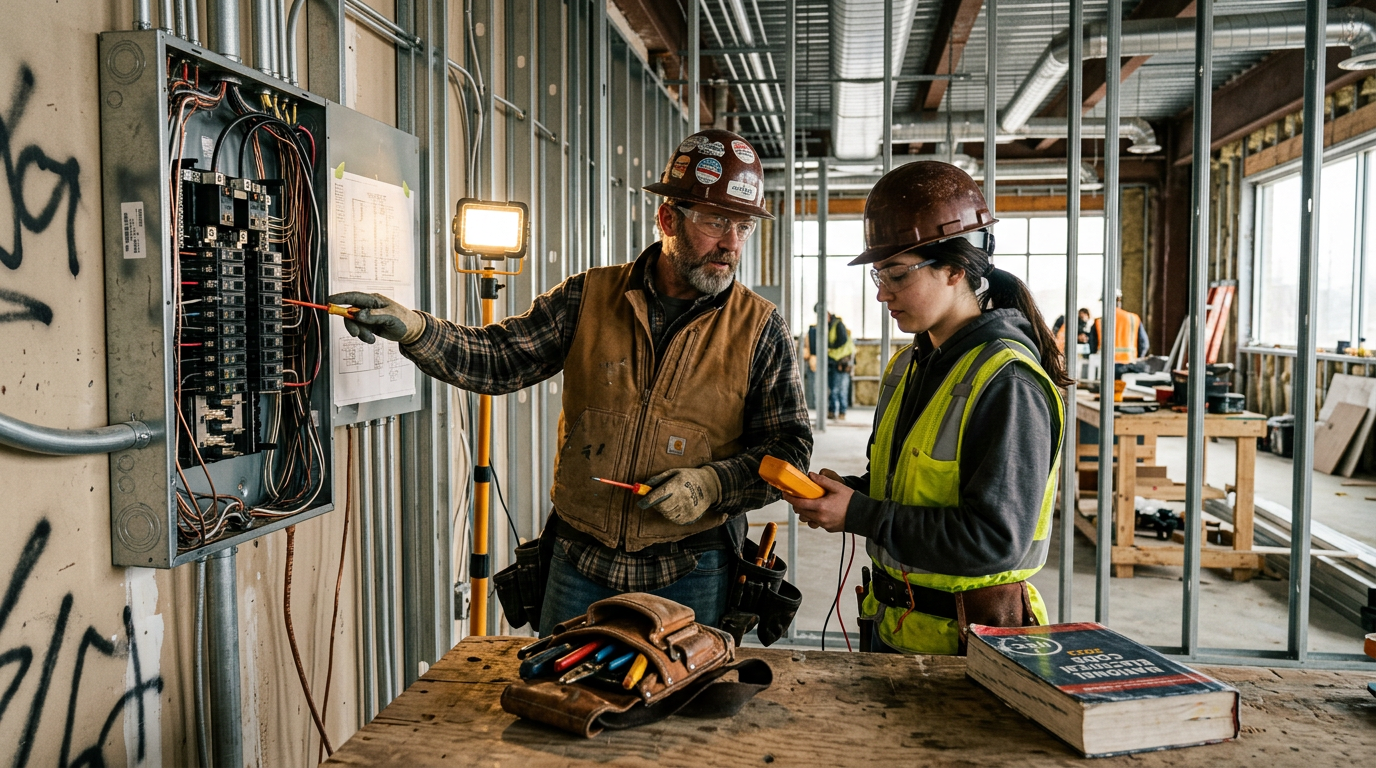
Your career officially begins as a registered electrical apprentice. As an electrician apprentice you need to be employed by a Master Electrician and Electrical Contractor. Sometimes, the same person holds both of these licenses. Furthermore, you need to be enrolled in a related technical instruction (RTI) program and have to continue your course work throughout your time as an apprentice. Keep your apprentice registration active and renew it every year on time otherwise you could get in trouble on the job site or have to pay a late fee. You can’t be on the job site without an active apprentice registration.
Step 2: The Journeyman Electrician Michigan License
This is the first major professional milestone. To qualify for the Journeyman electrician license exam, you must be at least 20 years old and have documented 8,000 hours of practical, on-the-job experience over a minimum of four years. This experience must be verified by your employers through a formal, notarized experience letter submitted with your exam application. Once you pass the state-administered PSI exams, you can work under the general supervision of a Master Electrician and are qualified to supervise apprentices. To pass the electrical journeyman exam requires scoring at least 75%. Reaching this stage significantly boosts your career opportunities and earning power. For more details on what that looks like, see our analysis of the Michigan electrician salary and job market.
Journeyman Resources:
- Application for Journeyman, Master Electrician Examination, Fire Alarm Specialty Technician or Sign Specialist Examination
- Experience Statement as required per the Skilled Trade Regulation Act
- Electrical Journeyperson License Map
Step 3: The Master Electrician License Michigan
For those with ambitions to lead projects and supervise others, the master electrician license is the ultimate goal. A master electrician has the authority to plan, lay out, and supervise the installation of wiring and equipment. To be eligible for the master exam, you must have held a journeyman electrician Michigan license for at least two years and have accumulated 12,000 hours of on-the-job experience over a minimum of six years. This license demonstrates a deep understanding of code, theory, and project management. You must take and pass the master electrician exam by scoring at least 75%.
Master Electrician Resources
- Application for Journeyman, Master Electrician Examination, Fire Alarm Specialty Technician or Sign Specialist Examination
- Experience Statement as required per the Skilled Trade Regulation Act
- Master Electrician License Map
Step 4: The Electrical Contractor License Michigan
If you aim to run your own business, the electrical contractor license Michigan is what you’ll need. This license authorizes you to enter into contracts, pull permits, and hire other electricians. To obtain it, you must either hold a Master Electrician license yourself or employ a full-time licensed Master Electrician who resides in Michigan to oversee all work and ensure code compliance. It’s important to note that while this license allows you to run an electrical business, its scope is distinct from other construction-related licenses; understanding the difference between a Michigan builders vs. electrical license is crucial for proper business operations. There is no test required to be an Electrical Contractor, but you still have to apply for the license.
Michigan Electrician License Requirements at a Glance
| License Type | Minimum Age | Experience Required | Key Responsibilities |
|---|---|---|---|
| Journeyman Electrician | 20 | 8,000 hours over 4+ years | Perform work under Master’s supervision; supervise apprentices. |
| Master Electrician | 22 | 12,000 hours over 6+ years (must be a Journeyman for 2+ years) | Plan, lay out, and supervise all electrical work. |
| Electrical Contractor | N/A | Must hold or employ a Master Electrician. | Operate an electrical business and enter into contracts. |
Specialty Electrical Licenses in Michigan
Beyond the primary licensing path, Michigan offers several specialty licenses for specific types of work. These allow professionals to focus their expertise in niche, in-demand fields:
- Fire Alarm Specialty Technician: To qualify for this license, you’ll need to demonstrate your expertise through specific industry credentials. Specifically, Michigan looks for technicians who hold a NICET Level II (or higher) certification focused on installation and repair. Alternatively, an ESA Certified Fire Alarm Technician (CFAT) Level II or higher is also accepted. Finally, the finishing touch is successfully passing the FAST exam with a minimum score of 75%.
- Sign Specialist License Michigan: To qualify as a licensed Sign Specialist, candidates must be at least 18 years old and bring a strong foundation of field experience to the table, specifically 4,000 hours (at least two years) of hands-on work in the manufacturing, installation, or repair of electric signs and related wiring. Along with this practical background, you’ll need to submit proof of completing an approved training course, which can be easily found through CEBroker.com. The final milestone in the licensing process is successfully passing the Sign Specialist exam with a minimum score of 75%.
Both fire alarm and sign specialists can also obtain contractor-level licenses under similar rules as electrical contractors, requiring a licensed individual to qualify the business.
Navigating the Regulatory Landscape
Staying compliant in Michigan means keeping up with the state’s rules and codes, which are enforced by LARA’s Bureau of Construction Codes and the Electrical Administrative Board.
The Rulebook: The Michigan Electrical Code and the NEC
The Michigan electrical code is based on the latest edition of the National Electrical Code (NEC), with state-specific amendments found in Part 8 of the Construction Code rules. As of March 12, 2024, Michigan has adopted the 2023 NEC. A thorough understanding of the NEC and Michigan’s amendments is not just critical for passing your exams – it’s essential for safe and compliant work every day.
License Maintenance: Renewal and Continuing Education
The topic of electrical license renewal in Michigan can be confusing because license renewal and continuing education operate on different schedules.
- License Renewal: Your Journeyman or Master license expires annually on December 31st, but you have a grace period until March 1st to renew by paying a late renewal fee.
- Continuing Education: The mandatory continuing education requirements are not tied to your annual renewal. Instead, they are triggered whenever Michigan adopts a new version of the NEC. Licensees must complete a board-approved code update course within 12 months of a new code taking effect. The required hours are:
- 15 Hours: For Master and Journeyman Electricians, and Fire Alarm Specialty Technicians.
- 8 Hours: For Sign Specialists.
Ready to fulfill your continuing education requirements? ExpertCE offers LARA-approved, online courses designed for busy professionals. Stay compliant and sharpen your skills on your own schedule. Browse our courses today to find the 2023 NEC update package you need.
Michigan Continuing Education Courses
Explore our board-approved continuing education courses for Michigan professionals:
View CE Requirements
Michigan – 15 hours NEC 2023 Code Changes Update
Michigan – 8 hours NEC 2023 Changes for Sign Specialist
Frequently Asked Questions
What is the main difference between a Journeyman and Master Electrician?
The primary difference lies in supervision and scope. A Journeyman can perform most electrical work but must operate under the general supervision of a Master Electrician. A Master Electrician has the authority to plan, design, lay out, and supervise any electrical project, and they are the only individuals who can qualify an electrical contractor’s license.
Where can I find LARA-approved continuing education courses?
The Michigan Department of Licensing and Regulatory Affairs (LARA) works with third-party services like CE Broker to list approved course providers. You can find state-approved courses from providers like ExpertCE that are specifically designed to meet the 15-hour code update requirement.
Disclaimer: The information provided in this educational content has been prepared with care to reflect current regulatory requirements for continuing education. However, licensing rules and regulations can vary by state and are subject to change. While we strive for accuracy, ExpertCE cannot guarantee that all details are complete or up to date at the time of reading. For the most current and authoritative information, always refer directly to your state’s official licensing board or regulatory agency.
NEC®, NFPA 70E®, NFPA 70®, and National Electrical Code® are registered trademarks of the National Fire Protection Association® (NFPA®)
You may also like

Delaware Electrical License Reciprocity with MD, PA & NJ

Alabama Electrical License Reciprocity: A 2025 Guide

 Login with Google